LinkedIn
 Twitter
 Facebook
 Youtube



Digital transformation in logistics sounds abstract until you watch it on the operations floor. A dispatcher who used to phone three carriers for a quote now reads automated rate options with margin already calculated. A customer who used to call for a status update now opens a portal and sees the truck on a map. A billing clerk who used to reconcile invoices in Excel at month-end now gets flagged on an overcharge the day it arrives. Real transformation shows up in dispatch time, recovered freight overcharges, on-time rate, and whether the business can double its shipment volume without doubling its headcount, not in the count of technologies installed.
What digital transformation actually means in logistics
Digital transformation in logistics is the move from manual, fragmented, reactive operations to integrated, automated, data-driven ones. It is not "adopting AI" or "going to the cloud" as ends in themselves. It is a change in how the operational work gets done, seen most clearly process by process.
| Process | Before | After |
|---|---|---|
| Carrier selection | A dispatcher calls carriers or checks load boards by hand, then guesses at the margin | An automated rate engine returns ranked options with cost, transit time, and margin already computed |
| Shipment tracking | The customer calls, the dispatcher calls the carrier, then relays the status back | A customer portal shows real-time status pulled straight from carrier and telematics feeds, with no human in the loop |
| Freight billing | Invoices are reconciled in a spreadsheet at month-end, and overcharges that slip through are gone | An automated freight audit compares each invoice against the contracted rate and flags discrepancies as they land |
| Planning | Decisions rest on a senior dispatcher's memory and intuition | Route and capacity decisions draw on historical lane performance, predictive analytics, and dynamic route optimization |
Across all four, logistics technology transformation removes the specific operational bottleneck that limits growth and leaves the rest of the operation alone until the next one is worth attacking.
The operational pressures that actually drive logistics digital transformation
Companies invest in logistics digital transformation under operational pressure, not because a trend told them to. Five forces drive that pressure.
Scaling without scaling headcount
Manual operations scale linearly. Twice the shipments means twice the people to enter orders, chase carriers, and reconcile invoices. Automation breaks that link, and the same team handles more volume. Funding usually follows once the next growth step would otherwise mean hiring a whole new shift.
Margin pressure
Logistics margins are thin. Freight overcharges, weak carrier selection, and manual data-entry errors eat directly into profit. An automated freight audit and a rate engine give a level of cost control that hand-checking cannot reach at volume.
Customer expectations
Shippers and consignees expect real-time visibility and accurate ETAs, a standard set by Amazon and the large carriers. A 3PL or carrier without that visibility loses points in every tender. Supply chain digital transformation has turned tracking from a differentiator into table stakes.
Integration complexity
As an operation grows, the number of systems (TMS, ERP, WMS, carrier portals, telematics) grows with it. Moving data between them by hand becomes the bottleneck that everything else waits on.
Competitive differentiation
In a commoditized freight market, two carriers often quote the same lane at the same rate. Transportation digital transformation is what separates them. The carrier with better operational efficiency and customer experience wins the account and keeps it. McKinsey reports that 87% of shippers have maintained or grown their technology investment since 2020, and 93% plan to hold or raise it over the following three years. The spend is structural, not a one-off (McKinsey). Gartner expects half of supply chain management software to carry agentic AI capabilities by 2030, so the bar for what counts as competitive keeps moving (Gartner).
Custom software success stories
The logistics software case studies below are representative project types drawn from TwinCore's logistics work, not named clients. Outcomes are described qualitatively where a public, verified metric is not available. Each of these digital transformation logistics software projects names the challenge, what was built, the outcome, and the factor that made it stick.
A regional shipper trapped in spreadsheet dispatch
The challenge. A regional distributor ran dispatch out of a shared Excel workbook. Two planners managed several hundred outbound loads a week, carrier rates lived in email threads, and freight invoices were reconciled by hand at month-end. Volume was rising and the spreadsheet had stopped scaling. Every new lane added manual work, and overcharges surfaced only by luck.
The solution. A custom transportation management system with three core modules: a rate engine that ranks carriers by landed cost and margin, a dispatch board that replaces the workbook, and a freight audit that checks every invoice against the contracted rate. The build started with dispatch and rating, the loudest bottleneck, before billing was added. TwinCore's TMS development services cover this kind of staged build.
The outcome. Dispatch moved off the spreadsheet to a live board, freight overcharges surfaced automatically instead of slipping through, and the same two planners absorbed higher volume without a third hire.
Why it worked. The team modeled the distributor's actual rating logic (accessorials, fuel surcharges, lane-specific contracts) rather than forcing a generic rate table. The dispatchers recognized their own workflow on screen, so adoption was fast.
A carrier running blind on its own fleet
The challenge. A mid-size transportation company had no real-time view of its fleet. Locations came from driver phone calls, and maintenance was reactive. Trucks went into the shop after a breakdown, not before. Utilization was hard to measure because the data sat in disconnected logs.
The solution. A fleet management platform integrated with the trucks' telematics, adding route assignment and a maintenance tracker that schedules service against mileage and engine-hour thresholds. The anomaly-detection model TwinCore uses for predictive maintenance flags sensor readings that drift outside normal range before they become a roadside failure.
The outcome. Dispatchers gained a live fleet map, maintenance shifted from reactive to scheduled, and idle assets became visible enough to redeploy.
Why it worked. Telematics integration is the hard part, and the team had done it before. The maintenance rules were tuned with the fleet manager rather than shipped as defaults nobody trusted.
A 3PL with one system per client
The challenge. A third-party logistics provider had grown by bolting on a separate setup for each client. Billing was manual and slow, onboarding a new client meant standing up another silo, and no one had a clean cross-client view. Errors crept into invoices because every account was reconciled by hand.
The solution. A unified multi-client platform with automated, contract-driven billing and a customer portal per client. New clients are configured on the shared platform instead of getting a new system. The build drew on patterns from TwinCore's 3PL and freight management work.
The outcome. Onboarding a new client became a configuration task rather than a project, billing errors dropped as manual reconciliation gave way to automated rules, and clients self-served status through their portals instead of emailing account managers.
Why it worked. The architecture separated shared platform logic from per-client configuration from day one, so growth did not multiply the maintenance burden.
Fragmented visibility across systems and carriers
The challenge. A logistics operator could not see a shipment end to end. Status lived partly in the WMS, partly in the TMS, and partly in carrier portals, each with its own login. Exceptions like a missed pickup or a delayed leg surfaced only when a customer complained.
The solution. A control tower that aggregates the TMS, WMS, and carrier feeds into one view, with exception rules that raise an alert the moment a shipment falls behind plan. The control tower added no new system here. It stitched the existing TMS, WMS, and carrier feeds into a single operational picture.
The outcome. Exceptions became something the team managed proactively instead of explaining after the fact, and on-time performance improved as delays were caught while there was still time to act.
Why it worked. The control tower read from the existing systems instead of replacing them, so it delivered value in months without a rip-and-replace.
Recognize your own operation in one of these? Talk to TwinCore about a discovery phase.
Where logistics digital transformation gets hard
Transformation programs run into the same five obstacles again and again.
Legacy system integration. Old ERP and WMS platforms without modern APIs are the single biggest technical bottleneck. Integration is doable, but it needs middleware or custom adapters, and that work adds to the timeline, so plan for it rather than discovering it mid-build. For operations already running an older TMS or ERP, modernization usually beats a rewrite. Adding APIs, a new front end, or the one missing module keeps the existing system live while the gaps get filled, instead of betting the operation on a big-bang replacement.
Data quality and fragmentation. Operational data is scattered across systems, spreadsheets, and email, riddled with inconsistencies. Cleaning and consolidating it routinely takes longer than teams expect, and it is a prerequisite for any automation or analytics built on top. Bad data feeding a good model produces confident wrong answers.
Change management and adoption. The best software fails if dispatchers and drivers refuse to use it. Resistance is a real risk, not a footnote. Phased rollout and hands-on training matter as much as the code. The logistics firms that bought AI forecasting and never wired it into the dispatcher's daily workflow ended up with data nobody used.
Underestimating scope. Trying to transform everything at once is the classic way these programs collapse. Gartner surveyed 306 logistics organizations and found 76% of their transformation efforts missed the budget, timeline, or KPI targets they were measured against (Gartner). Successful programs go one process at a time, with a measurable result at each step.
Cost and ROI expectations. Digital transformation is an investment with a horizon. Companies expecting payback next quarter are usually disappointed. A realistic window to measurable operational impact is 6 to 18 months, depending on which module goes first.
How to approach logistics digital transformation without stalling
Five principles, applied in this order, keep a transformation from stalling.
1. Start with the bottleneck, not the technology
Find the one operational problem that caps growth the hardest, whether dispatch time, freight overcharges, or lack of visibility, and transform that first. The technology choice follows from the problem.
2. Roll out in phases, not a big bang
One process or module at a time, each with a measurable result before the next begins. Phasing lowers risk and produces the early wins that keep executive and floor-level buy-in alive.
3. Build on solid data infrastructure
Automation and analytics depend on clean, integrated data. Spend on the data foundation before the advanced features that sit on it, or the features will inherit the mess underneath.
4. Choose a partner with logistics domain knowledge
Logistics software needs an understanding of how dispatch, rating, carrier management, and freight audit actually work. A generic software team will build something technically correct and operationally useless. Picture a dispatch screen that no dispatcher can run a shift on.
5. Plan for change management from day one
Build in training, phased adoption, and a feedback loop from the operations team before the first module ships, not after users start complaining.
How TwinCore drives logistics digital transformation
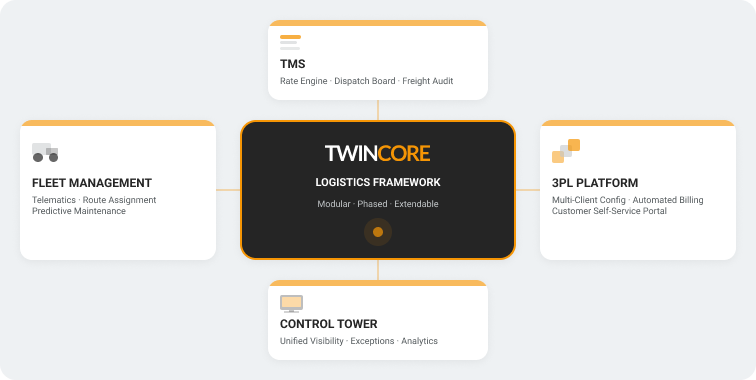
TwinCore builds custom logistics software that delivers digital transformation in practice, from custom TMS and fleet management to 3PL platforms, supply chain visibility, and AI-driven analytics. The TwinCore Logistics Framework, a modular architecture for phased transformation, lets a client start with one core module and extend outward without rewriting what already runs.
The anomaly-detection demos behind the freight-audit and predictive-maintenance scenarios above are working assets, not slides. The same approach extends to broader AI use cases in logistics and 2026 logistics and supply chain trends.
TwinCore connects custom software to:
- Carrier APIs: FedEx, DHL, UPS, regional LTL
- Telematics and ELD: Samsara, Geotab, Motive, Omnitracs
- EDI: X12 204/214/210 for load tender, status, and invoice
- ERP and WMS: SAP, Microsoft Dynamics, NetSuite, Manhattan, Blue Yonder
- Load boards: DAT, Truckstop
- Accounting and billing: QuickBooks, Xero
- Mapping and routing: Google Maps, HERE
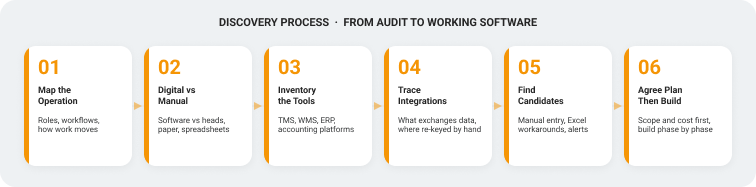
Discovery comes before any code. Every TwinCore engagement runs through the same sequence before a line of production software is written:
- Map the operation. The real processes, the roles that run them (dispatcher, planner, billing clerk, fleet manager), and how work moves between people.
- Separate digital from manual. What is already in software versus what lives in heads, on paper, or in chat.
- Inventory the software. Which TMS, WMS, ERP, or accounting tools are in use, and what each one actually does.
- Trace the integrations. Which systems exchange data, how, and where it is re-keyed by hand.
- Find the automation candidates. Excel workarounds, manual order entry, route planning, status notifications, alerts no one receives today.
- Agree the plan, then build. Scope, sequence, and cost signed off first; the build follows one working module at a time.
Discovery is a paid phase, and the client owns everything built afterward. Build runs phase by phase, each shipping a working module, followed by ongoing support. Two engagement models fit different needs: full delivery, where TwinCore builds and ships the platform, or staff augmentation, where logistics-experienced engineers join the client's own team as a logistics software developer or .NET developer.
More on the logistics practice is at twincore.net/logistics, and TwinCore's Illinois development presence covers North American clients from a Chicago office.
Why choose TwinCore for digital transformation
Domain knowledge. Engineers know how dispatch, rate management, carrier operations, and freight audit work on the floor, which separates a usable build from a technically correct one.
Proven delivery. A team of 30+ has delivered 100+ projects since 2011, 10+ of them in logistics, with client reviews on the TwinCore Clutch profile.
Conclusion
The logistics companies that get transformation right do not start with a technology shortlist. They start with the one process that is bleeding margin or capping volume, fix it, measure it, and move to the next. Three things keep a program out of the 76% that miss their targets:
- Phasing — one process at a time, with a measurable result before the next begins.
- Clean, integrated data under every automation and analytics layer.
- A partner with logistics domain knowledge who knows the difference between a rate engine and a price list.
Custom software is the lever, but the operational problem is the starting point.
Ready to transform your logistics operations? Talk to TwinCore.