LinkedIn
 Twitter
 Facebook
 Youtube



AI in logistics has moved through the pilot-and-buzzword phase. In 2025 and 2026 the question is no longer whether to adopt it, but where it delivers a real operational advantage and what that takes. The pilots that stalled all ran into the same wall: the technology was there, but the data was messy, the systems were not integrated, and the AI module sat outside the operational workflow as an isolated tool.
This article breaks down seven use cases where AI in logistics already delivers a measurable result, and what each one needs to work in production, not just in a presentation. The model is the easy part; the data and the integration around it decide whether the output changes a decision or just fills a dashboard.
What AI in logistics needs besides the model
AI in logistics works as an architectural layer over the operation, and it depends on three things most vendors skip past.
The first is clean, real-time data from the systems that already run the operation: TMS, WMS, telematics, and carrier feeds. The second is event-driven infrastructure that processes that data as it arrives, not in an overnight batch. The third, and the one that decides whether a deployment works or just runs up a bill, is integration between the AI output and the operational systems. A forecast has to change the plan automatically. An adjusted ETA has to update the customer notification. A re-optimized route has to reach the driver app without a dispatcher copying numbers between screens.
That operational plumbing is what separates measurable ROI from an AI dashboard that produces charts and zero change to how work actually happens. Each use case below names the data and system prerequisites it depends on, because skipping them is the most common reason these projects stall.
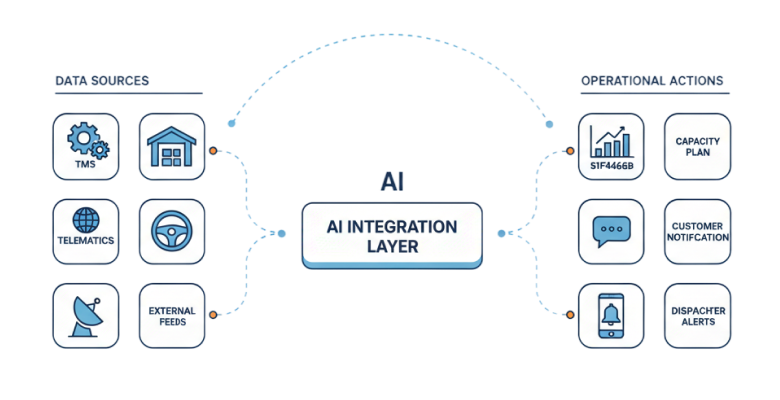
AI in logistics sits between the systems that hold the data and the systems that act on it. The integration layer is where ROI is won or lost.
7 AI use cases in logistics
Demand forecasting
What it is: A demand forecasting model predicts future demand for transport capacity or warehouse resources from historical data, seasonality, external signals, and known business events.
How it works: The model aggregates historical shipment volumes, order data, seasonal patterns, and external factors such as holidays, promotions, and weather, then produces a demand forecast by lane, region, or product category two to eight weeks out. Amazon runs the largest version of this: its Supply Chain Optimization Technologies (SCOT) team forecasts demand for more than 400 million products each day with a mix of machine learning and mathematical optimization.
What it gives the business: Instead of reacting to a capacity crunch by scrambling for carriers on the spot market, planners reserve capacity ahead of the peak. The same forecast feeds warehouse staffing and dock scheduling, so labor matches volume instead of trailing it. Downstream it drives inventory optimization: dynamic safety stock and multi-echelon planning that set stock against predicted demand rather than a static reorder point. McKinsey reports that AI-driven forecasting cuts forecasting errors by 20 to 50 percent and reduces lost sales from product unavailability by up to 65 percent, and Gartner projects that 70 percent of large organizations will adopt AI-based supply chain forecasting to predict demand by 2030.
What it needs: 12 to 24 months of clean historical shipment data, integration with an OMS or ERP for the order signal, and a retraining process for when business patterns shift. This is one of the clearest examples of predictive analytics in logistics paying back when the data history exists.
Predictive ETA and delivery time accuracy
What it is: A predictive ETA model estimates the real delivery time under current conditions (traffic, weather, carrier performance history, road events) rather than repeating the static schedule.
How it works: It takes the planned ETA from the TMS, the current position of the driver or shipment from telematics or carrier tracking, historical delay patterns by lane and carrier, and live traffic and weather feeds, then returns an adjusted ETA that updates as conditions change.
What it gives the business: Customer notifications get more accurate, which cuts the volume of inbound "where is my shipment?" calls. At-risk deliveries surface early, before they turn into missed windows, which gives a dispatcher time to act. The same delay data also feeds carrier performance scoring.
What it needs: Real-time telematics or carrier tracking integration, historical on-time performance data by carrier and lane, and a connection to the customer notification layer so updates go out without manual intervention. Accurate ETAs are also one of the building blocks of supply chain visibility and a control tower.
Dynamic route optimization
What it is: Dynamic route optimization recalculates the best sequence of delivery stops in real time when inputs change: new orders, cancellations, traffic, or delays.
How it works: The engine is usually a vehicle routing problem solver with a machine learning layer. It weighs the driver's current position, delivery windows, vehicle capacity, traffic data, and any new or changed orders, then issues an updated route. Static routing locks in a plan at 6 a.m.; AI route optimization adjusts it at 11 a.m. when three orders get added and a highway backs up.
What it gives the business: Fewer miles and lower fuel spend, fewer missed delivery windows, and less dispatcher overhead when the plan changes mid-day. The scale is proven at the top end: UPS reports its ORION routing system saves around 100 million miles and 10 million gallons of fuel a year, and its dynamic ORION upgrade trims a further two to four miles per driver per day. On the last mile the same optimization strips out empty miles and lowers CO₂ per drop, which increasingly lands in a sustainability report, not just a cost line.
What it needs: Real-time GPS from a driver app or telematics, a traffic data feed (Google Maps Platform, HERE, or TomTom), integration with order management for live order updates, and a driver app to push the revised route. We cover the mechanics in depth in our guide to dynamic route optimization.
Predictive maintenance for fleet
What it is: Predictive maintenance forecasts when a vehicle will need service before a failure happens, using sensor data, mileage, and historical failure patterns.
How it works: Telematics and IoT sensors collect engine performance, brake wear, fuel consumption, temperature, and vibration data. The model watches for the anomaly that precedes a failure and raises an alert days or weeks before the part actually gives out.
What it gives the business: A roadside breakdown costs a recovery, a missed delivery, and an emergency repair at list price; the same fix scheduled into a depot slot costs a fraction of that. Vehicles also last longer when service tracks actual wear instead of a fixed calendar.
What it needs: A telematics system with enough sensor depth, OBD-II at minimum or richer diagnostics, plus historical maintenance records to train on. This is a harder data prerequisite than the other cases carry. It also needs integration with the fleet management system so an alert can open a work order automatically instead of waiting in someone's inbox.
Freight audit and invoice anomaly detection
What it is: A freight audit model checks carrier invoices against contracted rates automatically and flags discrepancies, duplicates, and unjustified charges.
How it works: It compares each invoice line against contract rates, accessorial charges, and the shipment details in the TMS. Overcharges, duplicate bills, and wrong fuel surcharges get flagged for review instead of slipping through a manual reconciliation that no one has time to do line by line.
What it gives the business: The charges that escape a manual process, a wrong accessorial here or a duplicated line there, are exactly the ones an automated check catches every time. Recovering them shortens accounts-payable processing time and produces clean data for rate negotiations.
What it needs: Integration rather than a fancy model: a full connection between the TMS (shipment and rate data) and the AP system, a structured contract rate database in the TMS, and enough invoice volume to learn historical anomaly patterns. For 3PLs and brokers, this ties directly into 3PL and freight management software.
Carrier performance scoring and selection
What it is: This model scores carriers on historical KPIs and recommends the carrier with the best predicted performance for a new shipment, given the lane, timing, and service requirements.
How it works: It aggregates each carrier's on-time rate, damage claims, tender acceptance rate, pickup compliance, and invoice accuracy by lane. When a shipment comes in, the model recommends the carrier most likely to perform on that exact route and window. A carrier that runs clean on one lane can be the wrong pick on another, and the score captures that.
What it gives the business: On-time rates climb because selection follows data, not habit or who the dispatcher called last week. The same scorecards hand procurement an objective basis for negotiations and contract reviews.
What it needs: 6 to 12 months of historical performance data by carrier and lane in the TMS, a rate comparison integration to balance performance against cost, and a structured scorecard model. Most of this data already lives in a working TMS; the work is in structuring and scoring it rather than collecting it from scratch.
Supply chain disruption detection and alerting
What it is: A disruption detection system monitors external signals (weather events, port congestion, geopolitical news, carrier capacity alerts) and scores the risk to specific shipments or lanes.
How it works: It pulls external data feeds (weather APIs, port status, news processed with NLP, carrier alerts) and matches them against active shipments and planned orders in the TMS. A dispatcher or supply chain manager then receives prioritized alerts for at-risk shipments with suggested actions. FedEx productized exactly this pattern in Surround, a monitoring layer built with Microsoft Azure that flags weather and traffic risk to in-transit packages and lets a shipper intervene before a critical delivery slips.
What it gives the business: Disruption handling turns from reactive to proactive: capacity can be rebooked or routing changed before the disruption hits a delivery, which cuts emergency spot-market spending.
What it needs: Real-time external feed integrations, enough shipment visibility in the TMS to map a risk to a specific delivery, and a notification layer that reaches the right person. This is the use case most exposed to data gaps: a risk score that cannot attach to a specific shipment produces an alert no one can act on.
Beyond the predictive seven: warehouse, vision, and document AI
The seven above are the transport- and planning-side cases, where the data prerequisites are clearest. Three more run on the warehouse and back-office side and round out where machine learning in logistics actually earns its place.
Warehouse automation and slotting. A model assigns pick locations, sequences picks, and balances labor against inbound volume. It needs a WMS with item-level movement history and live order data, the same integration discipline as the transport cases. We cover the build in our guide to custom WMS software development.
Computer vision. Models read camera feeds to flag damaged freight, count pallets during cycle counts, and verify dock loading. The prerequisite is hardware plus labeled image data; without enough labeled examples of your own goods, the accuracy a vendor demo shows does not carry over.
Document and invoice extraction. OCR and NLP pull structured fields from bills of lading, customs forms, and carrier invoices, which removes manual data entry. It pairs with the freight-audit case above: extraction feeds the audit model the structured invoice data it runs on.
What it takes to make AI work in logistics operations
The four prerequisites below show up in every project that reaches production, and they are also the main challenges of implementing AI in the supply chain. They explain most of the deployments that never reach it. The constraint is rarely the model: Gartner found that just 23 percent of supply chain organizations have a formal AI strategy, so most projects stall on planning and integration rather than on the technology.
Data quality and availability. The data a model needs usually already exists inside the business, but it sits in disconnected systems with gaps and inconsistencies. Cleaning and normalizing it routinely takes longer than building the model itself, and teams that budget for the model but not the data preparation run over on both time and cost.
Real-time data infrastructure. Batch processing is fine for demand forecasting on a weekly horizon. Predictive ETA, dynamic routing, and disruption alerting need an event-driven architecture with live feeds from telematics, carrier APIs, and order systems. That is an architecture decision made early, not a setting toggled later.
Integration between AI output and operational systems. Real adoption means the demand forecast feeds capacity planning, the predictive ETA updates the customer notification, and route changes reach the driver app without a dispatcher in the loop. Without that, the model stays a reporting tool. This is also where most of the engineering effort goes, which is why teams often hire logistics software developers who know the operational systems rather than data scientists alone.
Iterative improvement and model maintenance. Machine learning models degrade as operations change — new lanes, new carriers, seasonal shifts, market moves. A working deployment includes monitoring of model performance and a schedule for retraining, not a one-time build.
Where logistics AI is heading: agentic and generative AI
The seven use cases above are the predictive layer, and it already runs in production. The next shift is from models that predict and recommend to systems that act.
Agentic AI takes on the actions a dispatcher used to perform around a model's recommendation: rebooking capacity when a disruption alert fires, re-routing when conditions change, tendering and communicating with carriers under defined rules. The forecast no longer sits in a dashboard waiting for someone to read it; an agent acts on it within set guardrails, and a human handles the exceptions.
This is the natural extension of dynamic routing and disruption detection, the two use cases above where the recommended action is already well defined. Gartner forecasts that spending on supply chain management software with agentic AI will grow from under $2 billion in 2025 to $53 billion by 2030. Adoption among enterprises that run SCM software climbs from 5 to 60 percent over the same period. Treat that as a trend to plan for, not a guaranteed result.
Generative AI shows up as control-tower copilots that answer shipment-status questions in plain language, auto-generated carrier communications and exception summaries, and what-if simulations of planning scenarios run against a digital twin of the network. Here generative AI is an interface and documentation layer over the same operational data foundation, not a separate product.
Both directions depend on the same groundwork as the seven predictive use cases: clean real-time data and operational integration. Without it, an agent acts on bad data and a copilot hallucinates over incomplete context. A correctly built predictive layer carries straight into agentic and generative use cases, while an isolated AI dashboard leaves the team starting over.
How TwinCore builds AI-powered logistics platforms
Every use case above stalls on the same step: wiring the AI output into the systems that already run the operation. That integration is the work TwinCore does. We are a .NET-focused engineering team that builds AI into complex, existing logistics systems — TMS, WMS, fleet platforms, and carrier integrations — instead of delivering a model that sits beside them and waits to be read. We have delivered 100+ projects, more than ten of them in logistics and around ten built around AI. The pattern holds across all of them: the model is rarely the blocker. What is hard is the connection between its output and the dispatcher's screen, the driver app, and the customer notification.
That is why we build AI in as integrated components of the platform, not as standalone tools bolted on afterward. In practice that means:
- predictive ETA models wired into the TMS and customer notifications;
- dynamic route optimization fed by real-time telematics and order data;
- freight audit automation with anomaly detection;
- demand forecasting modules connected to order management and capacity planning;
- carrier scoring systems built on historical TMS data.
The technical base is the TwinCore Logistics Framework: a modular architecture for TMS, fleet management, and supply chain visibility with a data pipeline layer ready for AI and ML integration. The stack runs on .NET and ASP.NET, React, and Angular. On the AI development side we build with ML.NET, so models can run inside the .NET application instead of behind a separate service, and with Python where the data-science work calls for it, alongside Azure ML, AWS SageMaker, and IoT integrations. Anomaly detection, the engine behind the freight-audit and predictive-maintenance cases above, is one capability we have already built into working demos.
Conclusion
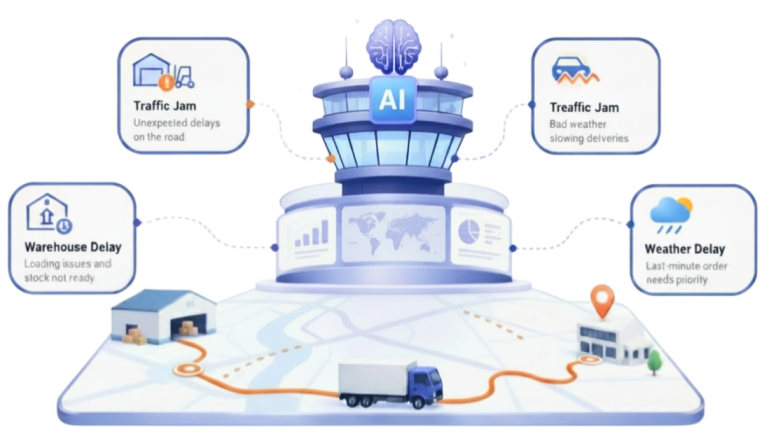
AI in logistics produces a real operational result, but only when it is built as an integrated layer over the operational systems rather than a standalone dashboard. Each of the seven use cases depends on a defined data infrastructure, system integration, and an operational workflow wrapped around the AI output. Companies that understand this before they start get the ROI. The rest get a good-looking demo and an unchanged process.
Ready to build AI into your logistics platform? Talk to TwinCore.