LinkedIn
 Twitter
 Facebook
 Youtube



AI MVP development has to prove something a normal software MVP does not. The build must show the AI works reliably on the real data it will handle in production, not only that users want the feature. Data preparation, evaluation, and human review supply that proof and move the estimate. Before estimating an AI MVP, answer four questions:
- What specific task should the AI perform?
- What real data will it use?
- How will you measure whether the output is good enough?
- Which existing systems must it read from or write to?
These answers determine whether the MVP is a $10,000–$25,000 validation project or a $50,000+ implementation involving data preparation, integrations, human review, and compliance controls.
What an AI MVP has to prove
An AI MVP validates both the product workflow and the AI component's performance.
Test the system on real inputs, not prepared demo data. A document-processing MVP should run on the formats, scan quality, and edge cases it receives in practice; a forecasting MVP should be compared against the current method, not only its own test results.
| Stage | Question it answers | Data | Users | Output |
|---|---|---|---|---|
| Demo / prototype | How could it look? | Curated or synthetic | None | A scripted walkthrough |
| Proof of concept | Does the approach work? | Sample of real data | None | A measured result |
| MVP | Is it reliable and useful? | Real data | A small real group | A working product slice |
| Pilot | Does it survive a real process? | Production data, live integrations | A real team | A process-level result |
| Production | Can we run it safely at scale? | Full production | All users | A supported, monitored service |
A proof of concept is cheaper than an MVP because it skips the interface, integrations, and rollout, and only shows the approach can work. Treat the two as separate phases in a PoC and MVP development plan, and watch for a demo presented internally as an MVP, which leaves later budget decisions resting on untested results.
AI MVP Development Process: Step by Step
The AI MVP development process below covers the decisions required to build an AI MVP, from a defined use case to a testable workflow. Each step states what to decide, build, and document before evaluating the result.
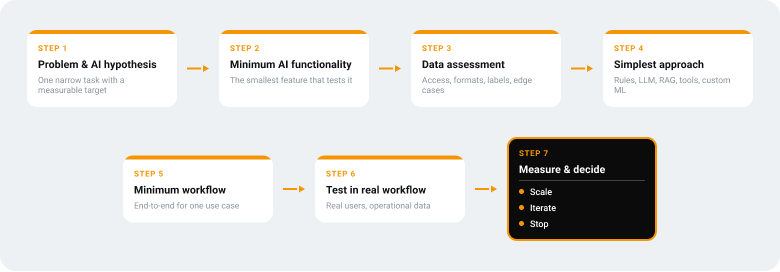
Step 1: Define the problem and AI hypothesis
Start with one narrow business task and a measurable hypothesis. For example:
The system should classify urgent support tickets with at least 85% precision and reduce manual triage time.
A goal like "use AI to improve customer service" names no task and no measurable target, so it cannot be validated. The 85% figure is illustrative.
Deliverable: a defined use case, the current baseline, and measurable acceptance criteria.
Step 2: Define the minimum AI functionality
Describe the smallest feature that can test the hypothesis. Examples:
- extracting five required fields from one document type
- answering questions from one approved document collection
- classifying one type of incoming request
- recommending an action without executing it automatically
Send uncertain or high-impact outputs to human review, not automatic action.
Deliverable: a limited MVP feature scope, not a full product backlog.
Step 3: Assess the available data
Review the actual data before the estimate is finalized. Check:
- data sources and access methods
- available formats and known variations
- existing labels or verified answers
- personal, confidential, or regulated data
- permission to use external AI providers
- known edge cases
- whether an evaluation dataset can be created
Data collection, cleaning, or labeling may become a separate workstream.
Deliverable: a short data-readiness assessment covering data, gaps, access limits, and required preparation.
Step 4: Choose the simplest suitable approach
Choose the least complex approach, or combination of approaches, that can meet the acceptance criteria:
- deterministic rules for logic that is already defined
- a hosted LLM with prompting and structured output for language tasks
- RAG when answers must be grounded in internal documents
- tool calling when the workflow must read from or update another system
- fine-tuning or custom ML when testing shows that simpler options cannot meet the required performance
These approaches are not sequential maturity levels and can be combined. One MVP may use RAG for retrieval, an LLM for a structured result, and tool calling to write into a CRM, ERP, or TMS.
Base the decision on:
- the task
- available data
- required performance and acceptable error rate
- cost and impact of an incorrect result
- integration requirements
- expected operating cost
Deliverable: the selected implementation approach and a short explanation of why each component is required.
Step 5: Build the minimum functional workflow
Include only the interface and integrations needed to run the test. The MVP may use:
- a simple web form
- an internal dashboard
- an API endpoint
- a manual review queue
Define where input comes from, where the result goes, who reviews uncertain outputs, and how invalid responses are handled and logged.
Deliverable: a working end-to-end workflow for one use case.
Step 6: Test with real users and operational data
Run the MVP inside the real workflow, not a prepared demo. Collect:
- accepted outputs
- corrections
- rejected outputs
- processing time
- recurring failure cases
- user feedback
Re-run the same evaluation dataset after any significant change to prompts, retrieval, routing, or the model.
Deliverable: evaluation results, a list of failure patterns, and user feedback.
Step 7: Measure the result and decide what happens next
Compare the MVP against the original baseline and acceptance criteria. Three outcomes:
- Scale. The technical and business criteria are met.
- Iterate. A specific failure can be addressed in another controlled test.
- Stop. Performance, operating cost, data quality, or user value does not justify further investment.
Deliverable: a documented scale, iterate, or stop decision with the supporting evidence.
Common types of AI MVPs
Scope and evaluation criteria depend on the type of AI solution being built.
| AI MVP type | Typical use case | What to validate |
|---|---|---|
| LLM or RAG assistant | Answering questions using internal documents | Answer accuracy, source correctness, permission handling, and the rate of unsupported answers |
| Document processing | Extracting fields from invoices, contracts, or delivery notes | Field-level accuracy across real formats, scan qualities, languages, and edge cases |
| Workflow agent | Creating records, updating systems, or triggering business processes | Task completion, incorrect or duplicate actions, approval rules, permissions, and rollback |
| Forecasting or classification | Predicting demand, prioritizing cases, or assigning categories | Performance against the current method, false-positive and false-negative rates, and data leakage |
Computer vision and voice solutions need extra testing for image quality, lighting, accents, background noise, and recording quality, on evaluation data that reflects the conditions the system will actually run in.
How to validate an AI MVP
Choose the validation method based on the use case:
| Use case | Validation method | Example pass criteria |
|---|---|---|
| Document extraction | Test on 200–500 verified documents | At least 95% accuracy for critical fields and less than 20% requiring manual correction |
| RAG assistant | Test 100–300 real questions with verified answers | At least 85% correct answers, valid sources, and no access-control violations |
| Classification | Run on labeled historical cases, then in shadow mode | Required precision and recall are met and results outperform the current process |
| AI agent | Start with human approval for every action | High task-completion rate, no unauthorized actions, and an acceptable correction rate |
Illustrative pass criteria — actual thresholds depend on the cost of an error and the current baseline.
After offline testing, run the MVP in shadow mode or with human approval before allowing full automation.
Define the pass criteria before testing. Compare the MVP with the current process on accuracy, review time, manual correction rate, processing cost, and failed actions.
What an AI MVP costs
An AI MVP typically costs between $10,000 and $100,000. The final estimate depends mainly on three factors:
- Data readiness. Whether usable and labeled data already exists.
- Integrations. How many systems the MVP reads from or writes to.
- Automation level. Whether users review the output or the system acts without approval.
| Workstream | Typical range | What increases the cost |
|---|---|---|
| Discovery and feasibility | $1,000–$6,000 | Multiple workflows, systems, and stakeholders |
| Data preparation | $0–$20,000 | Data collection, cleaning, labeling, and access problems |
| AI implementation | $5,000–$30,000 | RAG, fine-tuning, custom ML, or computer vision |
| Application and interface | $1,500–$15,000 | User roles, review screens, dashboards, and client-facing UI |
| Integrations | $500–$12,000 | Multiple APIs, write-back, permissions, and rollback |
| Evaluation and testing | $1,000–$8,000 | Larger evaluation sets and manual review |
| Security and compliance | $500–$6,000 | Personal data, regulated industries, and access controls |
| Deployment | $500–$3,000 | Environments, monitoring, and hosted infrastructure |
Typical project ranges:
- $10,000–$25,000. One narrow use case, existing data, a hosted model, minimal UI, and one simple integration.
- $25,000–$50,000. Document ingestion or a data pipeline, several integrations, user roles, and human review.
- $50,000+. Custom ML, extensive labeling, regulated data, or an agent that performs actions without approval.
Running costs are separate from development. A hosted AI MVP may cost approximately $200–$2,000 per month. RAG systems with monitoring and human review may cost $1,000–$6,000 per month, while dedicated self-hosted inference may start at about $5,000 per month.
Treat these as planning estimates; a reliable quote requires reviewing the data, integrations, workflow, acceptance criteria, and usage.
How long it takes
A lean LLM or RAG MVP with accessible data and one core workflow usually takes 6–10 weeks. Projects with several integrations, user roles, and a data pipeline typically take 3–5 months. Custom ML, extensive labeling, regulated data, or agentic actions can extend the timeline to 5–9 months.
| Phase | Typical duration |
|---|---|
| Discovery and hypothesis | 1–2 weeks |
| Data assessment and preparation | 2–8 weeks |
| Initial model implementation | 2–4 weeks |
| Custom training, if required | Additional 4–12 weeks |
| Interface and integration work | 3–6 weeks |
| User testing and evaluation | 2–6 weeks |
Interface and integration work runs alongside model work, and evaluation starts before the interface is finished. A realistic AI product MVP timeline accounts for overlap between these phases, so the durations should not be added together mechanically. Data preparation, integration access, or user testing may still determine the overall schedule.
The scheduling risks that stretch a plan are:
- data that is inaccessible or poorly structured
- missing labels or verified answers
- delays in integration access or approval
- multiple input formats to support
- users who are unavailable for testing
- repeated evaluation after each model or prompt change
Security and failure handling
For an MVP using real business data, include:
- permissions enforced during retrieval
- separation between users and tenants
- logging of prompts, outputs, model versions, and actions
- human approval for high-impact actions
- fallback handling for invalid output, timeouts, and provider outages
AI MVP best practices
These AI MVP best practices define how the team should manage evaluation, approvals, versioning, and project reporting during development.
- Agree on acceptance criteria before development begins, so the scale, iterate, or stop decision has a fixed target, not a number chosen after the results are in.
- Re-run one fixed evaluation dataset after every change to prompts, retrieval, routing, or the model, so each result stays comparable to the last.
- Route uncertain or high-impact outputs through human approval first, removing the gate only once the error rate is measured.
- Record prompt versions, model versions, corrections, and rejected outputs, so a regression can be traced to the change that caused it.
- Budget and schedule two or three evaluation rounds up front; a single pass rarely settles a threshold.
- Fix explainability or source-traceability requirements early for regulated or high-impact workflows; retrofitting them forces a model or architecture change.
- Report a demo, PoC, MVP, and production pilot as separate milestones, so a scripted demo is never approved as validated evidence.
Common mistakes that inflate cost and timeline
A few patterns show up in almost every over-budget AI project:
- selecting custom ML before prompting, RAG, or an existing model has been tested, which adds training cost before anyone knows a simpler option would work
- assuming the data is ready without checking access, rights, quality, and labels, then finding the preparation work after the estimate is signed
- starting development without a measurable baseline, so the final scale, iterate, or stop decision has nothing to compare against
- building a polished interface before the AI function is validated, then rebuilding it when the workflow changes
- moving straight to full automation instead of human approval, turning a correctable mistake into a visible failure in front of the first users
- underestimating CRM, ERP, TMS, and database integrations, especially write-back with permissions and rollback
- excluding evaluation iterations from the budget, when two or three rounds are the norm
- estimating the build while ignoring recurring operating costs that start during testing
When not to build one
Skip the AI MVP when plain automation already solves the problem, the data isn't accessible, or nobody agrees on a success metric. Postpone it when there are no users to test with, the process is undefined, or AI is added mainly for positioning. Do not proceed when the expected benefit does not justify the development and operating cost.
How TwinCore approaches AI MVPs
TwinCore approaches AI development for an MVP with a data-readiness review of rights, quality, access, and whether an evaluation set can be built, before any model budget is approved. The choice is then the simplest approach that meets the criteria, a hosted model by default, and scope held to one workflow, one baseline, and one metric.
Most of the work is integration. An extraction or agent feature has to respect the permissions, statuses, and audit rules of the CRM, ERP, or TMS it writes into, on an architecture that can extend into production.
TwinCore has built this kind of software since 2011, with 100+ delivered projects concentrated in logistics and document-heavy operations. Our AI in logistics use cases show where that work applies.
The takeaway
An AI MVP estimate should separate data preparation, AI implementation, integrations, evaluation, application work, and recurring operating costs. Before approving the scope, confirm the baseline, test dataset, acceptance criteria, review workflow, and systems involved. These inputs decide whether the project is a narrow validation exercise or the first stage of a production product.
Weighing the cost and timeline of an AI product idea? Talk to TwinCore.