LinkedIn
 Twitter
 Facebook
 Youtube



You do not need an enterprise logistics platform on day one. Trying to build everything at once usually makes the project slower, more expensive, and harder to test with real users. Start with one clear operational problem, solve it well, and only then add the next layer.
This article is a practical roadmap for logistics platform development, from a focused MVP to an enterprise-grade system. Treat it as a logistics software development roadmap: how to scope the first version, what to add at each phase, the architecture choices to make early, and how to read the signals that say the platform is ready for the next stage.
The aim is to build a logistics platform that grows with the operation instead of one that has to be rebuilt at the first volume jump.
The roadmap at a glance
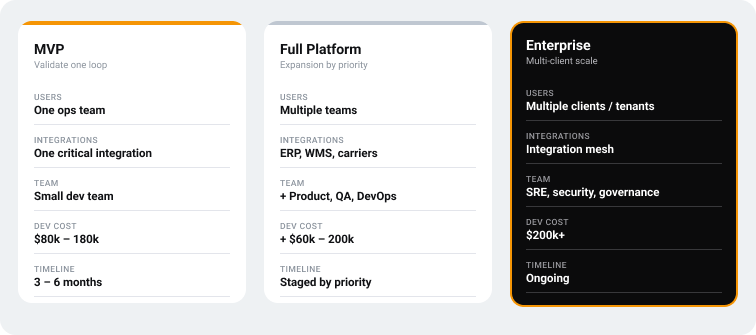
The table below maps the three phases on one screen, and it doubles as a readiness checklist: scan each row to see where your platform sits today and what the next phase asks for. Cost ranges are development cost and match the FAQ; they are not runtime infrastructure cost, which the operational readiness section covers separately.
| Phase 1 — MVP | Phase 2 — Full platform | Phase 3 — Enterprise scale | |
|---|---|---|---|
| Core focus | Validated MVP, one operational loop | Full platform, expansion by priority | Enterprise scale, multi-client |
| Users | One ops team | Multiple teams | Multiple clients / tenants |
| Integrations | One critical integration | ERP, WMS, carriers | Integration mesh |
| Data model | Clean core entities | Lifecycle and rates refactor | Tenant-aware, analytics-ready |
| Reliability | Basic monitoring | Alerts plus staging | HA / DR / SLA |
| Security | Auth and roles | Audit logs plus RBAC | SOC 2 / GDPR / security governance |
| Team | Small dev team | Product, QA, DevOps | SRE, security, governance |
| Typical dev cost | 80k–180k | +60k–200k | $200k+ |
| Timeline | 3–6 months | Staged by priority | Ongoing |
Why logistics platforms should start as an MVP
Building the full platform first feels like the safe move. It's usually the expensive way to learn the core workflow doesn't fit how the team really works. Every operation runs a little differently, and what looks clean in a planning doc often breaks on the floor. An MVP is how you check. The team runs one real workflow, start to finish, before the company commits to building everything else.
Scaling too early is the most common way startups die. Startup Genome studied more than 3,200 companies. About 70% scaled before they were ready in at least one area, and those companies grew slower than the ones that waited (Startup Genome). Build the full platform first and you spend six figures and a year before anyone uses it. An MVP gets a working tool to the operations team in months, while it's still cheap to change your mind.
The upside shows up early. Say the MVP kills the worst daily bottleneck: manual dispatch run across a spreadsheet and three inboxes. It pays off the week it goes live, not a year later. The usage data then tells you what to build next, which beats guessing in a planning meeting. That's the idea behind MVP and PoC development: prove the loop, then grow it.
What's the difference between an MVP and an enterprise logistics platform?
An MVP and an enterprise logistics platform differ in purpose, users, reliability, and architecture, not feature count. They solve different problems at different points in a product's life.
- Goal. An MVP proves one core operational hypothesis; an enterprise platform runs critical operations reliably at scale.
- Scope. One operational loop versus a full set of modules, integrations, and orchestration.
- Users. One team and one use case versus many clients, roles, business units, and outside stakeholders.
- Reliability. "Good enough to run the day" versus high availability, redundancy, SLAs, and disaster recovery.
- Security and compliance. Basic at MVP versus SOC 2, RBAC, audit logs, and regional compliance as a precondition to the contract.
- Architecture. A clean modular foundation versus mature microservices or a well-structured modular system tuned for volume.
The MVP is the right shape early; the enterprise platform is the right shape once the operation and the customer base demand it. What sits between them is a sequence of phases, not a single leap, and the rest of the article walks through that sequence.
Phase 1 — the MVP: core operational loop
A good logistics MVP should help the team complete one full workflow, not just test a collection of disconnected features.
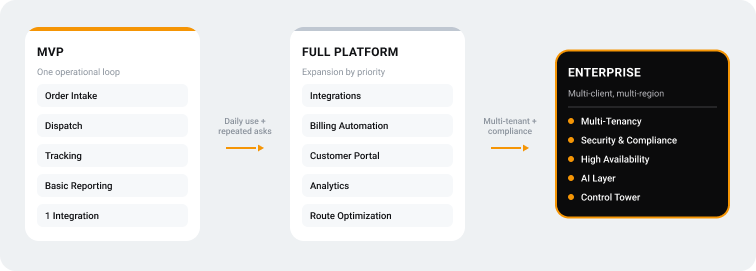
In a TMS-type product, the minimum useful flow usually looks like this: receive the order, assign the carrier or route, manage execution, track the shipment, and report on the result.
Each step can be simple at the MVP stage. But if one step is missing completely, the operation moves back to manual work. That is when the product becomes a side tool instead of the system the team actually uses.
What to include in the MVP (using a transportation platform as the example):
- Order and shipment management: the entry point, with basic statuses.
- Basic carrier management or rate logic, depending on whether the business buys capacity or runs its own.
- A dispatch or assignment workflow.
- Shipment tracking, even if it starts as a manual status update.
- Essential reporting: the few operational metrics the team actually opens every day, not a dashboard gallery.
- One core integration: the most critical one, often order intake from an OMS or ERP.
This is a scope list, not a module catalog. For the module-level detail behind each capability, see the guides on what a transportation management system is and how it works and the typical structure of a TMS. This roadmap links to them rather than repeating the breakdown. The point of the MVP list is the boundary: one loop, end to end, and nothing that does not serve it.
What to leave out of the MVP:
- Advanced AI and ML such as route optimization or predictive analytics. That is Phase 2 or later.
- Multiple integrations. Ship the one that matters; add the rest once the loop is stable.
- A customer-facing portal, unless self-service visibility is the actual value proposition.
- Complex billing and freight audit, unless reconciliation is the central problem being solved.
- Multi-client architecture, if the business starts with a single operation.
An MVP should be simple in scope, not in architecture. Build it on a modular structure with a clean data model and an API-first approach. Cutting scope ships fast; cutting architectural corners creates the technical debt that blocks Phase 2.
Knowing when to move beyond the MVP
The MVP is ready to grow when people stop "testing" it and start relying on it.
The ops team uses it daily. The main workflow runs without constant fixes. And the same gap shows up again and again. For example, if dispatchers keep exporting data to Excel because the platform does not calculate something yet, that is a strong signal for the next feature.
Business signals point the same way: shipment volume climbs, new clients or lanes come on, an out-of-scope integration becomes a blocker, or competition makes a capability like customer visibility non-optional.
There are anti-signals too, and they matter as much. Do not scale if the MVP has no stable adoption, if feature requests are guesses rather than observed usage, or if the core loop still breaks under normal load. Scaling before validation is the same mistake as never scaling at all, and it costs more.
Architectural decisions to get right early
Some decisions cost almost nothing to make correctly in the MVP and a great deal to undo in Phase 2 or Phase 3. This is not a call to over-engineer. It is a short list of choices that are cheap now and become a refactor later, and getting them right is the difference between additive growth and a rebuild. Each one below reads as: the decision, why it is cheap to lay down early, and what the rework costs if you skip it.
Data model for rates, shipment lifecycle, and multi-leg movements. This is the hardest and most expensive part of the logistics domain to refactor. Rates, shipments, tracking events, reports, and integrations all depend on the same core structure. If that structure is wrong, Phase 2 becomes less about growth and more about undoing the first version.
API-first contract design. Stable internal contracts from the first sprint let Phase 2 integrations bolt on without touching the core. Retrofitting clean contracts onto a code-base that grew without them means rewriting the call sites that already depend on the messy version.
Tenancy-aware identifiers, even in a single-tenant MVP. Carry a tenant or org scope in the keys before you need it. Adding multi-tenancy in Phase 3 without it is a rewrite of the data layer, because every row has to be re-keyed and every query re-scoped.
Clear domain and module boundaries. Keep dispatch, rating, tracking, and billing as separated concerns. Clean boundaries let a module move out into its own service later without untangling shared code; tangled boundaries mean the split becomes a multi-month project.
Idempotency and traceable integration messages. Give messages and events a stable identity early. The event-driven patterns that Phase 2 leans on depend on it, and adding identity after the fact means reprocessing and deduplicating a live message stream.
None of this means building enterprise on day one. It means not making the few decisions that quietly close the door to scaling.
Phase 2 — scaling to a full platform
Phase 2 turns a validated loop into a working platform, and the order of expansion should follow what the MVP data showed, not a generic checklist. The sequence below is typical; the priority is specific to each business.
- Additional integrations. ERP for freight cost allocation, WMS for warehouse coordination, more carrier APIs and EDI links. This is usually the largest single effort in Phase 2, and the most underestimated, as the pitfalls section covers. TwinCore handles that surface as logistics API integrations.
- Freight audit and billing automation. If it was out of the MVP, automating invoice reconciliation and billing returns ROI quickly because it removes recurring manual review. 3PL and freight management software covers this depth.
- Customer-facing portal. Real-time visibility, document access, and self-service. This is what raises client retention once the operation runs multiple accounts.
- Advanced reporting and analytics. Multi-dimensional reporting, carrier scorecards, P&L visibility, KPI dashboards.
- Route optimization. AI-driven sequencing and dynamic rerouting, if the operational profile justifies it.
- Mobile apps. A driver app for fleet operations or field execution.
The technical work in Phase 2 is where early architecture pays off or bites back. The data model often needs refactoring as the MVP schema reaches its limits, especially around rates and shipment lifecycle. A modular monolith may need to split toward microservices, but only when team size and scale actually demand it, not on principle. Event-driven patterns come in to support real-time features, and the API layer gets hardened for the rising count of integrations. The architecture and cost mechanics of a custom build are broken down in the guide on how to build a custom TMS.
This is also the phase where MVP shortcuts surface. If the first version was built with a throwaway data model and hard-coded assumptions, refactoring becomes the blocker that holds up every new feature. If the architecture was clean, expansion is mostly additive. The difference was decided in Phase 1, not here.
Knowing when you're ready for enterprise scale
The signals for the Phase 2 to Phase 3 jump are different: load, contracts, and risk, not feature requests.
- The platform serves several clients, business units, or is becoming a product sold to an outside market, which creates the need for multi-tenancy.
- Enterprise clients require SOC 2, an SLA, audit logs, and role-based access as a precondition to signing, not as a future nicety.
- Transaction volume approaches the limits of the current architecture, and performance incidents start showing up under load.
- Downtime now costs real money, which makes high availability, redundancy, and disaster recovery non-optional.
- Regulatory or compliance pressure, such as GDPR or regional rules, becomes mandatory rather than aspirational.
The anti-signal is chasing enterprise features such as multi-tenancy or SOC 2 before the Phase 2 platform has stable adoption and real enterprise demand. That is premature scaling at a new altitude, and it burns the same budget.
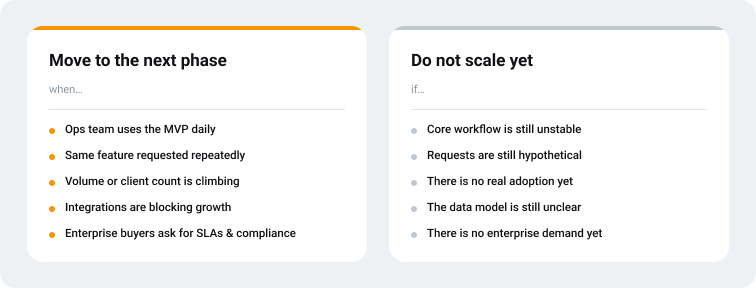
The same rule governs both transitions: advance on observed adoption and real demand, not on plans. Here are the go and no-go signals.
| Move to the next phase when… | Do not scale yet if… |
|---|---|
| The ops team uses the MVP daily | The core workflow is still unstable |
| The same feature is requested repeatedly | The requests are still hypothetical |
| Volume or client count is climbing | There is no real adoption yet |
| Integrations are blocking growth | The data model is still unclear |
| Enterprise buyers ask for SLAs and compliance | There is no enterprise demand yet |
Phase 3 — enterprise-grade platform
A logistics platform reaches enterprise level when it can support daily operations reliably across more users, clients, lanes, and integrations. The capabilities below are what enterprise buyers usually expect at this stage. The next section explains how to support them in practice.
- Multi-tenancy and multi-client architecture. Full data isolation, per-tenant configuration, and an architecture that scales per tenant, once the platform serves several clients or becomes a product itself. TwinCore builds this on a modular logistics software foundation.
- Enterprise security and compliance. SOC 2, role-based access control, audit logs, data encryption, and GDPR or regional compliance, a prerequisite to signing enterprise clients. The perimeter-defense side sits in operational readiness below.
- High availability and scalability. Redundancy, load balancing, auto-scaling, and disaster recovery, so operations do not pause when a node fails. The horizontal-scaling mechanics sit in operational readiness below.
- An advanced AI/ML layer. Predictive ETA at scale, demand forecasting, anomaly detection, and carrier scoring, wired into the operational workflow rather than standalone dashboards.
- Control tower and orchestration. Unified visibility and management across operations, with exception management and real-time alerting. TwinCore covers this as supply chain visibility and a control tower.
- Deep ecosystem integration. A full integration mesh across corporate systems, partner platforms, and carrier networks.
- Governance and extensibility. An API platform for third-party extensions, configuration without code changes, and data governance the compliance team can defend.
The engineering profile shifts from Phase 1: mature microservices or a well-structured modular architecture, dedicated DevOps with CI/CD, performance tuning for high transaction volumes, and a data warehouse feeding BI. The logistics software market reached USD 16.24 billion in 2025 and is forecast to grow at roughly 8% a year into the early 2030s (Fortune Business Insights), with the enterprise tier taking most of the custom-system spend.
Enterprise operational readiness: infrastructure, scaling, observability, and security
A set of enterprise features on paper is not the same as a system that holds traffic, volume, and threats in production. The Phase 3 capabilities above only deliver value when the platform underneath them is operationally sound.
Horizontal scaling
Multiple instances and auto-scaling. An enterprise platform runs on several instances behind a load balancer, not one box, so a failed instance or a traffic peak does not take it down. Azure and AWS add instances under load automatically, a choice to make on purpose, not a default.
Statelessness is the condition for scaling out. Multiple instances only work if the app keeps no session, cache, or state in local memory; otherwise users get bounced between instances and sessions drop. Move state to a shared store like Redis, and decide this early, because retrofitting it is painful.
Environments and data safety
Separate the database from the application. On one server they fight for CPU, RAM, and disk, so an app spike drags the database down with it. Co-locate in the MVP, but plan a separate managed database for enterprise.
Keep production and staging apart. Test and release on a staging environment that mirrors production, never on the live system. Without it, every release risks live operations and there is nowhere to reproduce a bug.
Have a real backup strategy. Nightly database backups at a minimum, copies stored off the main server, and regular restore drills, because a backup that has never been restored does not exist. Skip it and one disk failure or bad query means lost data and downtime. Backups complement disaster recovery: backups are the data, DR is the speed of coming back up.
Plan data retention before the database slows down. High-turnover data (logs, events, audit trails, tracking history) grows without pause, and without scheduled purging or archiving, queries slow and indexes bloat. Build retention into the architecture, not after the database already crawls.
Visibility and cost
Observability answers the operational questions. An enterprise platform has to answer two specific questions: "why did this order fail?" and "why does the system slow down at peak?" That needs end-to-end tracing and structured logging across the request path, well beyond error logs. Without it, every incident is investigated blind for hours, and downtime costs money and contracts. As orientation:
- Azure. Application Insights plus Log Stream at minimum: request tracing, dependency tracking, and performance counters out of the box.
- On-premises. The ELK stack (Elasticsearch, Logstash, Kibana), powerful but heavy on CPU, RAM, and storage, so budget dedicated capacity.
- Resource-threshold alerts. Alert when disk, CPU, or RAM stays above 85% for more than 30 minutes, so the team reacts before peak pressure becomes downtime.
Runtime cost scales with traffic. Moving from MVP to enterprise volume turns cloud cost (compute, traffic, storage) into a standing line item, not a one-off, and auto-scaling means the bill grows with the load. If the platform uses an LLM API, token cost scales with operations the same way, a meaningful line of its own. Budget these runtime costs into total cost of ownership from the start, not just development cost.
Security
The attack surface grows with the product's visibility. An MVP with no public profile is nobody's target; once the platform is known through public endpoints, clients, and integrations, fraudsters, DoS and DDoS attacks, spam, abuse, and scraping arrive. Get the perimeter ready before the first attack:
- Edge. Cloudflare or a CDN with a WAF in front of the platform.
- API. Rate limiting, plus bot protection and monitoring for abnormal traffic.
- Auth. Login protection against brute-force and credential-stuffing.
- Load. Caching to shed load and soften traffic spikes.
This is the active perimeter side, alongside the Phase 3 compliance controls (SOC 2, RBAC, audit logs, encryption), not a replacement. The attack vector scales with visibility, so security moves from optional at MVP to a precondition at enterprise.
Testing before you scale: the coverage that prevents a failed transition
Test discipline is the insurance policy on the MVP-to-enterprise transition. What ran fine at small volume breaks quietly under load and at every refactor, and without coverage the move can fail outright. Tests make expansion safe, tying back to the early architectural decisions and the technical-debt pitfall.
Cover the core. Not everything needs tests, but the critical business logic (rating, dispatch, billing) must be, because an error there costs money and trust and is the hardest to spot. Modern AI tooling raises core coverage fast, which kills the usual "no time for tests" excuse.
Test integrations under realistic conditions. Test integrations and data handling against a production-like environment, not a simplified stub, or the problems surface at the customer. An in-memory database hides constraint and migration issues that only appear against the real engine.
Check behavior under load before a client does. The platform's behavior under expected operational volume has to be verified before a real enterprise client creates that volume. Otherwise scale gets "validated" in production, which is the most expensive way to find out.
Common pitfalls in scaling a logistics platform
Six mistakes account for most of the budget burned between MVP and enterprise scale. Scaling logistics software is where each of them surfaces, usually at the worst time.
Premature scaling. Building enterprise features before the MVP is validated spends money on capabilities nobody confirmed they need. The Startup Genome data above is the clearest warning here.
Architectural shortcuts in the MVP. "Ship it fast, rewrite it later" is the technical debt that blocks Phase 2. The MVP has to be simple in scope and clean in architecture; those are not the same lever.
Big-bang releases. Shipping many features in one drop instead of incrementally raises risk and makes a fault almost impossible to isolate. Phased rollout keeps each change small enough to diagnose.
Ignoring the data model early. A weak early data model is the most expensive thing to refactor later, because every feature and integration is already built on top of it. (The architectural-decisions section above is the positive version of this: design the rate, billing, and lifecycle model cleanly up front, and this pitfall never lands.)
Underestimating integrations. Integration is the largest hidden effort in a logistics build. A single integration costs roughly 3,000–15,000 when mapped upfront, and integrations together run 8–15% of an enterprise implementation budget (ERP for Private Equity). ERP and carrier connections found after the plan is set are a recurring source of overruns, so map every connection during discovery, not during the sprint that needs it.
Building without operational feedback. A platform built without real dispatchers in the room produces software that is technically correct and operationally unusable. The people who run the loop daily have to shape the features that automate it.
How TwinCore builds logistics platforms from MVP to enterprise
TwinCore is not a generic enterprise outsourcing vendor. It focuses on custom logistics platforms for teams that need a practical path from MVP to a scalable product without rebuilding the system later. The work runs across every phase, from a validated MVP to an enterprise-grade platform. It runs on the TwinCore Logistics Framework: a modular architecture that starts at the core loop and expands without a rewrite, built to avoid the scaling pitfalls above. The framework and its services are documented under TwinCore Logistics and the Logistics Framework page.
The work combines logistics domain knowledge with software engineering. Understanding dispatch, rating, carrier management, and freight audit is what keeps the MVP aimed at the real problem instead of a theoretical one. Delivery is handled by the TMS development services team, with warehouse-side work covered in custom WMS software development. The process is a paid discovery to scope the MVP, iterative development, a phased rollout, and architectural planning that accounts for future scale from the first sprint. The engineering runs on .NET and ASP.NET, React, Angular, Azure and AWS, with microservices and event-driven patterns where scale calls for them. On the market since 2011, TwinCore has delivered 100+ projects with a team of 30+ professionals.
Conclusion
Building an enterprise logistics platform is a journey, not a single project. The teams that get there start with a focused MVP that removes one real bottleneck, scale on operational learnings instead of assumptions, and build on a clean architecture from the first commit. The right partner understands both the engineering and the logistics floor it runs on.
Planning your logistics platform roadmap? Talk to TwinCore.