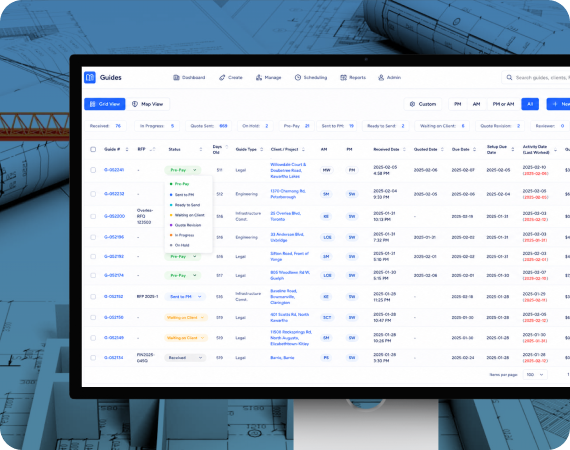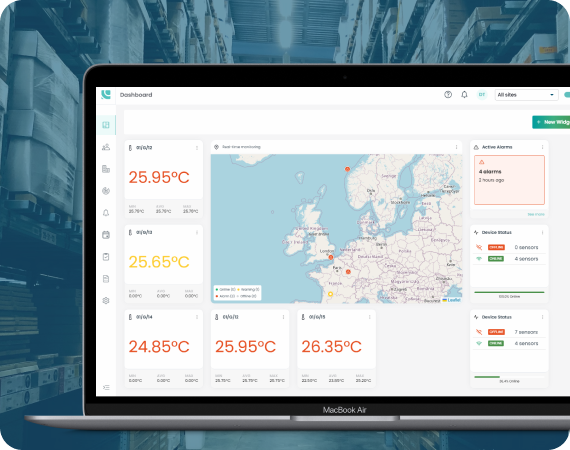





ERP integrations
SAP, Oracle, Microsoft Dynamics, NetSuite, Odoo, and other ERP platforms for financial data, cost allocation, automated reconciliation, and operational workflows.
 Get in touch
TwinCore builds custom logistics API integrations that connect your TMS, WMS, ERP, OMS, CRM, carriers, and delivery platforms into one real-time operational network. Disconnected systems mean manual copy-paste workflows, delayed tracking updates, mismatched statuses between tools, and endless portal-hopping just to sync orders and shipments. Without a unified API layer, adding partners or carriers becomes a heavy engineering project, data consistency suffers, and visibility across the supply chain stays fragmented instead of real time.

TwinCore has elevated the client's customers to the next level of supply chain management. The team is highly cost-efficient from a project management standpoint, and internal stakeholders are particularly impressed with the service provider's team dynamic.












We integrate the major global carriers and regional specialists you rely on. If a carrier exposes an API, we can integrate it. If it doesn't, we can wrap their portal or file interface in a custom adapter.

This DHL integration focuses on e-commerce operations, so you can connect it to your online store or order management system for order fulfillment, labeling, and tracking.

This API offers a convenient tool for document creation alongside basic shipping service features.

A software interface for calculating shipping rates, creating labels, and tracking your orders delivered by FedEx.

With this API, you'll be able to optimize your shipments by picking the most convenient routes and transportation offered by dozens of carriers available.

If you use Royal Mail as your carrier, tracking orders and their labeling as well as integration with your online shop will be nothing but a smooth experience.

You'll get a complete integration with all relatable shipping services and features such as tracking, labeling, and price calculations.

In addition to standard features like tracking and labeling, this API includes inventory management for packages shipped across the United States.

The company offers an in-depth data solution that can help you improve your company's customer experience.

This carrier provides an API that will let you track and label orders, and even help your customers claim returns hassle-free.

The Sway technology developed by this company provides you with a network of warehouses and vehicle fleets you need for next-day shipping or middle-mile/last-mile delivery.
We connect logistics systems with your core business applications so data stays consistent everywhere. Through typical automated flows, an order confirmed in the OMS automatically creates a shipment in the TMS, while a delivered shipment instantly updates the ERP for invoicing and triggers the WMS to adjust inventory. Additionally, customer records in the CRM seamlessly drive specific service options, routing rules, and alerts. Your team continues working in the tools they already use while APIs keep everything perfectly in sync.
SAP, Oracle, Microsoft Dynamics, NetSuite, Odoo, and other ERP platforms for financial data, cost allocation, automated reconciliation, and operational workflows.
Large shippers and carriers still depend on EDI. We make it work alongside modern APIs instead of against them.
Behind the scenes we translate EDI into structured events your systems understand, with validation, retries, logging, and monitoring. To your TMS and ERP it looks like a clean API; to your partners it behaves like compliant EDI.
1 /4
Operational truth often comes from devices, not just business systems. These signals are linked to vehicles, loads, and stops inside your systems — powering accurate ETAs, condition monitoring for cold chain, geofence events, and exception alerts in real time.
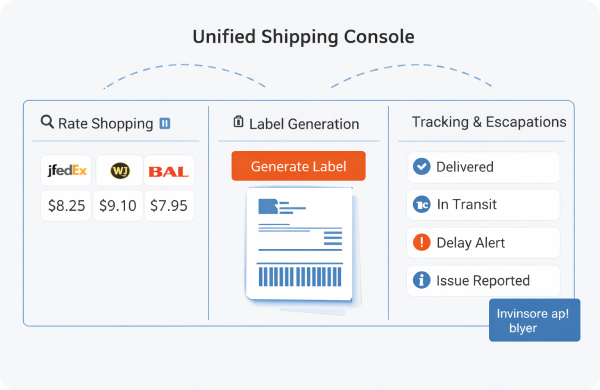
When rates, booking, labels, tracking and delivery confirmations all live across different carrier sites, operations slow down, errors multiply, and teams lose visibility. A unified logistics API layer lets all shipping actions happen inside your TMS or order management system:
This removes the operational drag caused by inconsistent portals and replaces it with a predictable, automated flow.
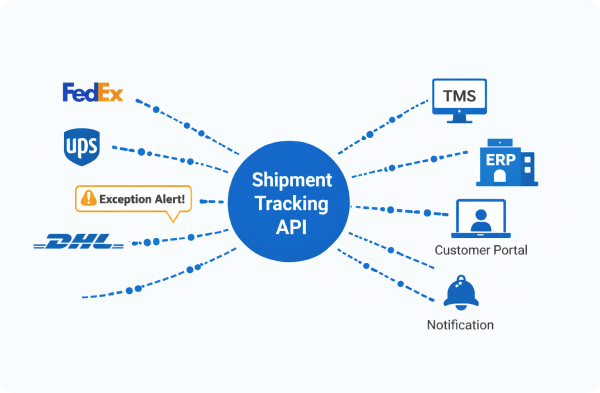
Tracking data often arrives late, is inconsistent between systems, or disappears into vendor dashboards that no one checks on time. With a centralized shipment tracking API:
Visibility stops being a guessing game and becomes a reliable operational signal.
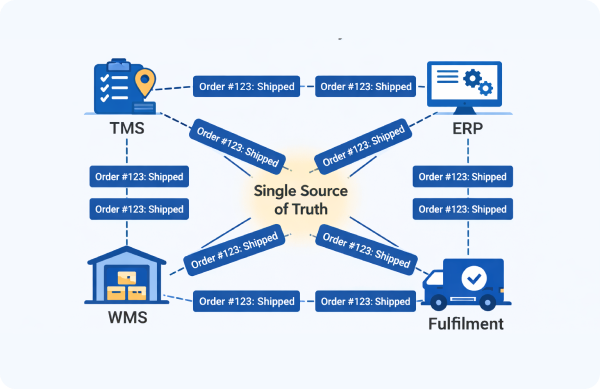
Disconnected integrations create mismatched statuses, incorrect charges, duplicated data and unreliable reporting. API-driven logistics integrations ensure that:
This eliminates the data chaos that slows down planning, billing and customer communication.
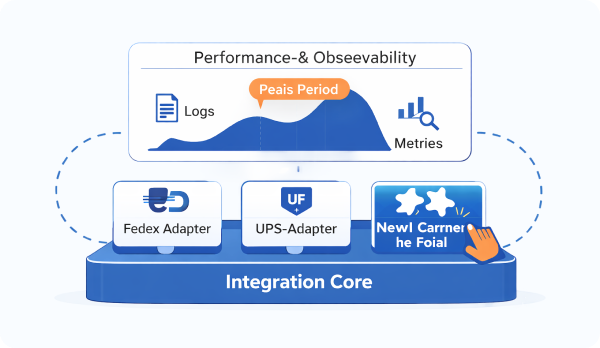
Adding a new carrier shouldn't require a multi-week development project or risky one-off scripts. A flexible integration layer allows new partners to be onboarded by extending:
This keeps engineering focused while letting operations expand the network quickly.
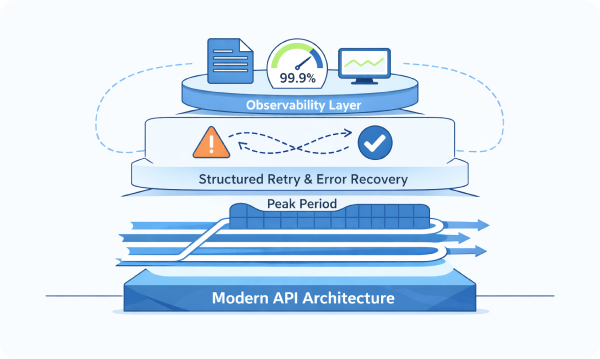
Logistics integrations fail when they rely on fragile point-to-point connections, poor error handling or systems not built for volume. A modern API architecture ensures:
As shipment volume grows, integrations remain stable — not another bottleneck.
There are several major benefits your business can achieve after integrating with logistics carriers:

You'll always have important data such as shipping rates, tracking, and inventory levels at your fingertips to make quick yet well-informed decisions.

The amounts of repetitive and manual tasks will decrease, letting your teams focus on more important tasks.

Your company will never face over or understocking risks as you'll always know how many items you have in your stock at the moment.

Whichever order you have to deliver, the integration will offer you the best route and transportation method for the most optimal price.

You'll be able to create documents for compliance and reporting in a couple of clicks and error-free.

Once you save time and effort as well as pick the most optimal routes, you'll save much of your operational expenses.
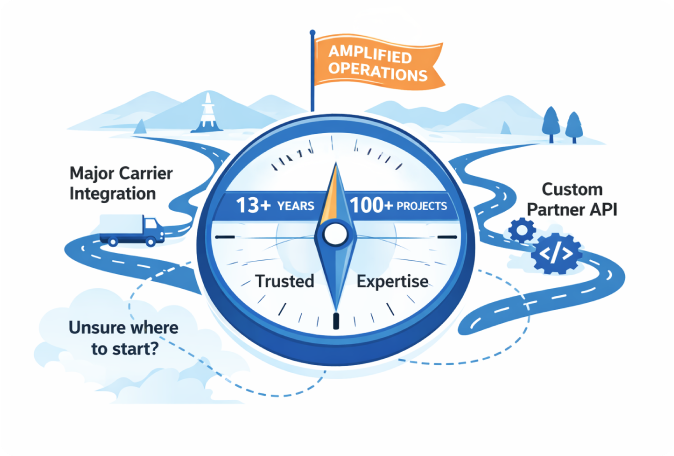
Being integrated with a major logistics carrier or just with a small company you partner with is a good amplifier of your business operations, delivery time, and customer experience. Whether you need to integrate with a big carrier or write a brand-new API for integration with your partner company, you can always count on TwinCore.
Our team has more than 13 years of experience in custom logistics software development, and we have successfully finished more than 100 successful projects. Even if you don't know where to start and what integrations you need, you can still get in touch with us. Our team of experts will answer all your questions and provide you with a detailed roadmap of how we can help you advance your business processes.
Our Integration Process
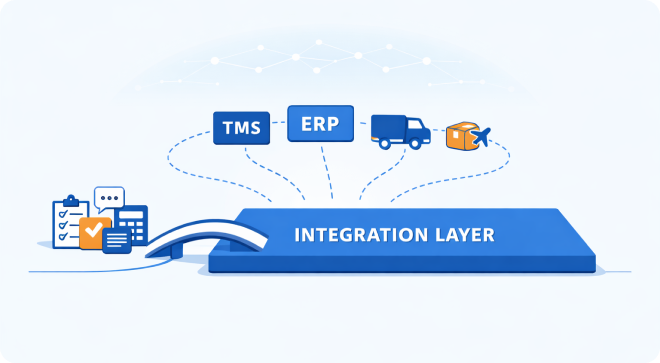
If your teams are still acting as the "middleware" between systems, it's time to replace manual work with a proper integration layer.
TwinCore designs and builds logistics API integrations that connect carriers, platforms, and internal systems into one reliable, real-time network.
Talk to our logistics engineering team to map your current systems and design the integrations you actually need.
Building with .NET is rarely about writing code fast. It's about making decisions that won't block the product six months later. Architecture, ownership, and long-term maintainability matter from the first step. If you need .NET developers who can join your team and work inside real systems with responsibility, TwinCore is ready to help.
Case study of a real-time load board that connects carriers and brokers, adds order tracking, predictive demand analytics, and secure payments for a US logistics firm.
Custom order management system with rate engine, real-time tracking, and cost analytics built for a US logistics company, helping control routes and operational costs.
How a custom freight rate engine with 30+ carrier APIs helped a US logistics company automate LTL/FTL pricing, cut operational time, and centralize control.
How TwinCore delivered a legacy ASP.NET modernization for a land-surveying ERP — migrating to modern .NET and Angular, with Redis caching and no downtime.
How TwinCore built a multi-tenant temperature monitoring platform for cold-chain and pharma compliance — real-time SignalR alerts, audit log, GDP/HACCP-ready reports.

A practical roadmap for modernizing legacy logistics systems with .NET — audit, migration phases, risk...

How to turn supply chain data into decisions: logistics dashboards, KPIs that matter, actionable design,...

How custom software drives digital transformation in logistics — real success stories, common...

How to integrate carriers with your TMS in 2026: EDI for freight, REST API for FedEx, UPS, DHL....

Why .NET remains a strong choice for logistics enterprise systems in 2026 — performance, typed business...

A practical roadmap for building a logistics platform, from a focused MVP to an enterprise-grade system....

A practical guide to logistics API integrations: REST vs EDI, TMS-ERP-WMS connections, carrier APIs,...

What features do freight brokers and 3PLs actually need in software? Multi-client billing, dynamic...

7 practical AI use cases in logistics: predictive ETA, demand forecasting, dynamic routing, freight...

Discover key Logistics & Supply chain trends for 2026, including automation, AI-driven logistics, and...