LinkedIn
 Twitter
 Facebook
 Youtube



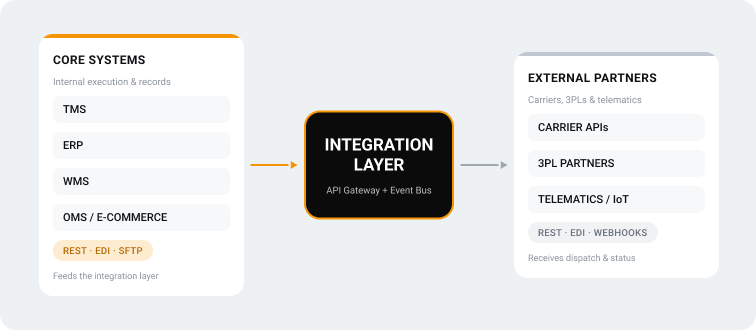
A logistics operation runs on top of a dozen systems that were never built to talk to each other: a TMS for freight, an ERP for finance, a WMS in the warehouse, carrier portals, telematics units, and the customer's order system. Without integration, people move the data by hand. A dispatcher phones a carrier for a status. An AP clerk keys a freight invoice into the ERP. Someone reconciles rates in a spreadsheet.
Logistics API integration removes those manual steps by connecting the systems directly, but the landscape is messy: REST, EDI, and SOAP all coexist, carrier APIs vary in maturity, and a legacy ERP may expose no modern endpoint at all.
This guide covers the main types of logistics API integrations, the protocols behind them, a realistic integration architecture, and the problems that bite teams in production.
Why logistics operations depend on integration depth
The value of any single TMS, WMS, or ERP depends on how deeply it connects to the systems around it. A standalone tool automates its own corner and stops at the boundary.
A TMS with no ERP link is a freight execution system with no financial control. Freight cost never lands in the general ledger on its own, and invoice reconciliation stays manual. A TMS with no carrier tracking is a booking system with no visibility: the dispatcher does not know where a load is without calling the carrier. A WMS with no TMS link is a warehouse system with no shipment coordination, so pickup scheduling and dock management drift apart from transportation.
Integration depth sets the ceiling on how much a team can automate. Connect the systems and the routine steps — posting cost, confirming a pickup, updating a status — run without a person. Leave them disconnected and the operation recreates each of those steps by hand on every shipment. That gap is why two companies running the same TMS can have completely different headcounts in the back office.
The logistics API landscape: REST, EDI, SOAP, and webhooks
Four protocols carry most logistics traffic. Knowing which one a given partner speaks decides how much work an integration takes.
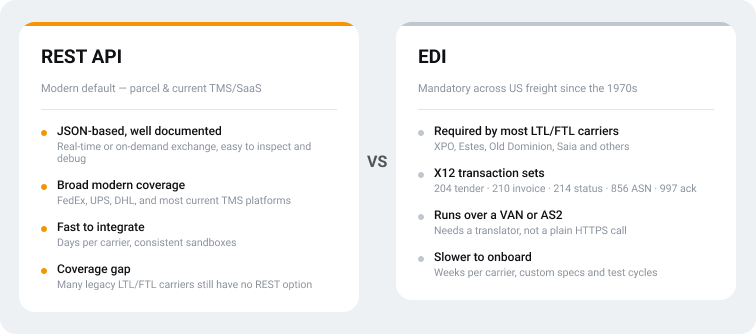
REST APIs are the modern default for new carrier and logistics SaaS connections. They are JSON-based, well documented, and support both real-time and on-demand exchange. FedEx, UPS, DHL, and most current TMS platforms expose REST endpoints. The limit is coverage: many legacy carriers, especially in the US LTL segment, still have no REST option.
EDI (Electronic Data Interchange) is a standard from the 1970s that remains mandatory across US freight. The transaction sets that matter for logistics are EDI 204 (load tender), 210 (freight invoice), 214 (shipment status), 856 (ship notice/manifest), and 997 (functional acknowledgment). Most large US LTL and FTL carriers — XPO, Estes, Old Dominion, Saia — require EDI for operational integration. It runs through an EDI translator or a VAN (Value Added Network), and the X12 standards body governs the formats. EDI is harder to set up than REST, but full US carrier integration is not possible without it.
Shippers now expect 214 status updates every few hours, which makes a reliable EDI logistics integration a baseline, not an extra.
SOAP/XML shows up in older ERPs (SAP, older Oracle releases) and a few carrier APIs. It needs XML parsing and more verbose code. Avoid it on new work, but a legacy ERP may leave no choice.
Webhooks flip the model from pull to push. Instead of polling, the source system fires a notification on a state change: a carrier sends a webhook on pickup, an in-transit scan, or a delivery. For real-time tracking this beats polling on both latency and load. The cost is operational: the receiver needs a public endpoint and event handling that does not drop messages.
Common logistics API capabilities
A logistics API usually exposes some subset of these functions:
- rate shopping
- shipment creation
- label generation
- pickup scheduling
- address validation
- carrier booking and tendering
- tracking
- webhook notifications
- POD and document retrieval
- invoice exchange
- returns
No carrier offers all of them over REST. One carrier gives you rating and labels over a clean API but sends invoices only over EDI. Another supports tracking webhooks but takes tenders by email. A real carrier API integration almost always combines REST, EDI, SFTP, and a manual fallback for the gaps. Planning for one clean protocol per partner is the fastest way to underestimate the work.
Key logistics API integration types
Six integration types cover most of what a logistics platform needs. Each moves a specific set of data and produces a specific operational result.
TMS ↔ ERP integration
This connects freight operations to financial control. The TMS runs execution; the ERP owns accounting, procurement, and inventory.
Data moves both ways. From ERP to TMS: purchase orders, order detail, cost centers, GL accounts, vendor records. From TMS to ERP: freight cost per shipment, carrier invoices, accruals, proof of delivery.
The payoff is in finance. Freight cost posts to the GL with no manual entry, accruals close the period on time, and the TMS rate matches against the ERP's accounts payable automatically. This is where ERP TMS integration earns its keep.
Difficulty is high. ERPs carry complex, often customized data models. SAP wants BAPI or RFC calls, or IDocs through middleware. Oracle E-Business Suite goes database-level or through SOA. Microsoft Dynamics 365 exposes REST, but legacy NAV and AX do not. The sharpest risk is mapping cost centers when the two systems structure the GL differently.
TMS ↔ carrier APIs
This links the TMS to carrier systems for rating, booking, tracking, and invoicing — the core of day-to-day TMS API integration.
From TMS to carrier: rate request, load tender, pickup request, BOL. From carrier to TMS: rate quote, tender acceptance or rejection, tracking events, POD, freight invoice.
The result is fewer portal logins and fewer phone calls. Rate shopping runs across carriers automatically. Tenders go out digitally instead of by email. Tracking updates land in the TMS, and invoices arrive ready for freight audit.
Protocols split by carrier tier. REST for modern carriers and parcel (FedEx, UPS, DHL), where a single freight API covers rating, labels, and tracking. EDI 204/210/214 for US LTL and FTL. For smaller carriers, a proprietary API or, in the worst case, a portal with no API at all. Difficulty runs medium to high, and the work never fully stops — carriers revise API specs and bump EDI versions, and each change needs a mapping update.
TMS ↔ WMS integration
This synchronizes the warehouse with transportation so a shipment hands off cleanly from the dock to the road.
From WMS to TMS: shipment-ready confirmation, actual weight and dimensions, packing list, dock availability. From TMS to WMS: carrier assignment, pickup time, BOL number, tracking number.
The actual weight matters more than it looks. When the WMS sends real weight and dimensions instead of an estimate, the TMS rates the load correctly the first time, and the freight audit later finds nothing to dispute.
Difficulty is medium. Most WMS platforms expose REST or SOAP. The hard part is timing: the WMS confirms a shipment is ready, and the TMS has to assign a carrier and a pickup window inside the same operational window, or the truck and the freight miss each other at the dock.
TMS ↔ OMS / e-commerce integration
This wires the TMS to an order management system or e-commerce platform — Shopify, Magento, or a custom OMS.
From OMS to TMS: order detail, ship-to address, requested delivery window, item weight and dimensions, service level. From TMS to OMS: tracking number, carrier assignment, ETA, delivery confirmation.
A confirmed order creates a shipment in the TMS with no rekeying, the tracking number flows back to the OMS, and the customer gets notified without anyone touching it.
Difficulty is low to medium. Modern OMS and e-commerce platforms ship well-documented REST APIs and webhooks, so this is often the first integration a team gets working. It is also the cleanest place to evaluate API integration logistics software, because the endpoints are stable and the test data is easy to generate.
TMS ↔ 3PL partner integration
This connects a shipper's TMS to a 3PL for outsourced operations, and it is where 3PL API integration gets political as well as technical.
The shipper sends orders and shipment instructions to the 3PL. The 3PL returns confirmations, tracking, POD, and billing.
Done right, the shipper sees outsourced freight without chasing email and portal logins, 3PL invoices reconcile against contracted rates automatically, and reporting consolidates every carrier including the 3PL's.
Protocols depend on the partner. A modern 3PL offers REST or EDI; a smaller one may have only email or FTP file transfer. Difficulty is medium, and it climbs with each added partner, because every 3PL brings its own spec and its own idea of what a "shipment" is.
Telematics and IoT integration with TMS
This brings GPS and telematics data into the TMS or fleet management system. The providers are Samsara, Verizon Connect, Geotab, and the ELD units already in the trucks. A solid telematics integration TMS turns raw GPS into dispatch decisions.
From telematics to TMS: live vehicle and driver location, speed, idle time, hours-of-service (HOS) status, engine diagnostics. From TMS to telematics: dispatch assignments, route plans, delivery instructions.
ETAs recalculate from where the driver actually is. Dispatch reaches the driver through the in-cab device instead of a phone call. HOS compliance ties straight into dispatch planning, which the FMCSA ELD mandate requires carriers to track anyway.
Difficulty is medium. The large providers have good APIs; the friction is mapping vehicle and driver IDs between two systems and handling GPS gaps when a truck loses signal.
Core data objects in logistics integrations
Integration does not start with protocols. It starts with agreeing on the objects that pass between systems, because a clean field mapping is what every protocol ends up carrying.
These are the objects that move most often:
- order
- shipment
- load
- stop
- leg
- carrier
- driver, vehicle, equipment
- rate quote
- tender
- BOL
- POD
- invoice
- accessorials
- tracking event
- exception event
The trap is that the same real-world thing wears a different name in each system. What the OMS calls an order, the TMS may treat as a shipment, the carrier sees as a load, and the 3PL bills as a consignment. One physical movement, four identities. If the integration does not pin down which object maps to which — and how one order can fan out into several loads — the mismatch surfaces later as a reconciliation error nobody can trace.
Mapping these objects is usually the largest single piece of any logistics system integration.
Status mapping and event normalization
Tracking integrations rarely break at the API. They break at the meaning of a status. Every carrier, EDI feed, and webhook describes the same physical events in its own vocabulary, and the receiving system has to reconcile them.
The common events are familiar:
- picked up
- in transit
- arrived at terminal
- delayed
- out for delivery
- delivered
- POD available
- exception
- invoice received
One carrier sends "OFD", another "Out for Delivery", a third an EDI 214 with status code AF. All three mean the same thing. Show raw carrier statuses straight in the TMS and the dispatcher sees three different labels for one event, plus codes that mean nothing to a human.
A status mapping table fixes this. It translates each source-specific code into one normalized status the platform uses everywhere. Keep both values: the normalized status drives the UI and the logic, and the original source status stays on record for audit and for the carrier dispute that comes six weeks later.
Events also arrive dirty. The same scan can come in twice, a delivery can land before its in-transit update, and a webhook can fire late. Each event needs a timestamp, a source system, an event type, and a correlation ID so the platform can dedupe duplicates, reorder out-of-sequence events, and ignore a stale update that would otherwise overwrite a newer one.
A normalized event is small and predictable:
{
  "correlation_id": "SHP-100482",
  "source_system": "carrier:estes",
  "event_type": "in_transit",
  "source_status_code": "AF",
  "occurred_at": "2026-06-24T14:02:00Z",
  "received_at": "2026-06-24T14:07:31Z",
  "location": "Columbus, OH"
}
Those normalized events feed everything downstream: ETA calculation, exception alerts, the control tower dashboard, and customer notifications. Get the mapping wrong and every one of those surfaces inherits the error.
Integration architecture approaches
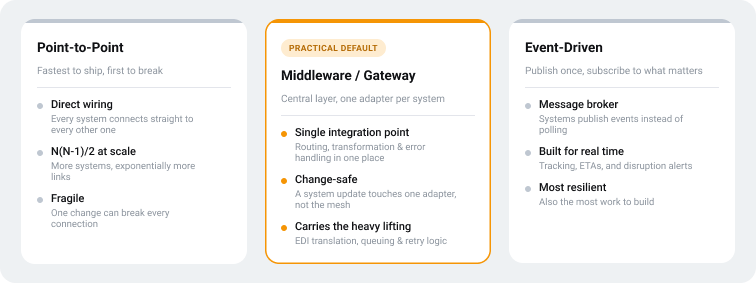
Three architectures dominate, and the right one depends mostly on how many systems you connect.
Point-to-point
Every system wires directly to every other one. It is the fastest way to ship two or three integrations. It stops scaling fast: N systems need N×(N-1)/2 connections, and a change in one system can break every link that touches it. Past four systems, point-to-point becomes the thing teams pay to unwind.
Integration middleware / API gateway
A central layer sits between the systems. A gateway or integration platform — MuleSoft, Azure Integration Services, or custom middleware — handles routing, transformation, and error handling. A change in one system touches one adapter instead of every connection. The layer also carries EDI translation, message queuing, and retry logic. This is the practical default for enterprise logistics.
Event-driven architecture
Systems publish events — shipment created, status updated, invoice received — to a message broker such as Azure Service Bus, AWS SQS, or RabbitMQ. Other systems subscribe to what they care about. This suits real-time work where latency matters: tracking, ETA recalculation, disruption alerts. It is more work to build and the most resilient once it runs.
Most production platforms end up hybrid: an event bus forreal-time status and tracking, a gateway with an EDI translator for carrier and ERPtraffic, and a queue absorbing the spikes between them. The architecture follows thetraffic, not the other way around.
Reliability patterns for production logistics APIs
A logistics platform cannot stop because a carrier API returned a 503. These patterns keep it running through the failures that production guarantees:
- Idempotency keys on shipment creation, booking, and tendering, so a retried request does not book the same load twice.
- Retry with exponential backoff for transient failures, instead of hammering a struggling endpoint.
- Circuit breaker to stop calling an endpoint that is clearly down and let it recover.
- Dead-letter queue for messages that fail every retry, so nothing vanishes silently.
- Webhook deduplication, because carriers resend the same event and at-least-once delivery is the norm.
- Event replay to rebuild downstream state after an outage from the recorded event stream.
- Correlation IDs threaded through every hop, so one shipment is traceable across systems.
- Audit logs of every inbound and outbound message for disputes and debugging.
- Operational alerts when an integration falls behind or an error rate climbs.
- Fallback workflows for when a carrier API is down — queue the non-urgent calls, and give the operator a manual path for the urgent ones.
The pattern set is not optional at scale. Skip idempotency and a retry storm double-books loads; skip a dead-letter queue and a malformed message disappears with the shipment it described.
Common integration challenges in logistics
The honest version of this work includes the parts that go wrong. Naming them up front is more useful than promising a clean connection.
Data format inconsistencies. Every system carries its own model. Weight in pounds here, kilograms there. Address formats that do not line up. A shipment ID that is a SKU in one place and a reference number in another. Mapping and normalizing this is often the largest share of the effort, not a preliminary step before the real work.
EDI complexity and maintenance. Setting up an EDI trading partner takes time and paperwork. Carriers revise specs and add transaction sets, and each change forces a mapping update. EDI errors need their own monitoring and alerting, separate from the REST side.
Legacy ERP without modern APIs. Older SAP and Oracle releases expose no REST endpoint. Integration runs through BAPI, IDocs, a database layer, or a middleware adapter — every one of them heavier than a plain REST call, and every one needing someone who knows that specific system.
Rate limiting and API availability. Carrier APIs enforce rate limits and take maintenance windows. The operation cannot pause for either. This is exactly what the reliability patterns above exist to absorb.
Testing against live carrier systems. Carrier sandboxes are often incomplete or drift from production, and some EDI carriers have no test environment at all. You end up validating against a target you cannot fully see until go-live.
How TwinCore builds logistics API integrations
TwinCore builds logistics API integrations as part of custom TMS, fleet management, and supply chain visibility projects. The work is in the logistics practice, and integration is treated as a standing capability, not a one-off task.
The team has delivered EDI integrations with US LTL and FTL carriers (204/210/214), REST integrations with FedEx, UPS, DHL, and modern freight platforms, and ERP integrations with SAP, Microsoft Dynamics, and NetSuite for freight cost allocation and invoice posting. It has built WMS integrations for shipment and dock coordination, telematics integrations with Samsara and Geotab for live fleet visibility, and 3PL partner integrations for multi-operator networks.
The architecture is an event-driven integration layer over the TwinCore Logistics Framework, with an API gateway and EDI translation and message queuing underneath for resilient real-time operations.
Conclusion
Logistics API integration is an ongoing engineering capability, not a project that closes. Every new carrier, every ERP upgrade, and every new 3PL adds scope. A team that builds the right architecture early — a gateway, an event bus, and an EDI translation layer — adds the next partner with an adapter.
A team that wired everything point to point refactors the whole mesh on every growth step. The architecture choice you make at three systems is the one you live with at fifteen.
Need to build or improve your logistics integration layer? Talk to TwinCore.