










AI Agent Development Services

TwinCore’s custom AI agent development services design, build, and deploy production AI agents that connect to your CRM, ERP, TMS, and legacy systems. They read company data, update records, and complete multi-step workflows inside the tools your team already uses.

  • TwinCore has elevated the client's customers to the next level of supply chain management. The team is highly cost-efficient from a project management standpoint, and internal stakeholders are particularly impressed with the service provider's team dynamic.

    Alex Lopatkin

    Alex Lopatkin

    Amous

  • Bonusme
  • Amous
  • Cross
  • Ntree
  • Catalyst
  • Baddi
  • Friction
  • Sensilla
  • Schwim

2011

building software since

30+

engineering professionals

100+

modernized projects

Our AI Agent Development Services

We create AI agents as real software your team can run, modify, and own. Our AI agents development services start with one workflow, prove the value, and grow from there into a managed multi-agent platform.

Custom AI Agent Development

We develop AI agents around a single repeatable job: triaging support tickets, reconciling invoices, enriching leads, or extracting data from documents. It follows an explicit execution graph: plan the task, call a tool, check the result, decide what to do next, then retry or finish.

Multi-Agent System Development

AI Agent Integration Services (CRM/ERP/legacy)

RAG-Powered Agent Development

AI Agent Consulting & Architecture

Agent Modernization & Managed Support

Best First Workflows for an AI Agent

The best first workflows usually share a few traits. Start where the work looks like this:

If most of these are true, the workflow is a strong candidate for your first agent, and we’ll tell you whether it should become an agent, a script, or a dashboard.

Send workflow

1/5

  • Repetitive and high-volume

    A task your team runs dozens of times a day, not once a quarter.

  • Clear input, clear output

    You can state what goes in and what a correct result looks like.

  • Measurable time savings

    The hours an agent removes show up in a task log, so ROI is tracked, not guessed.

  • API-accessible systems

    The tools involved expose an API or a documented interface the agent can call.

  • Human approval is possible

    For high-risk actions, someone can approve the change before it goes through.

failure patterns

Why Most Corporate AI Projects Fail

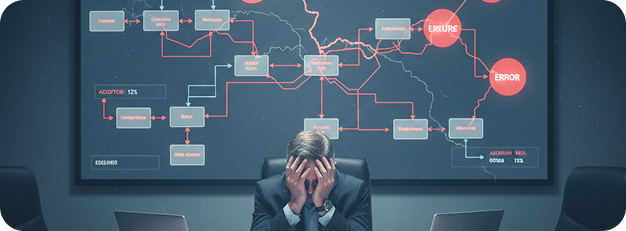
Team reviewing an AI agent project on a screen

Buying an AI license is easy. Getting useful AI into daily production is the hard part. MIT's NANDA report "The GenAI Divide: State of AI in Business 2025" found that 95% of enterprise generative-AI pilots delivered little to no measurable P&L impact (MIT NANDA via Fortune, 2025). The wider picture is the same:

  • Gartner predicts over 40% of agentic AI projects will be canceled by the end of 2027 (Gartner, 2025).
  • McKinsey's State of AI 2025 finds 88% of organizations use AI and 62% are at least experimenting with agents, but only 23% have scaled one (McKinsey, 2025).
  • In the same MIT study, builds with an external vendor or partner succeeded about 67% of the time; internal-only builds succeeded roughly a third as often (MIT NANDA via Fortune, 2025).
Team reviewing an AI agent project on a screen

Three failure patterns explain most of the gap:

  • Passive tools can’t take real action A chatbot gives an answer and stops. A person still has to open the CRM, enter the update, and move the ticket. An agent closes the loop: it calls the API, writes the record, and moves the task itself, with human approval for high-risk changes.

  • When no-code flows are not enough Zapier, Make, and Copilot Studio ship a first flow in an afternoon, but often stall when a workflow has to branch on partial results, retry with a different strategy, or work with a legacy API. We use no-code where it fits and custom code where the workflow needs deeper logic, integrations, and auditability.

  • PII safety and compliance are non-negotiable An agent with database access needs strict permissions, logging, and approval rules. For regulated flows, we build in input and output checks, tight permissions, action logs, and human approval for sensitive writes, planned from the start, not added later as a compliance patch.

See It Live: Our Custom AI Agent Platform

We can walk you through a production platform running for a live client, screen by screen.

A real platform, running in production for a US client.

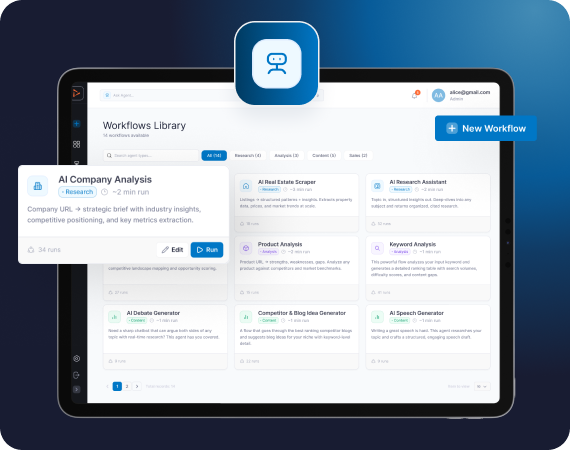
TwinCore built an AI research and workflow-automation platform for a US B2B client. Business users create agents, launch workflows, and monitor runs that research companies, extract data, track competitors, and generate content. It runs 14 reusable agent types across 6 workflow categories. The client's company-research cycle dropped from 10–15 working days to 2–3 days per batch. By month 6, four researchers were saving a median of 5.5 hours per week based on weekly task-log audits.

Production Architecture: How We Build AI Agents

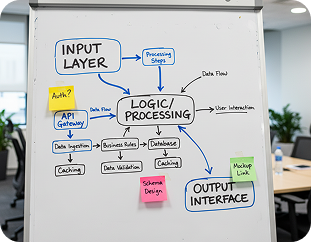
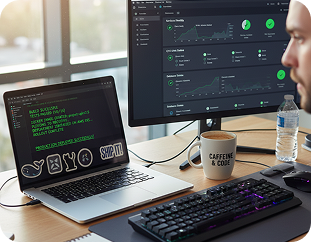
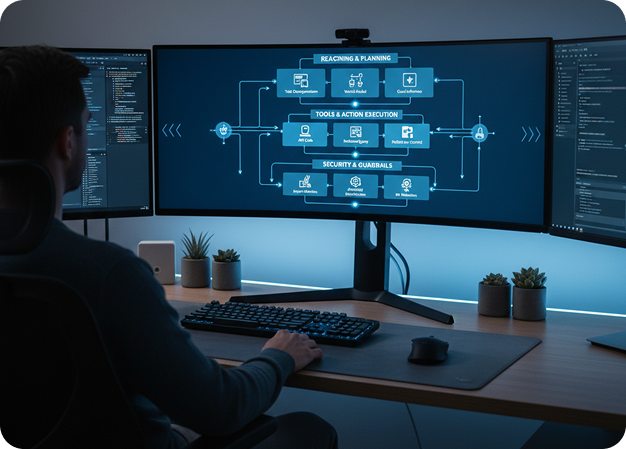
Engineer reviewing an AI agent's architecture on a laptop

1/4

  • 1

    Reasoning layer

    Plans the task and picks the model per step. A stronger model handles planning and complex decisions; a faster, cheaper model handles summarizing and formatting. The routing stays model-agnostic, so switching between GPT, Claude, or a local model is a configuration change, not a rewrite.

  • 2

    The action layer (tools)

    Where the agent touches your systems. System updates are designed to be safe to retry, so the agent does not create duplicate orders, charges, or records. High-impact actions pass through a human-in-the-loop approval gate before they commit.

  • 3

    Guardrails and security layer

    Validates what goes in and out. Inputs and outputs are scanned, tokens are scoped through OAuth to the narrowest permission, and every tool call is logged for audit.

  • 4

    What field-level confidence scoring fixed

    Early in production, some company records still had one wrong field even when the overall answer looked confident. We changed confidence scoring from record-level to field-level. After the fix shipped in week 12, every extracted value received its own score, and low-confidence fields were routed to review before reaching the CRM.

Types of AI Agents We Build

We build several types of agents and choose the right shape for each workflow.

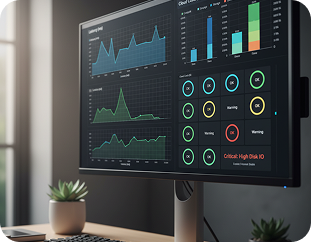
Engineers reviewing AI agent dashboards on multiple monitors

1/5

  • RAG agents

    ground answers in your own documents, so support, policy lookup, and contract Q&A cite the source instead of the model's memory.

  • Transactional and workflow agents

    execute steps inside your systems: creating a shipment, posting a journal entry, or updating a case, with each write logged and safe to retry.

  • Reasoning & planning agents

    break a goal into steps, act, observe the result, and adjust (the ReAct pattern), for tasks with no fixed script.

  • Multi-agent swarms

    split a task across specialist agents under a supervisor that routes work between them.

  • Coding & data-analysis agents

    read a codebase or dataset, run queries, and return structured results, PR reviews, or reports.

Technology Options We Support

We build with tools your team already uses and can maintain after handover:

1/4

  • Build AI agents in C# / .NET

    For teams standardized on Microsoft, we build agents in .NET with Semantic Kernel. The agent runs alongside your existing C# services and shares the same auth, logging, and deployment model.

  • Build AI agents in Python

    For complex branching logic and research-heavy workflows, we use Python with LangGraph, which defines an agent as an explicit graph of nodes and edges. Every branch, retry, and decision is visible in the run log.

  • Build AI agents with Microsoft Agent Framework

    For fast rollout inside Teams and Microsoft 365, Copilot Studio can put a working agent in front of users quickly. When the logic outgrows the canvas, we move the complex parts into custom code.

  • Build AI agents with Claude / the Claude Agent SDK

    For long-document reasoning and multi-step tool workflows, we can build on Anthropic’s Claude when its context window and reasoning quality fit the task.

AI Agent vs Chatbot

A chatbot and an AI agent differ in what happens after the model replies.

A chatbot tells your rep how to issue a refund. An agent can issue the refund, log it, and update the case.

Criterion Chatbot AI agent
Logic Follows a script or a single prompt Reasons and plans across multiple steps
Data & tools Text in, text out Calls APIs, tools, and your data
Action Answers the question Takes the action, then reports it
Conversation Linear; needs a new prompt each turn Executes a whole task on one instruction
Collaboration Single-turn, on its own Coordinates with other agents

What You Actually Get

Fewer manual handoffs

Manual handoffs between systems are reduced or removed. Instead of copying values between screens, people review exceptions while the agent reads, decides, and writes under controlled rules.

Faster triage

Standardized processes

Measurable ROI

Features of Our AI Agents

  • Router architecture

    Sends each step to the right model by cost and difficulty.

  • Stateful memory

    Keeps context across steps and sessions instead of starting from scratch each time.

  • RAG integration

    Grounds answers in your documents with a vector store and retrieval rules.

  • Model Context Protocol (MCP)

    Can expose tools and data to the agent through a shared standard.

  • Deterministic function calling

    Maps agent decisions to typed, schema-checked API calls.

  • Legacy integration

    Connects agents to modern REST and to old .NET, SOAP, and file-based systems alike.

  • Human-in-the-loop gates

    Holds high-impact writes for approval before they commit.

  • OpenTelemetry traceability

    Records each step, tool call, prompt, and token, so failed runs can be investigated and replayed.

AI Agents Tailored
for Different Industries

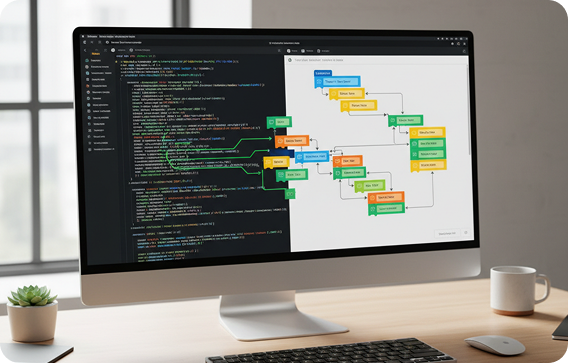
Two engineers reviewing an industry-specific AI agent workflow

We build agents around the real workflow, not a generic assistant renamed for each industry.

Two engineers reviewing an industry-specific AI agent workflow

1/4

  • Logistics & Supply Chain

    Agents can automate load tendering, reconcile bills of lading against orders, and translate EDI messages between partners using different formats.

  • Healthcare

    For healthcare workflows, we design agents with PII handling, permission limits, audit logs, and human approval steps. For example, an intake agent can read a patient referral, extract diagnosis codes and insurance details, check eligibility against a payer API, and route uncertain cases to a coordinator.

  • IoT

    A monitoring agent can watch device telemetry, detect abnormal patterns, and open a maintenance ticket before the issue becomes downtime.

  • Software Development

    A QA agent runs tests, summarizes failures, checks the diff against your style guide, and posts review comments.

Case Studies

  • United Kingdom

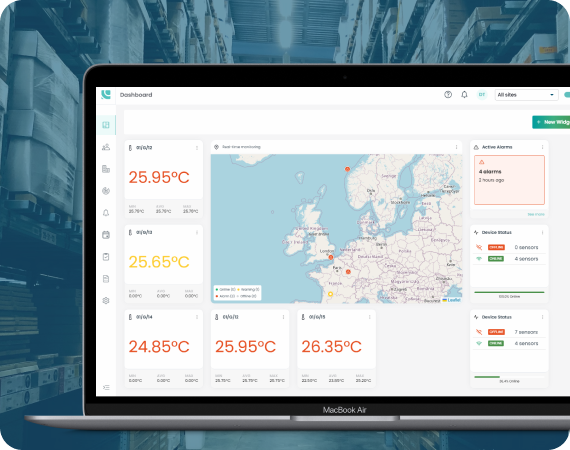
    Real-time temperature monitoring platform for cold-chain compliance

    How TwinCore built a multi-tenant temperature monitoring platform for cold-chain and pharma compliance — real-time SignalR alerts, audit log, GDP/HACCP-ready reports.

    40% improvement in operational data visibility
    55% faster retrieval of necessary project records
  • USA

    Mental Health Clinic Software Case Study | TwinCore

    Our team successfully supported and enhanced a custom software solution for a US-based mental health clinic, focusing on improving operational efficiency, treatment tracking, and reporting capabilities. Designed for healthcare professionals, the platform streamlines the management of Electronic Health Records (EHR) and Electronic Medical Records (EMR) while adhering to strict HIPAA regulations.

    45% faster data loading and processing
    60% faster team collaboration and coordination
  • United Kindom

    Accounts Payable Automation Platform Case Study | TwinCore

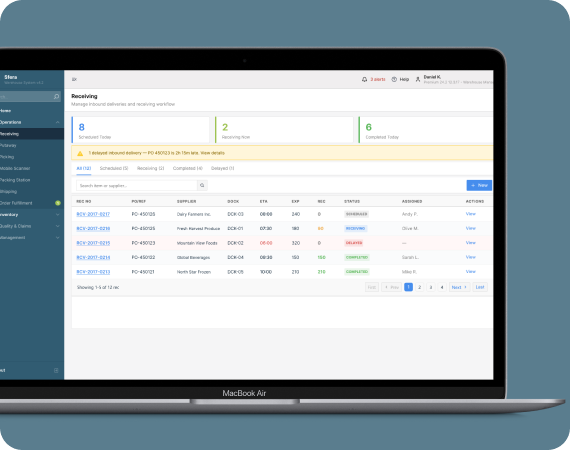
    The goal of this project was to design and implement a scalable, secure, and extensible backend system for automating the accounts payable (AP) lifecycle - from purchase requisition and approval workflows to invoice processing, supplier management, and payment scheduling.

    50% less time spent on routine manual tasks
    55% faster retrieval of necessary project records

What We Deliver

Source Code

The full codebase, ready for your team to run, change, and redeploy.

Pricing plan

AI Agent Development Cost

Custom AI agent development usually falls into one of three ranges. Final pricing depends on the workflow, integrations, autonomy level, and compliance requirements. After discovery, we can lock the scope and fixed price.

2–8 weeks

~$4K–$20K

Proof of concept / single-task agent

Enough to prove the workflow works on your data before you invest in a larger build.

Talk to us
What's Included:
8–16 weeks

~$25K–$50K

Production multi-tool agent

This is the range where most production business cases land.

Talk to us
What's Included:
Popular
4–6 months

$50K+

Enterprise multi-agent platform

A platform with coordinating agents, role-based access, monitoring.

Talk to us
What's Included:
Book a call

Hybrid Approaches: Code Meets No-Code

No-code tools and custom code

No-code tools and custom code are useful for different parts of the workflow.

No-code orchestrators such as n8n, Make, Zapier, Pipedream, and Relay.app can handle triggers, routing, and approvals quickly. We use custom code for the parts that no-code tools cannot handle reliably: branching on partial results, retrying with a new strategy, or reading a legacy API. The result is a workflow business users can follow and engineers can safely maintain.

AI Agent Deployment Options

Where the agent runs is a data and governance decision, not a default

Cloud (managed)

Usually the fastest to ship and the simplest to operate, with the vendor handling scaling and uptime. Fits teams without strict data-residency rules.

Self-hosted (on-prem or private cloud)

Hybrid

Rule of thumb choose cloud for speed, self-hosted for control, and hybrid when sensitive data must stay inside your network

Why Us

Software engineers, not prompt-only consultants

We are software engineers, so integrations, retries, permissions, and deployment are handled like production software.

Stack neutrality

No proprietary platform lock-in. We build on your stack (C#, Python, Claude, or Microsoft) and hand over the full codebase.

Legacy integration experience

We connect agents to modern REST APIs and to old .NET, SOAP, and file-based systems. Old APIs, incomplete documentation, and legacy .NET systems are familiar territory for us.

Evaluation rigor

Every agent ships with evaluation tests and observability, so you can prove it works and catch regressions before users do.

Comparison Table

Criterion SaaS agent builders Big consulting TwinCore
Connectivity to legacy systems Limited Varies Deep, including old .NET and SOAP
Logic & reasoning Templated flows Strategy depends on team Custom graph logic, evaluation tests, and code-level control
IP ownership Vendor-locked Often shared You own the codebase
Deployment Cloud only Flexible but slower to customize Cloud, self-hosted, or isolated on-prem
Cost model Per-seat / per-run High fixed fee Fixed scope after discovery
Live reference platform Rare Sometimes Yes — production AI agent platform available to show

AI Agent Delivery Process

A typical engagement moves through five phases, with real checkpoints from our AI agent platform build included below.

1/5

  • 1

    Discovery

    1–2 weeks

    We map the workflow, systems, risks, and autonomy level, then agree on scope and cost range.

  • 2

    Architecture & PoC

    2–4 weeks

    A working proof of concept. On the agent platform build, a single-agent PoC ran internally by week 4.

  • 3

    MVP Build

    4–6 weeks

    The core agent in production against real data. On that project, the core platform reached production use by week 12.

  • 4

    Pilot & Tuning

    Ongoing

    Run with real users, review live results, and tune prompts, evaluations, and guardrails.

  • 5

    Scale & Handover

    Continuous

    Add agents and workflows, then hand over the codebase with documentation, or keep it under managed support.

Ready to Build AI Agent?

Send us one workflow and we’ll tell you whether it should become an agent, a script, or a dashboard.

Our Projects

  • United Kingdom

    Real-time temperature monitoring platform for cold-chain compliance

    How TwinCore built a multi-tenant temperature monitoring platform for cold-chain and pharma compliance — real-time SignalR alerts, audit log, GDP/HACCP-ready reports.

    40% improvement in operational data visibility
    55% faster retrieval of necessary project records
  • USA

    Mental Health Clinic Software Case Study | TwinCore

    Our team successfully supported and enhanced a custom software solution for a US-based mental health clinic, focusing on improving operational efficiency, treatment tracking, and reporting capabilities. Designed for healthcare professionals, the platform streamlines the management of Electronic Health Records (EHR) and Electronic Medical Records (EMR) while adhering to strict HIPAA regulations.

    45% faster data loading and processing
    60% faster team collaboration and coordination
  • United Kindom

    Accounts Payable Automation Platform Case Study | TwinCore

    The goal of this project was to design and implement a scalable, secure, and extensible backend system for automating the accounts payable (AP) lifecycle - from purchase requisition and approval workflows to invoice processing, supplier management, and payment scheduling.

    50% less time spent on routine manual tasks
    55% faster retrieval of necessary project records

Latest Insights

Frequently Asked Questions