




Delivery Model
Delivery Model & Timeline
Predictable stages, measurable outcomes.
 Get in touch
TwinCore builds custom transportation management systems (TMS) designed around your freight flows, carrier network, contract logic, and operational structure. Off-the-shelf TMS products force rigid workflows, generic rate logic, and limited integration options that don’t match how your operation actually runs. A custom TMS aligns planning, execution, billing, and carrier connectivity with your business logic, eliminates manual workarounds, and gives you consistent, automated control over transport operations.

TwinCore has elevated the client's customers to the next level of supply chain management. The team is highly cost-efficient from a project management standpoint, and internal stakeholders are particularly impressed with the service provider's team dynamic.












Growing freight operations rarely fail because of volume. They fail because systems stop reflecting how the business actually works. A custom TMS becomes relevant when your operation starts bending software instead of the other way around.
If every customer has different rate logic, accessorial rules, approval flows, and carrier agreements, generic systems turn into spreadsheets with a UI. A custom TMS models your actual contract structure and keeps quoting, dispatch, and billing aligned.
Off-the-shelf platforms assume your workflows are average. Growing freight networks rarely are. TwinCore builds custom TMS software aligned with your contracts, carriers, fleet structure, and pricing logic — so the system reflects how you actually operate.
1 /8

Core order and dispatch management logic is engineered as part of your custom TMS development — including shipment creation, load consolidation, carrier assignment, automated tendering, contract-based rating, and exception workflows tailored to your freight operations.

We build route planning and optimization functionality directly into your transportation management system, supporting multi-stop routing, time windows, driver constraints, cost-per-mile calculations, and real-time operational adjustments.

Custom TMS software includes a structured rate engine that supports contract rates, fuel surcharges, accessorial charges, lane-based pricing, and carrier-specific agreements — eliminating spreadsheet-based pricing logic.

Your transportation management system integrates with carrier APIs, EDI providers, GPS, ELD, and IoT devices to deliver real-time shipment tracking, ETA prediction, geofencing events, and automated exception alerts.

Custom TMS development includes automated freight invoicing, contract validation, billing reconciliation, dispute management, and audit trails designed to reduce revenue leakage and manual financial processes.

We implement operational dashboards and logistics analytics inside your TMS software to track OTIF performance, carrier KPIs, cost-per-mile, dwell time, margin by lane, and shipment profitability in real time.
1 /8

We build TMS platforms using .NET when our clients need an enterprise-grade transportation management system that integrates naturally with Microsoft environments and scales predictably. This stack works particularly well for high-throughput APIs, contract rating engines, billing logic, and secure data layers. It is also the right choice for organizations that rely on Azure, SQL Server, Microsoft Dynamics, or Active Directory for identity and access control.
For logistics companies operating long-lived, mission-critical systems, .NET provides the reliability, maintainability, auditability, and compliance capabilities required to support complex transportation operations at scale.
We build TMS interfaces using Blazor when our clients want a unified C# stack and a consistent enterprise UI without splitting domain logic across separate front-end and back-end codebases. This approach works especially well for dispatcher consoles, operations dashboards, admin portals, and forms-heavy workflows where role-based access control, security, and long-term maintainability are critical.
Blazor is often the right choice for organizations already building on .NET that want faster delivery, fewer moving parts in the architecture, and a more maintainable engineering stack over the lifetime of the system.


We build TMS front ends using React when our clients need highly interactive interfaces and real-time visibility across transportation operations. React works especially well for live fleet maps, exception management workflows, dispatcher dashboards, and control panels powered by REST or GraphQL APIs with WebSockets for streaming updates.
This stack is often chosen for TMS platforms where usability drives adoption and the interface must remain fast and responsive while dispatchers, planners, and operations teams manage constantly changing logistics conditions.
We build TMS front ends using Angular when our clients need a structured, enterprise-grade interface with strong architectural consistency. Angular works particularly well in regulated logistics environments, complex role-based access control scenarios, and large multi-team programs where governance, strong typing, and predictable state management help reduce operational and engineering risk.
This stack is commonly used for dispatcher applications and internal transportation systems that must remain stable, maintainable, and predictable over many years of operation.


We build TMS systems using Node.js for event-driven services that power real-time shipment tracking, telematics ingestion, geofencing events, and notification workflows. Node.js works especially well for lightweight microservices handling streaming updates, high-frequency carrier status events, and IoT integrations where low latency and high throughput are critical.
In modern transportation management systems, Node.js often powers the real-time data layer that complements core dispatch, rating, and billing services.
A custom transportation management system is only as strong as the ecosystem it connects to. We engineer end-to-end TMS integrations and structured data flows that eliminate manual handoffs, prevent data mismatches, and ensure every operational decision is based on consistent, real-time information.
1 /6
Many logistics operations run across multiple countries, but decisions are still made locally: by law, by language, by infrastructure, and by customer expectation. Your TMS needs to respect that.
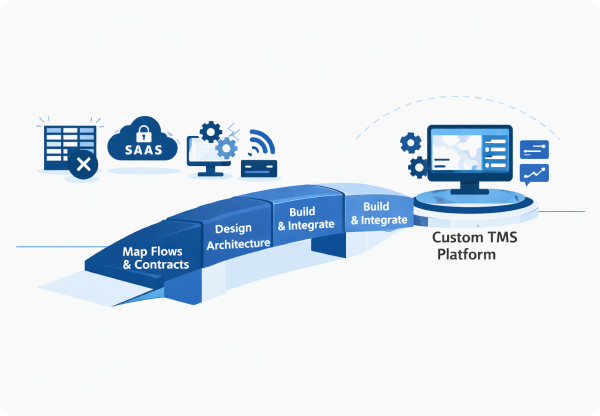
Predictable stages, measurable outcomes.

Process mapping, integration inventory, success metrics (cycle time, exception rate, billing accuracy).

Critical paths only: dispatch, rating, tracking, or billing. Production-ready slice with CI/CD and monitoring.
Additional modules, TMS integration with ERP/WMS, user roles, data migration plan, training.
Performance tuning, advanced analytics, new carrier/EDI endpoints, change management. SLA-backed support.
Process mapping, integration inventory, success metrics (cycle time, exception rate, billing accuracy).
Transportation systems fail in predictable places: rates that don't reflect real contracts, routing logic that can't adapt to exceptions, integrations that break under real traffic, and workflows that look good in demos but collapse in production.
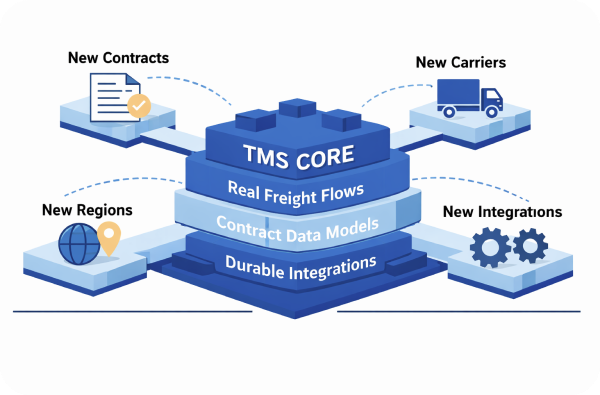
The focus here is not on shipping generic features, but on building systems that match how logistics businesses actually operate. That means designing data models around real-world contracts, structuring routing logic to handle edge cases, and treating integrations as core infrastructure rather than side functionality.
The architecture is built to handle change. New carriers, new pricing rules, new regions, and new operational constraints don't require rebuilding the platform from scratch. They extend what already exists.
The difference is not in promises. It's in understanding where TMS platforms usually break when real scale appears, and designing around those failure points from day one.
If your current tools are limiting your logistics operation – whether through missing functionality, poor integrations, or architecture that can't grow with you – we can help you design and build a TMS that actually reflects how your business runs. Share what your network looks like today and what needs to change. We'll propose an architecture and a delivery path that gets you there with less risk and more control.
Case study of a real-time load board that connects carriers and brokers, adds order tracking, predictive demand analytics, and secure payments for a US logistics firm.
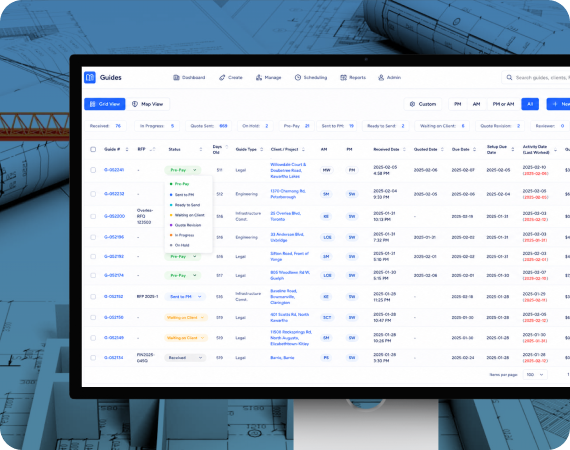
Custom order management system with rate engine, real-time tracking, and cost analytics built for a US logistics company, helping control routes and operational costs.
How a custom freight rate engine with 30+ carrier APIs helped a US logistics company automate LTL/FTL pricing, cut operational time, and centralize control.
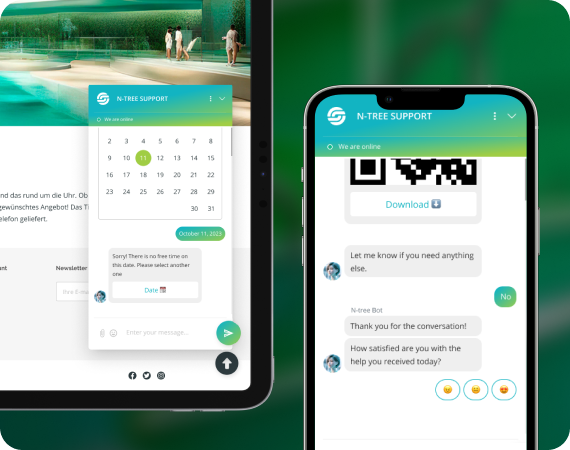
TwinCore built a nopCommerce AI sales chatbot with conversational product search, store-aware answers, in-chat booking, and QR tickets for services.
How TwinCore delivered a legacy ASP.NET modernization for a land-surveying ERP — migrating to modern .NET and Angular, with Redis caching and no downtime.

A practical roadmap for modernizing legacy logistics systems with .NET — audit, migration phases, risk...

How to turn supply chain data into decisions: logistics dashboards, KPIs that matter, actionable design,...

How custom software drives digital transformation in logistics — real success stories, common...

How to integrate carriers with your TMS in 2026: EDI for freight, REST API for FedEx, UPS, DHL....

Why .NET remains a strong choice for logistics enterprise systems in 2026 — performance, typed business...

A practical roadmap for building a logistics platform, from a focused MVP to an enterprise-grade system....

A practical guide to logistics API integrations: REST vs EDI, TMS-ERP-WMS connections, carrier APIs,...

What features do freight brokers and 3PLs actually need in software? Multi-client billing, dynamic...

7 practical AI use cases in logistics: predictive ETA, demand forecasting, dynamic routing, freight...

Discover key Logistics & Supply chain trends for 2026, including automation, AI-driven logistics, and...