LinkedIn
 Twitter
 Facebook
 Youtube



Freight brokers and 3PLs run a different operation than a shipper: several clients with different rate structures, a carrier network that can run into the thousands, dynamic pricing on every load, and constant margin pressure on each shipment. The market keeps raising the stakes — the global 3PL market sat around USD 1.26 trillion in 2025 and is projected to reach USD 2.5 trillion by 2033 — so more volume runs through the same manual workarounds. This article covers the features that decide operational efficiency, the architecture underneath them, where SaaS stops being enough, and what it takes to build 3PL software around the workflows generic tools miss. When you decide to build, you start with the workflows you can no longer afford to run by hand.
What makes 3PL and freight brokerage software different from a generic TMS
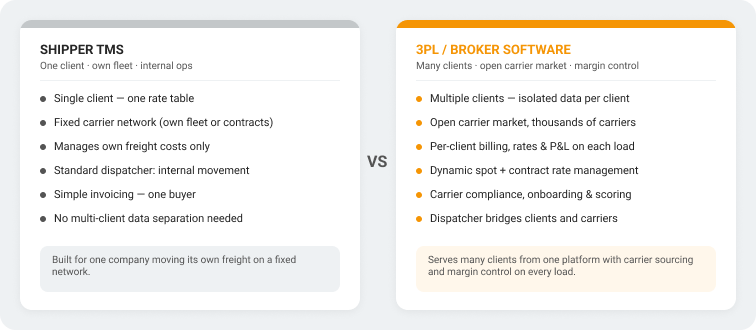
A generic TMS serves one shipper moving its own freight. 3PL and freight brokerage software runs many clients at once: separate rate tables and SLAs, carrier selection across the spot and contract market, per-client billing and P&L, customer-facing visibility, and relationships with hundreds of active carriers.
The split sits in the dispatcher's role. In a shipper TMS the dispatcher moves the company's own shipments; in a freight broker TMS the dispatcher sits between client and carrier, so the freight broker software serves both sides in one workflow. That two-sided requirement separates 3PL management software from a single-shipper TMS, and it is where 3PL software development starts. For how a TMS routes, rates, and tenders loads underneath, see what a TMS is and how it works.
This is also where freight-broker scope diverges from warehouse software. A 3PL that runs physical warehouses needs custom WMS software for receiving, putaway, and picking, which is a separate problem from the freight and carrier management this article covers. Brokers without warehouses need none of it.
TwinCore builds on the broker side of that line. The team has delivered logistics and freight platforms — rate engines, carrier-broker workspaces, billing, and visibility portals — as part of 100+ projects since 2011, so the feature set below maps to workflows the team has shipped, not a generic checklist.
Core features 3PL and freight brokerage software must have
The nine freight brokerage software features below are the ones a shipper TMS handles badly or not at all, each showed through what breaks in the operation without it.
Multi-client management and data separation
A 3PL serves several clients from one environment, so the software isolates each client's data inside one shared workflow. A client sees only its own shipments and reports; the dispatcher sees every client with a filter; billing, reporting, and KPIs calculate separately per client. Without a native multi-client architecture, you fall back to manual partitioning or a separate instance per client, which erases the reason you wanted one platform.
For CTOs: decide the tenancy model (shared schema with row-level security vs schema-per-client) before the first query, and enforce isolation at the data layer, not in each query.
Dynamic rate management and spot quoting
Brokers and 3PLs working a broad carrier market balance contract rates against the spot market on every load. Contract rates lock in for months; spot rates are negotiated per shipment, all-in, and move far more than contract rates, which is why the same lane can price three ways in a week. Multi-client logistics software has to hold contract rate tables in several structures: per mile, per hundredweight, flat rate, and accessorial schedules. The same engine runs a spot quote workflow that broadcasts to several carriers at once, compares it against the contract rate, and shows margin on each quote before anyone commits. Run rate management in spreadsheets and it lives in a few brokers' heads, which is an operational risk the day one of them leaves.
For CTOs: keep rate and accessorial logic in a configurable rate base, not code, and snapshot the margin at quote time so a later rate change never rewrites a closed quote.
Carrier onboarding and compliance management
A freight broker can work with thousands of carriers, and onboarding each one means checking the MC number, insurance certificates, safety rating, W-9, and a signed carrier agreement. Done by hand, that takes days and leaves a compliance gap. The software should automate it:
- A carrier portal for self-service onboarding and document upload
- Automatic FMCSA status and insurance-expiry checks, with alerts before anything lapses
- Blacklist and preferred-carrier lists
- Carrier performance scoring from historical data
Compliance also keeps moving, so the automation has to move with it. The FMCSA Broker and Freight Forwarder Financial Responsibility Rule is effective January 16, 2026, changing how financial security and trust accounts are validated. Software that tracks those requirements automatically lets a broker grow the carrier network without growing compliance headcount at the same rate.
For CTOs: make compliance a scheduled re-check with expiry-driven jobs, not a one-time onboarding gate. A carrier valid in March can lapse by June.
Load board integration and carrier sourcing
Brokers use load boards such as DAT, Truckstop, and 123Loadboard to find spot capacity. Without integration, they post the same load manually, switch between browser tabs, copy carrier offers into spreadsheets, and lose time when the market moves quickly.
Integrated load boards turn that into one workflow. A broker can post a load to multiple boards from one screen, collect carrier responses in one queue, compare offers by price, equipment fit, lane history, and carrier score, then move the selected carrier into the shipment workflow. The same integration can also capture pickup, in-transit, and delivery updates back into the shipment record.
For CTOs: put each load board behind its own adapter with rate-limit and retry handling, so a board's API quirks and outages never reach the core workflow.
Multi-client billing and invoice generation
Billing is where 3PL and brokerage operations diverge hardest from standard TMS invoicing. One client bills per shipment, the next as a percentage of freight, a third on a flat monthly management fee, and each carries its own accessorial schedule and billing cycle. 3PL billing software has to handle every variation without a manual recalculation, across three separate axes:
- Rate basis. Per-shipment, per-mile, per-pallet, percentage-of-freight, or a flat management fee.
- Invoice grouping. Consolidated, or one invoice per shipment.
- Billing cycle. Weekly, bi-weekly, or monthly.
The billing engine also reconciles each carrier invoice against the broker's margin, then releases the client invoice once the carrier invoice clears.
For CTOs: separate the rate engine from invoice rendering, and write an immutable charge line per shipment, so reconciliation and disputes always have a record to read.
Real-time shipment visibility and customer portal
3PL clients want to track their freight without calling the broker, so the customer portal carries real-time status and ETA, document access (BOL, POD, invoice), filtered shipment history, and a way to submit new shipment requests. A self-serve portal cuts the status emails and the account-manager escalations that follow them, so the client no longer has to call to find out where their freight is. Most generic TMS products ship a portal too rigid to white-label across a multi-client 3PL, which is why the portal is so often the first thing brokers want rebuilt.
For CTOs: feed the portal from the same status model as internal ops, and build white-label theming in from the start. Retrofitting per-client branding later is costly.
Carrier performance tracking and scorecard
A broker that does not measure carrier performance loses leverage in negotiation and lets risk accumulate quietly. The scorecard aggregates on-time pickup and delivery by carrier and lane, tender acceptance rate, claims and damage frequency, and communication responsiveness. With it, carrier selection runs on data instead of habit, and it gives the broker a concrete line in rate talks. A carrier with a lower on-time rate has to justify a preference it has not earned.
For CTOs: log scoring events (on-time, tender accept/reject, claims) as they happen in the workflow. You cannot backfill carrier history you never captured.
Automated freight audit and carrier invoice reconciliation
Brokers and 3PLs process hundreds of carrier invoices a week, and manual reconciliation is both the bottleneck and the error source. The software compares each carrier invoice against the quoted or contracted rate, flags overcharges, duplicate invoices, and wrong accessorials, opens a dispute workflow on any mismatch, and routes clean invoices to payment. Freight invoice errors are not rare: vendor analysis puts carrier overcharges at roughly 2–5% of freight spend. At high freight volumes, even small audit recoveries can justify the module.
For CTOs: run the audit as a tolerance-based rules engine that auto-clears matches and routes only exceptions to a human queue, with every decision logged.
Reporting and P&L visibility per client and lane
3PL reporting needs more dimensions than a shipper dashboard offers, and standard TMS dashboards are tuned for a single shipper with no client-level P&L. The software has to break out revenue and margin by client, lane, carrier, and period: client-level profitability net of all accessorials and fees, lane profitability to inform pricing, carrier cost trends for negotiation, and per-client operational KPIs (on-time rate, claims rate, transit time) for a quarterly business review.
For CTOs: capture the margin event (revenue, carrier cost, accessorials) on the shipment record as it happens, so P&L is a query, not a nightly reconstruction.
Typical 3PL software architecture
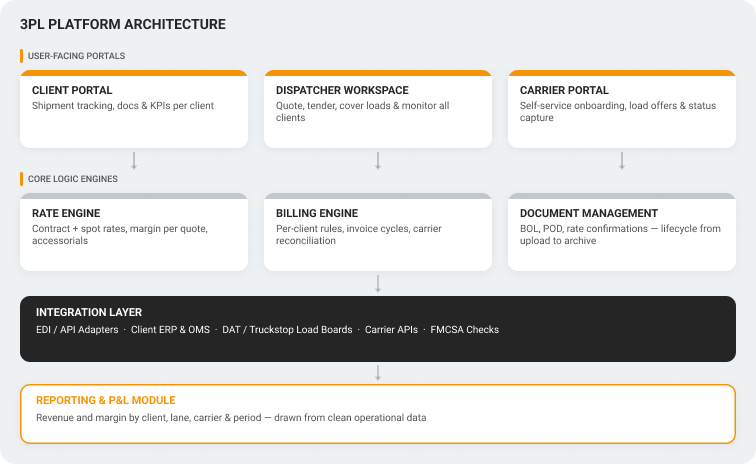
A 3PL platform is usually assembled from these parts, each owning one job:
- Client portal. The white-label front end where each client sees only its own shipments, documents, and KPIs.
- Dispatcher workspace. The internal cockpit where operators quote, tender, cover loads, and watch every client at once with a filter.
- Carrier portal. Self-service onboarding, document upload, load offers, and status capture for carriers.
- Rate engine. Contract rate tables, spot quoting, margin calculation, and contract-vs-spot comparison on each load.
- Billing engine. Per-client rate configuration, accessorial handling, carrier invoice reconciliation, and client invoice generation across cycles.
- Document management. BOL, POD, rate confirmation, and insurance certificates stored against the shipment and carrier, with a defined lifecycle from upload to archive.
- Integration layer. The boundary that connects client ERP/OMS/WMS, load boards, and carrier systems without coupling them to the core.
- EDI / API adapters. Per-partner connectors. X12 EDI for shippers on transaction sets like the 204 load tender and 214 status message, REST for newer stacks, plus the FMCSA checks behind carrier compliance.
- Reporting / P&L module. Revenue and margin by client, lane, carrier, and period, drawn from clean operational data rather than re-keyed exports.
Two cross-cutting concerns sit under all of it: role-based access and per-client data separation decide who sees what, and an audit log records who changed a rate, approved an invoice, or edited a load. Both are far cheaper to build in from the start than to retrofit.
When SaaS 3PL software reaches its limits
SaaS 3PL software fits a specific profile, and for that profile building from scratch wastes money:
- Standard workflows with no deep customization
- Simple rate structures
- A small set of clients with similar requirements
- A business starting out, with no engineering capacity to maintain custom software
It starts to break as the operation grows:
- The standard billing engine needs a manual override on most invoices because client rate logic is too specific for it.
- Carrier integration needs run past the connectors the vendor ships.
- The customer portal cannot match a client's branding or feature requests.
- Custom integrations into client ERP or OMS systems are off the table.
- Per-shipment or per-user pricing turns into a recurring cost large enough to fund development on its own.
To locate the tipping point, count the weekly hours your team spends on work the software should be doing:
- Manual invoice fixes and carrier reconciliation
- Rate lookups in spreadsheets
- Retyping load details between board windows
- Chasing carrier documents
Once that passes one full-time role while the SaaS bill keeps climbing, both costs argue for a build. One client large enough to justify a custom workflow on its own is the other common trigger.
Price is not the only cost of staying. The lock-in shows up beyond the invoice:
- Operational data lives in the vendor's schema, and exports come on the vendor's terms
- Every integration is rebuilt against the vendor's API
- New workflows wait in the vendor's backlog behind every other customer
That lock-in is the cost a CTO notices last and feels longest, and it weighs on the build decision as much as the monthly bill.
Custom development does not mean building everything from zero. The common path in 3PL platform development is hybrid: a modular base for the commodity functions, custom work only on the differentiated workflows. That shortens time-to-launch and keeps the operational flexibility the SaaS product was taking away.
If your team spends 20+ hours a week fixing invoices, quotes, or carrier documents by hand, TwinCore can map the workflow and scope a custom or hybrid build against it.
MVP vs full platform: what to build first
The fastest way to stall a 3PL build is to scope the full platform up front. The workable path is an MVP that runs real loads, then a second phase that automates the expensive edges once the core workflow is stable.
A first release that covers daily operations end to end usually holds:
- Multi-client load management with per-client data separation
- A carrier database with onboarding and basic compliance checks
- Rate tables and basic quoting
- A customer portal for status and documents
- Invoice generation per client
Phase 2 layers on the automation that pays for itself at volume:
- DAT / Truckstop load board integration
- Automated freight audit and carrier invoice reconciliation
- Carrier scorecards
- EDI connectivity for shipper clients
- Advanced reporting and P&L
- Mobile tracking with driver-app status capture
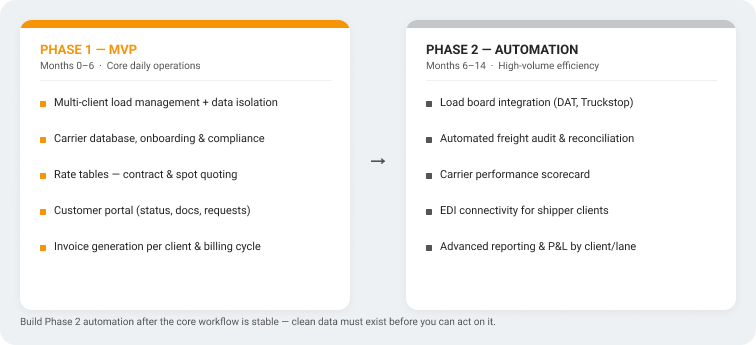
The MVP gets the operation off spreadsheets; phase 2 chases margin once there is clean data to act on. Building phase-2 automation before the core workflow settles is how budgets get spent on features the team later rebuilds.
Common mistakes when building 3PL software
Nine mistakes show up in stalled 3PL builds more than any others:
- Treating billing as a phase-2 problem. Multi-client billing is the hardest part of the system and shapes the data model. Bolt it on late and the rate engine, the invoice rules, and the P&L all get reworked.
- Hardcoding rate logic in code. Rates, accessorials, and fuel surcharges change constantly. Keep them in a configurable rate base, not code, or every client rate change becomes a deploy and a regression risk.
- Weak data separation. If client isolation is a filter on a shared table instead of a structural boundary, the first cross-client data leak is a trust problem you cannot patch quietly.
- No audit trail. Without a log of who changed a rate, approved an invoice, or edited a load, disputes turn into someone's word against another's, and compliance reviews have nothing to read.
- No exception workflow. Loads that fall outside the happy path — a missing POD, a rate mismatch, a carrier no-show — need a defined queue and owner, or they get handled in email and disappear.
- No document lifecycle. POD, BOL, and rate confirmations need a defined path from upload to archive, tied to the shipment. Documents living in inboxes is the root cause of slow billing.
- Wiring integrations before the core workflow is stable. Connecting ERP, load boards, and carrier APIs onto a workflow that is still changing means rebuilding the adapters every time the core moves.
- No canonical status model. Carriers and load boards each send their own status codes, time zones, and timestamps. Map every feed into one normalized status model, or the customer portal shows wrong status and ETAs and exception alerts misfire.
- Building dashboards on dirty data. Reporting built before operational data is clean produces numbers nobody trusts, and a P&L view the team works around instead of from.
How TwinCore builds 3PL and freight brokerage software
TwinCore builds custom logistics software and has delivered 3PL and freight brokerage platforms across 100+ projects since 2011. The kinds of systems the team has built map directly to the building blocks above:
- Rate engine. Contract and spot rate tables with margin calculation on each quote, so brokers price against carrier cost instead of guessing.
- Load board and carrier-broker platform. A dispatcher workspace with load posting and carrier sourcing tied into one queue.
- Logistics order management. Multi-client load and order handling with per-client data separation.
- Customer visibility portal. White-label tracking, document access, and KPI dashboards for each client.
- Carrier, ERP, and WMS integrations. Connectors that move tenders, statuses, and invoices between the platform and the systems clients already run.
Integration is the part CTOs ask about first, so it leads the build. The platforms connect to client ERP, OMS, and WMS over two paths: EDI for shippers still on X12 transaction sets like the 204 load tender and 214 status message, and REST APIs for newer stacks, plus load board (DAT, Truckstop) and carrier APIs. Backing all of it is the TwinCore Logistics Framework, a modular base covering core logistics functions so 3PL-specific components go on top of a proven foundation rather than a blank repo. The stack runs on .NET / ASP.NET, React, Angular, Azure, and AWS. For the broader transport side, the team also offers dedicated TMS development services.
Engagement follows the build sequence this article describes. A Discovery phase maps the workflows, data model, and integrations and fixes the scope, and the price locks after Discovery, not before. Build then runs MVP first and phase-2 automation second, so the operation is on the platform before the expensive edges get automated.
Because the platform is custom, you own the schema, the data, and the roadmap, and new workflows ship on your schedule, not a vendor's backlog.
Conclusion
3PL and freight brokerage software is a separate category from a generic TMS, with its own demands on multi-client billing, dynamic rate management, carrier compliance, and customer visibility. Teams that bend a shipper-oriented TMS into a 3PL operation accumulate workarounds that grow with the business until the workarounds become the system. Build to the operational logic of the broker or 3PL, not the other way around, and start with the two or three workflows where the manual cost is already showing.
Building or scaling a 3PL platform? Talk to TwinCore.