LinkedIn
 Twitter
 Facebook
 Youtube



Two parallel forces shape the supply chain trends in 2026:
- External pressures such as tariffs, geopolitical volatility, regulatory tightening, and the cost of capital
- Technological capabilities that are finally reaching practical adoption
Companies that limit themselves to tech buzz without analyzing the operational impact of each logistics trend risk investing in the wrong areas.
This article is a practical overview of logistics trends and supply chain trends in 2026 through operational consequences and software implications.
What Macro Trends Reshape Supply Chains?
Major logistical interruptions lasting a month or longer now occur on average every 3.7 years, forcing a complete reevaluation of global network designs.
Resilience as a structural requirement
The structural transition from just-in-time logistics to buffered models has been underway since the systemic shocks of 2020. However, the primary operational challenge in 2026 remains a critical lack of visibility beyond tier-one partners. True resilience is no longer defined by simply holding safety stock, which binds valuable capital in an environment of elevated interest rates. Instead, resilience has become a disciplined exercise in:
- Multi-source
- Multi-region network design
- Continuous, scenario-based planning
From a software perspective, this requires a fundamental shift in investment. Executing day-to-day logistics is no longer enough. Software architectures must incorporate:
- Dedicated cognitive layers for scenario modeling
- Dynamic alternate routing
- Multi-tier supplier risk profiling
Platforms must enable operators to model the financial and operational fallout of potential disruptions before physical shipments are committed.
Tariffs and geopolitical volatility are driving ongoing network redesign
Tariffs have evolved from a predictable cost into a highly dynamic risk. Geopolitical tensions continue to disrupt global supply chains through:
- Trade barriers
- Sudden tariff impositions
- Export controls
- Shifting alliances
- Economic sanctions
- Regional conflicts and military tensions
- Customs and regulatory changes
- Restrictions on critical technologies and materials
- Transportation route disruptions
- Political instability in key sourcing regions
- Increased compliance and reporting requirements
- Currency fluctuations driven by geopolitical events
- Supplier concentration risks in affected markets
- Cross-border investment restrictions
- Rising costs of international logistics and procurement
The impact is highlighted by major global conflicts, such as:
The Thomson Reuters 2026 Global Trade Report indicates that 72% of trade professionals cite U.S. tariff volatility as their most impactful regulatory challenge, up from 41% the prior year. Furthermore, 76% of these professionals believe current tariff policies represent a permanent approach to trade rather than a temporary negotiating tactic. This paradigm shift has created severe margin compression for importing firms.
| Trade Policy and Tariff Metrics in 2026 | Value | Operational Consequence |
|---|---|---|
| Leaders Expecting to Hit Tariff Absorption Wall | 73% | Internal margins can no longer offset trade costs; price increases forced downstream. |
| Average Effective U.S. Tariff Rate | 18% | Sourcing models shift from low-cost paradigms to risk-minimization metrics. |
| Section 232 Tariffs on Steel and Aluminum | 50% | Double previous rates, immediately impacting industrial manufacturing inputs. |
| US-China Bilateral Trade Decline | 30% | Sourcing shifts accelerate toward alternative global regions. |
To make matters more complex, regulatory frameworks have become highly granular, with certain products like semiconductors now tariffed based on the Country of Diffusion rather than the Country of Origin. This introduces severe compliance challenges that cannot be managed manually. Software architectures must ingest live, automated customs data feeds and trade compliance APIs to dynamically recalculate landed costs and verify supplier origins in real time.
Regionalization and multi-local networks
The historical China Plus One strategy has evolved into an intensive diversification mandate, and in some sectors, an Anywhere-but-China sourcing strategy. Organizations are actively shifting sourcing to new regional manufacturing hubs.
| Sourcing Destination | Well-Developed Infrastructure | Labor Force Potential | Day-to-Day Volatility / Risk |
|---|---|---|---|
| Vietnam | High | High | Low |
| India | Less Mature | High | Moderate |
| Mexico | Moderate | Moderate | High (requires sophisticated risk management) |
| East & West Africa | Minimal | Large (Long-term potential) | High |
This regionalization requires logistics systems to handle highly fragmented networks. Some companies are pursuing deep vertical integration. They bring manufacturing expertise in-house to:
- Combat structural price volatility
- Reduce their dependence on concentrated suppliers
You must adapt to localized carrier rules, customs frameworks, and varying transport infrastructure qualities across these new regions.
Visibility beyond tier one remains a gap
While most companies maintain structured communication with tier-one suppliers, the sub-tiers of the supply chain remain a critical operational blind spot. Margin compression from tariff absorption is pushing financially fragile tier-two and tier-three suppliers toward bankruptcy, creating unpredictable supply bottlenecks. If a fire, regulatory sanction, or physical disruption occurs at a sub-component factory, organizations without multi-tier visibility are left unaware of the impact until production lines halt downstream.
Logistics software must move beyond simple transactional records to map the entire supply ecosystem, linking sub-components to finished product SKUs. This allows the platform to proactively identify risk concentrations and secure alternative sourcing before a disruption propagates through the market.
Cybersecurity as a supply chain operational risk
Supply chain cybersecurity has transitioned from an IT compliance task to a core business continuity risk. The vulnerability of the supply chain was highlighted by incidents such as the Jaguar Land Rover cyberattack, which forced assembly line halts across multiple countries and resulted in $250 million in direct losses, dragging down quarterly GDP growth. Marks & Spencer is another incident that highlights the vulnerability af the supply chain.
Approximately 70% of organizations are very concerned about cybersecurity risks in their supply chains. Yet, 78% admit that their internal security frameworks cover less than 50% of their total vendor ecosystem.
| Cyber Threat Category | Primary Vector | Operational Impact in 2026 |
|---|---|---|
| Shadow IT | Unvetted cloud-based tools and remote work SaaS. | Creates unmonitored entry points and data flows outside the corporate security perimeter. |
| Open-Source Dependencies | Malicious code embedded in widely used public repositories. | Upstream library compromises infect legitimate applications downstream (e.g., Shai-Hulud worm). |
| Identity & OAuth Abuse | Harvested executive credentials, API keys, and service tokens. | Attackers log in via trusted integrations, bypassing traditional firewall and perimeter defenses. |
| Critical Supplier Concentration | Single managed service providers (MSPs) or software vendors. | Compromising a single upstream partner allows attackers to cascade breaches across hundreds of clients. |
This high-risk environment has forced a transition toward Zero Trust controls and the mandatory integration of real-time Software Bills of Materials (SBOMs). Security architectures must automate continuous vendor threat monitoring rather than relying on point-in-time audits. Why? Because static audits leave high-severity issues unresolved for many days.
Logistics Technology Trends With Practical Operations Impact
Logistics operations scale. Consequently, supply chain technology must transition from experimental concepts to robust platforms. They must stabilize margins, automate exceptions, and ensure strict compliance. Here are the logistics trends you must be aware of.
Traceability under regulatory pressure
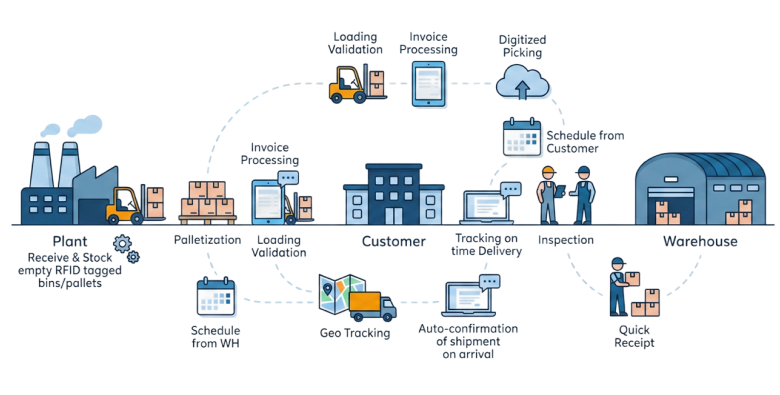
Global regulatory pressures are driving the adoption of blockchain and digital product passports to create immutable records of goods from raw material origin to final delivery. In the event of a product defect, these integrated traceability models reduce the time required to locate and isolate the compromised batch from several weeks to a few seconds. You can easily mitigate brand damage and regulatory exposure.
AI moving from pilot to differentiating layer
88% of enterprises use AI tools within their daily operations, driving a 15% reduction in overall logistics costs. Rather than acting as isolated chatbots, AI in supply chain is deeply embedded into enterprise systems to ingest data from:
- Internal ERPs
- Threat databases
- Supplier platforms
- Transportation management systems (TMS)
- Warehouse management systems (WMS)
- Procurement and sourcing platforms
- Demand forecasting tools
- IoT sensors and connected devices
- Market intelligence feeds
- Weather and environmental data sources
- Customs and trade compliance databases
- Financial and commodity market data
- Customer orders and sales channels
- Carrier and logistics partner networks
AI in supply chains separates critical operational signals from background noise.
Automation and robotics scaling to the mid-market

Advanced automation and robotic systems have scaled into mid-market operations, helping logistics providers reduce localized processing costs per order by 30% to 40%. High-speed sorters and automated storage lines increase order processing speeds 3-5 times while reducing defects.
Furthermore, autonomous forklifts using computer vision and LIDAR eliminate the need for magnetic floor tape, safely navigating warehouses to optimize capacity, with solutions like AutoStore quadrupling storage density. Last-mile delivery is also seeing the integration of autonomous trucks and drones to bypass traffic congestion and lower delivery costs.
Predictive analytics for faster replanning
Predictive analytics engines use machine learning to process real-time variables, including:
- Weather anomalies
- Competitor activities
- Port congestion and vessel schedules
- Terminal delays
- Individual driver behaviors
- Traffic and road conditions
- Demand fluctuations
- Supplier performance metrics
- Inventory levels across facilities
- Fuel price volatility
- Labor availability and workforce disruptions
- Customs clearance times
- Geopolitical and regulatory developments
- Equipment utilization rates
- Customer order patterns and buying trends
Dynamic data processing reduces excess inventory costs by 15%-20% while eliminating stockouts. In route optimization, these engines calculate traffic and road conditions to automate smart scheduling, generating up to 25% savings in fuel costs and ensuring on-time delivery rates above 98%.
Digital twins for network simulation
This supply chain technology uses real-time IoT and system data to mirror entire:
- Factories
- Warehouses
- Transport lanes
- Supplier operations
Major firms, such as General Motors (collaborating with NVIDIA Omniverse) and Delta Electronics, use digital twins to simulate the operational and financial impact of disruptions before executing physical changes.
However, the reliability of a digital twin depends entirely on the quality of its inputs. Flawed, delayed, or self-reported supplier data leads to erroneous simulations. You face severe legal and contractual risks if simulated decisions cause downstream breaches.
IoT and condition monitoring as a compliance requirement
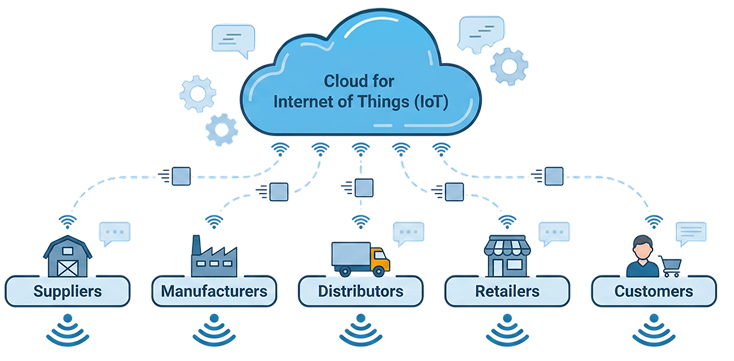
Real-time IoT sensors are now standard compliance requirements. They track:
- Location
- Temperature
- Humidity
- Light exposure levels
- Impact and shock forces
- Vibration levels
- Pressure conditions
- Door opening and closing events
- GPS route deviations
- Air quality and contamination indicators
- Fuel levels and consumption
- Battery health and device status
Within cold-chain food and pharmaceutical logistics, even a 10-minute telemetry gap can result in millions of dollars of ruined inventory. Real-time alerts allow dispatchers to intercept and correct environmental excursions in transit. This way, you can protect cargo integrity.
Simultaneously, fleet telematics transmit hundreds of vehicle parameters to the cloud. Operators can move to predictive maintenance and prevent on-road breakdowns.
Reverse logistics as a strategic function
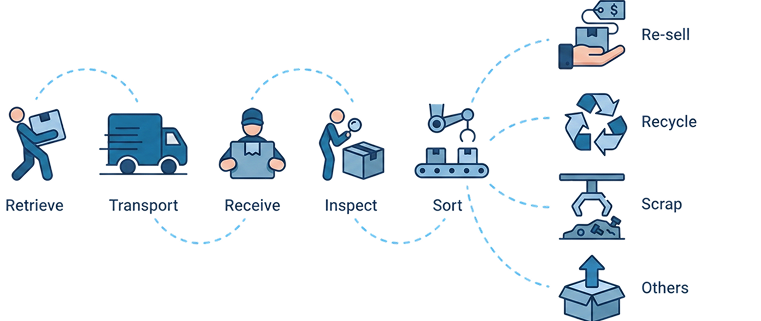
With e-commerce return rates 2-3 times higher than brick-and-mortar retail, reverse logistics has become a critical margin-preservation function. Returning an item represents a massive financial drain. 48% of online orders are returned in the USA.
To protect margins, companies are implementing automated returns management modules that use intelligent decision trees to route returned products based on condition, value, and transport costs.
This transition is accelerated by stringent European environmental regulations coming into force in late 2026. The Packaging and Packaging Waste Regulation (PPWR), applicable from August 12, 2026, introduces strict target metrics for e-commerce delivery packaging. Article 24 of the PPWR establishes a trajectory toward a strict 50% maximum void space limit for transport, grouped, and e-commerce packaging, with any space filled by air pillows, bubble wrap, or foam fillers categorized legally as empty space.
While the strict 50% threshold faces full enforcement in 2030, the following things turn packaging design into a compliance-critical factor:
- General packaging minimization principles
- Substance restrictions (such as banning PFAS in food-contact packaging)
- Labeling rules are active from August 12, 2026
Simultaneously, the EU Empowering Consumers Directive (EmpCo), applied from late September 2026, updates consumer protection laws to require that all environmental claims are fully substantiated. Under transpositions such as Germany's amended Act against Unfair Competition (UWG), active September 27, 2026, generic claims like "climate-neutral" or "eco-friendly" are prohibited at checkout unless backed by a recognized, independent certification scheme. Carbon offset claims are also prohibited unless they reflect the product's entire lifecycle, and violations carry fines of up to 4% of a company’s annual turnover.
Additionally, the transition to the ISO 14083:2023 standard requires companies to replace generic default emission factors with primary carrier data. This includes actual fuel consumption, real load factors, and verified transport activities.
What This Means for Software Architecture
How to navigate this volatile operational environment? Supply chain organizations must transition away from legacy systems toward highly integrated software architectures. Here are logistics software trends you must take into account.
Control towers as an integration layer
Supply chain control towers function as centralized, AI-powered cognitive coordination layers that sit above existing execution systems, rather than acting as basic reporting dashboards. The global market is projected to reach $32 billion in 2030, with 37% of organizations prioritizing control tower investments to shift from reactive tracking to autonomous execution.
Cognitive control towers can:
- Automatically detect exceptions
- Evaluate alternative routing options
- Execute resolutions with minimal human intervention
This happens thanks to integrating data from ERP, TMS, WMS, and carrier portals into a normalized database with sub-minute refresh cycles.
By the way, when to build custom WMS? You should build a custom WMS when off-the-shelf solutions can no longer support your operational complexity, scalability goals, or integration requirements.
Modular and composable architecture
To achieve high operational agility, enterprises are migrating away from all-in-one software suites toward composable architectures. Composed of interchangeable Packaged Business Capabilities (PBCs), this modern design organizes software around discrete business functions that possess their own logic, data models, and API surfaces. This allows development teams to deploy, scale, or upgrade specific workflows independently. Integration complexity is reduced, and systemic release risks are eliminated.
Real-time data infrastructure
Operating high-volume logistics networks requires an enterprise data architecture built for real-time processing. Systems use service-oriented backends and robust messaging or streaming frameworks, such as:
- Apache Kafka
- RabbitMQ
- SignalR
They help handle continuous telemetry feeds from GPS sensors, carrier portals, and dispatch applications. This real-time visibility ensures that dynamic routing engines and dispatch coordinators operate on the most accurate data available.
Data governance as an AI prerequisite
Logistics operators cannot successfully deploy AI-driven predictive analytics or digital twins without establishing front-end data governance. When underlying data sourced from fragmented carrier networks, legacy spreadsheets, or external portals is delayed, inconsistent, or unverified, the resulting AI decisions lead to:
- Inventory imbalances
- Shipping delays
- Costly contractual disputes
- Inaccurate demand forecasts
- Poor inventory allocation decisions
- Production planning disruptions
- Inefficient route optimization
- Compliance and regulatory violations
- Reduced customer satisfaction
- Increased transportation costs
- Supplier performance issues
- Missed service-level agreements (SLAs)
- Revenue leakage and financial losses
- Erosion of trust in AI-driven systems
Data validation pipelines must be embedded directly into the integration layer to scrub and normalize incoming data before it reaches the intelligence layer.
Deep integration over point solutions
Relying on disconnected point solutions for execution, billing, and compliance creates critical data silos and manual bottlenecks. Composable systems must establish deep, API-driven connectivity across all operational layers.
TwinCore specializes in custom logistics software development for companies that don’t need just another SaaS subscription, but a platform that aligns with their operational logic. The team can help with:
- TMS development
- Control tower development
- Route optimization
- Fleet management
- AI-driven logistics analytics development
- IoT integrations
By using a modular .NET-based framework, TwinCore combines production-ready components, such as Order Management, Rate Engines, and Route Planning modules. The highly cohesive, custom execution environments eliminate manual bottlenecks and scale seamlessly without big-bang deployment risks. By the way, TwinCore also has deep expertise in eCommerce.
Three Operational Scenarios
The following scenarios outline distinct logistics software trends and will help you understand what supply chain technology you really need.
Scenario 1: Importer or manufacturer with international supply chains
Suppose an importer or manufacturer relies heavily on complex Asian sourcing networks, maintaining direct visibility into tier-one suppliers but possessing no transparency beyond that initial tier. In the wake of major tariff changes, the company is forced to review its entire sourcing and supplier network. However, landed costs remain highly unpredictable and alternative shipping routes are not modeled. Critical scenario planning is conducted manually in Excel once a quarter, leaving the business vulnerable to rapid trade shifts.
The immediate priorities for this operator require:
- Establishing multi-source supplier visibility
- Automating tariff simulation within the TMS
- Implementing continuous scenario planning
- Establishing supplier risk scoring
The targeted software investment must focus on deploying an execution-led supply chain control tower equipped with multi-tier supplier mapping capabilities. This platform must deeply integrate with automated customs and global trade compliance APIs, such as ONESOURCE or Descartes. This is necessary to dynamically calculate landed costs, monitor restricted entities, and simulate alternative shipping routes before physical purchase orders are executed.
Scenario 2: 3PL, shipper, or last-mile operator
Suppose a third-party logistics (3PL) provider or last-mile shipper manages hundreds of time-sensitive regional deliveries daily. Customers demand highly accurate, real-time ETAs. Yet, dispatchers face severe communication bottlenecks whenever delays occur. Freight costs are rising due to suboptimal carrier selection, inefficient routing, and unnoticed carrier billing discrepancies.
The operational priorities for this business require implementing:
- AI-driven route optimization
- Real-time carrier tracking
- Automated freight audit capabilities
- Dedicated dispatcher control tower
The software investment must focus on a modern TMS equipped with an AI routing layer and real-time telematics integration. This system must ingest live GPS data to:
- Automatically optimize routing
- Dynamically calculate ETAs
- Notify customers of potential delays
Additionally, an integrated rate engine must automatically cross-reference carrier contracts against invoices to eliminate billing leakage and automate the dispute resolution workflow.
Scenario 3: eCommerce or returns-heavy retailer
Suppose an e-commerce or returns-heavy retailer faces a massive volume of customer returns, which are processed via slow, manual warehouse workflows. There is no real-time status visibility for inbound returns, leading to severe inventory imbalances and margin loss. Simultaneously, the retailer's partners and the European regulatory market require verified carbon tracking and circular packaging traceability under the active PPWR and EmpCo frameworks.
The critical priorities for this retailer require deploying:
- Automated returns management
- Reverse logistics routing
- Shipment-level carbon tracking
- Compliant traceability data models
The software investment must center on a dedicated returns management module that integrates seamlessly with the existing OMS and WMS to automate return validation and disposition routing. This must be paired with an ISO 14083-compliant carbon calculation layer that integrates directly with carrier APIs to collect primary emissions data at checkout. All environmental claims must be fully substantiated, auditable, and compliant with national laws.
Summary
The supply chain in 2026 is defined by the necessity of replacing manual processes with intelligent automation. Shifting trade tariffs, intense geopolitical volatility, and strict environmental regulations are forcing organizations to reevaluate their global network designs.
AI in supply chain, predictive analytics, and digital twin simulations provide a decisive operational advantage. Yet, their execution depends entirely on a high-quality data infrastructure and structured data governance. Supply chain leaders who build modular, composable logistics platforms with end-to-end visibility and API-driven connectivity will establish the operational resilience required to navigate future disruptions.
To discover how custom logistics software can stabilize operational margins, TwinCore is always ready to help you with our AI for logistics services. We have 100+ successful projects behind our backs. TwinCore can guide you through your entire project. Just get in touch with us, and we’ll get back to you to discuss the details of your request.