LinkedIn
 Twitter
 Facebook
 Youtube



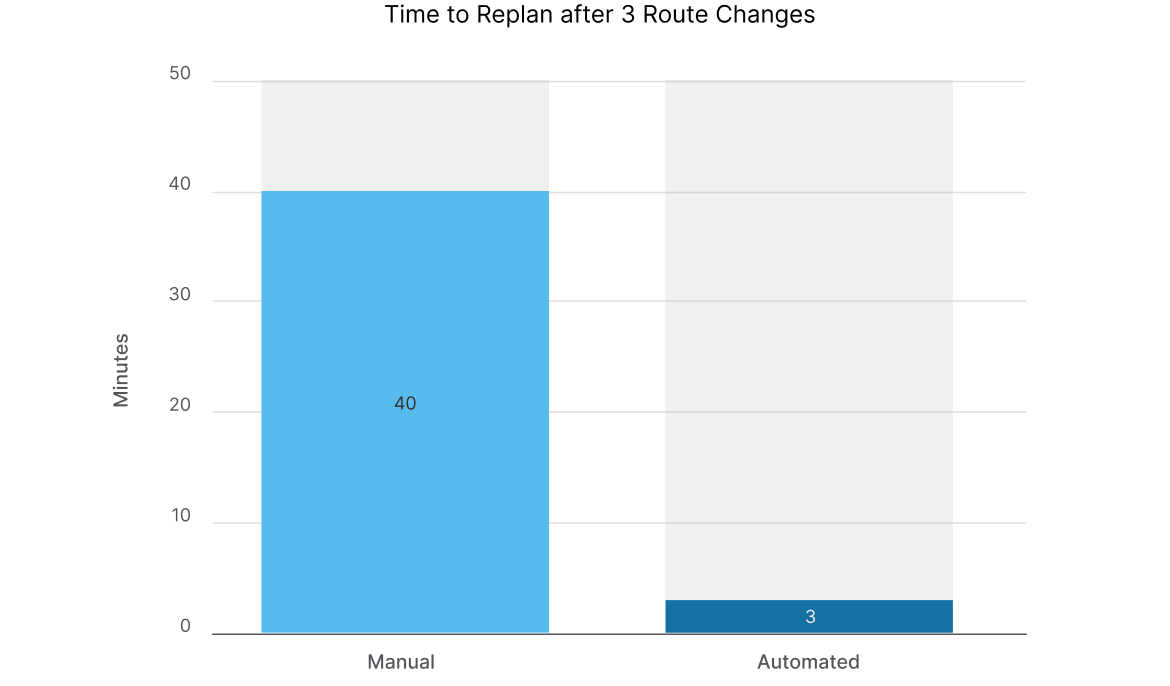
It's 7:00 AM. Routes are finalized — 12 drivers, 140 stops, vehicle capacity accounted for, delivery windows set. By 10:30 AM, three orders have changed addresses, one customer has cancelled, and a traffic incident on a key corridor has added 40 minutes to six route sequences. Manually rerouting takes 35–45 minutes, assuming the dispatcher drops everything else.
Drivers keep rolling on outdated routes the entire time. Dynamic route optimization replaces that manual replanning loop with automated reoptimization — triggered by real-time events, measured in seconds.
This is where the question surfaces: does the operation need automated real-time rerouting, or is there a better way to manage intraday disruption?
The answer is not the same for every operation. This guide gives logistics teams a framework to evaluate both.
What Is Dynamic Route Optimization?
Dynamic route optimization is the process of recalculating delivery routes in response to real-time events — new stops, cancellations, traffic incidents, driver delays, or order changes that occur after routes have been dispatched.
Static routing builds the route plan at the start of the day from fixed data. Changes during execution are handled manually, or not handled until the next planning cycle.
| _ | Static routing | Dynamic routing |
|---|---|---|
| When routes are built | Before dispatch | Continuously or on-trigger |
| Handles intraday changes | Manually | Automatically or semi-automatically |
| Data inputs | Historical, fixed | Real-time feeds |
| Best for | Stable, predictable runs | High-volatility operations |
In practice most fleets run a mix. On one end of the range: manual planning with dispatcher-driven exception handling. On the other: continuous automated reoptimization adjusting routes every few minutes. Three factors decide where a fleet should sit — how often plans change during the day, how tight the delivery windows are, and what a missed execution actually costs.
Under the hood, routing engines split into two families. Constraint solvers (heuristic and OR algorithms) search for a plan that respects every rule. ML models predict the inputs the solver depends on: travel times, dwell times, demand patterns. Production systems usually combine both.
The Data Dynamic Routing Runs On
Dynamic route planning depends on a continuous stream of accurate input data. The quality of routes produced is a direct function of the quality of data flowing in.
Traffic and road conditions. Real-time traffic APIs (Google Maps, HERE, TomTom) provide incident data, congestion levels, and road closures. The system recalculates route sequences and ETAs as conditions change.
Delivery windows. Hard windows (customer receiving closes at 2 PM; no exceptions) versus soft windows (preferred between 10 AM and noon, but flexible) carry different sequencing consequences. A routing engine without window constraints produces plans that look optimal on paper but fail in the field.
Vehicle capacity and type. Weight limits, cubic volume, refrigeration, liftgate availability. Routes built without these constraints are operationally useless. A driver cannot take the next stop if the vehicle is already full.
Driver availability and hours of service. Shift times, mandatory break rules, HOS compliance, skill-based assignments. These are hard constraints. Ignoring them produces routes that break compliance or require same-day manual corrections.
Intraday order changes. New orders mid-day, cancellations, address corrections, priority escalations — each triggers a reoptimization decision. The system needs a live connection to the order management system or a real-time API feed to respond.
Telematics. Live GPS position of each vehicle is the foundation of actual rerouting. Without knowing where a driver is right now, the system calculates from a starting assumption that may be 30 minutes out of date. Accurate position data is non-negotiable for dynamic routing optimization.
Customer ETAs. Downstream notification accuracy depends on the routing model being current. Promised windows drive customer satisfaction scores, re-delivery costs, and inbound call volume.
Dynamic routing is as good as the data feeding it. A complete constraint model running on incomplete or delayed data produces unreliable routes.
When Dynamic Routing Creates Real Business Value
Reducing missed delivery windows during intraday disruptions
When a traffic event blocks a key corridor, a dispatcher working manually can address one route at a time. A routing engine with a real-time traffic feed identifies all affected routes simultaneously and recalculates. The difference is the number of windows that miss while the replanning queue clears.
Cutting manual replanning time
For a dispatcher managing 10+ active routes, replanning after a cluster of mid-day changes can take an hour. Automated reoptimization returns a revised plan in seconds. That time shifts to exception management, customer calls, and decisions that require judgment rather than calculation.
The Response Time Difference Looks Like This:
Fuel and mileage reduction
As new orders are inserted and existing stops shift, a static plan accumulates inefficiency. Optimized dynamic routing recalculates sequences as the day evolves, compressing that accumulated distance. The effect compounds over weeks and months across a large fleet. Fuel is one of the largest variable cost components in fleet operations — ATRI's annual trucking cost analysis tracks this consistently, and route efficiency directly affects that line item.
ETA accuracy and downstream costs
When a routing engine updates ETAs in real time and pushes them to a customer notification layer, the gap between what customers expect and what happens narrows. Fewer inbound calls, fewer re-delivery attempts, lower cost-to-serve per stop. Capgemini Research Institute's last-mile delivery study found that nearly three-quarters of consumers are willing to reward retailers who improve delivery accuracy with increased spend and loyalty — missed ETAs reverse that directly.
Fleet utilization for same-day demand
Without rerouting, inserting a same-day order means either dispatching an additional vehicle or deferring the delivery. A system that inserts stops into active routes — with live capacity checks — absorbs same-day demand without adding vehicles.
Use this flowchart to define your profile in 30 seconds.
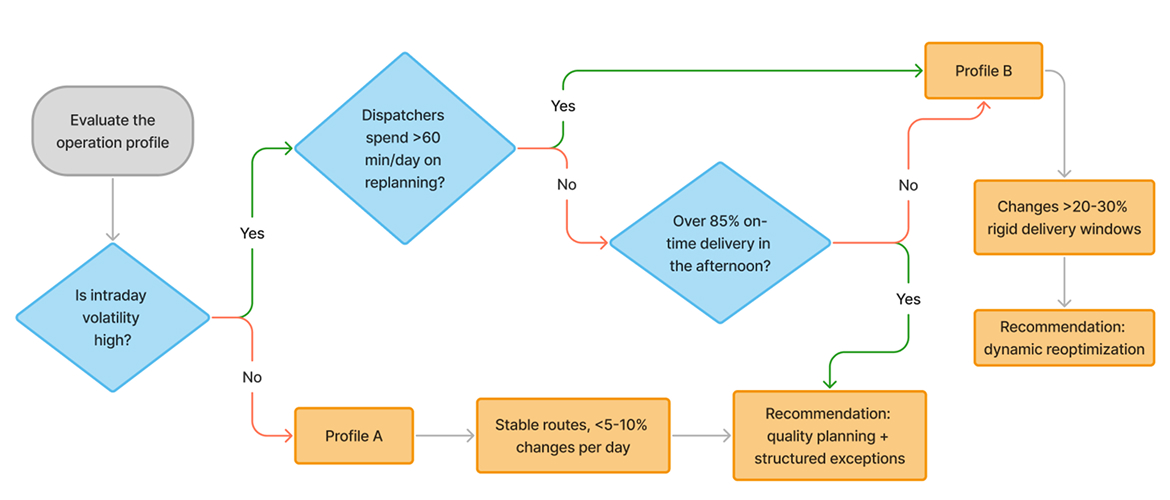
Decision Framework: Do You Actually Need Dynamic Routing?
Before evaluating vendors or platforms, assess whether the operation's profile matches where the technology creates value.
Profile A — Quality planning and structured exception handling are sufficient
- Delivery volume is below 30–40 stops per vehicle per day
- Routes are geographically stable — same customers, same zones, week to week
- Intraday changes affect fewer than 5–10% of stops on a typical day
- The dispatcher team handles exceptions without becoming a bottleneck
- On-time delivery performance is above 90% with current processes
For this profile, investing in better route planning software and a structured dispatch protocol for exceptions returns more value than a full dynamic route scheduling system.
Profile B — Dynamic routing investment is justified
- High intraday volatility: same-day orders, frequent cancellations, address changes
- Tight delivery windows with customer consequences for misses
- Dispatchers spend 60–90+ minutes per day on reactive replanning
- On-time delivery performance is below 85%, and the root cause is mid-day disruption, not planning quality
Operational signals pointing toward Profile B:
- Drivers call the dispatcher regularly because route sequences are unrealistic by the time they're on the road
- Missed windows cluster in the afternoon, not the morning — early disruptions compound through the day
- Customers escalate because ETAs at dispatch don't match actual arrival times
- Adding a dispatcher hasn't resolved the replanning bottleneck
- Volume has grown 30%+ without a proportional increase in dispatch capacity
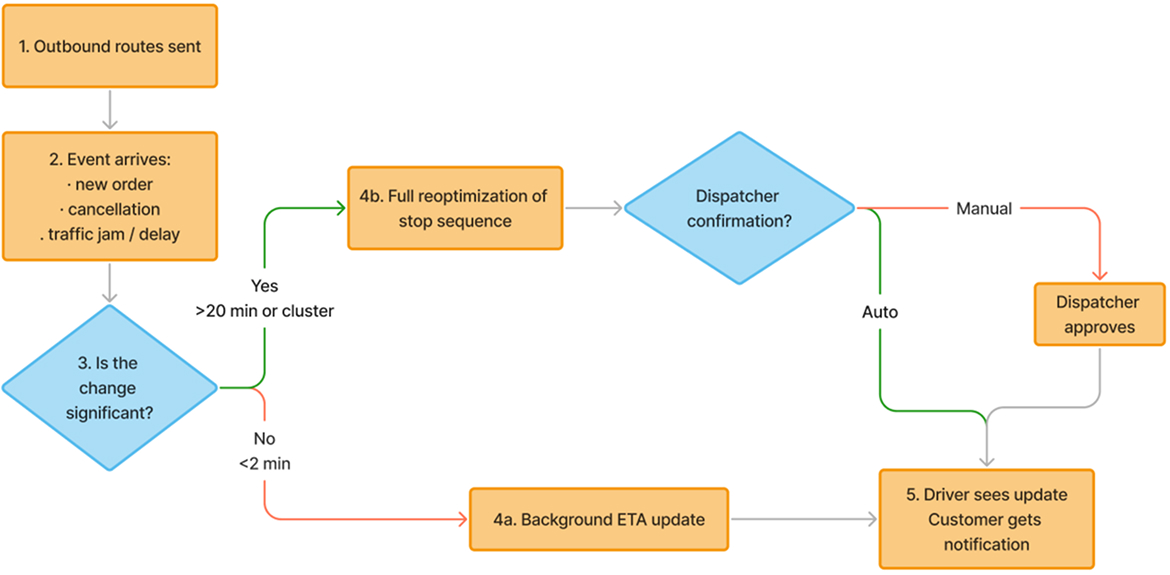
Many mid-size fleets sit between these profiles. In those cases, routing solutions that handle dynamic reoptimization don't need to run in continuous mode — trigger-based rerouting on significant events (a delay over 20 minutes, a cluster of cancellations) delivers most of the value at a fraction of the integration complexity.
Five-minute self-assessment
Answer yes or no, then count.
- Dispatchers spend more than 60 minutes a day on reactive replanning.
- On-time delivery sits below 85%.
- Same-day orders or address changes hit more than 10% of stops on a typical day.
- Drivers regularly call in because the planned sequence is unrealistic by the time they reach it.
- Missed windows cluster in the afternoon, not the morning.
- Volume has grown 30%+ in the last 12 months without adding dispatch capacity.
- Delivery windows are tight enough that a miss carries direct customer consequences.
0–2 yes → Profile A; fix planning and exception handling first.
3–4 yes → mid-zone; start with trigger-based rerouting on defined events, not full continuous mode.
5+ yes → Profile B; the case for dynamic routing is solid.
Build, Buy, or Hybrid
Three paths cover the market.
Vendor SaaS: fastest start, per-vehicle fee, constraint model fixed by the vendor.
Custom build: full control over constraint logic and TMS integration, higher upfront cost, longer time-to-value.
Hybrid: a vendor routing engine wrapped in an in-house orchestration layer that handles edge cases and integration with internal systems.
The choice comes down to three questions: how unusual are the operation’s constraints, how tight is the coupling to the existing TMS, and how strategic is routing to the business model. Standard constraints with a thin TMS lean SaaS. Routing logic as competitive differentiator leans custom or hybrid.
What It Takes to Implement Dynamic Route Optimization
Data infrastructure
- GPS or telematics on every vehicle with low-latency position reporting
- A real-time order management system or API that pushes changes to the routing engine as they occur
- Traffic data feed, either through the routing platform's provider or a dedicated integration
System integrations
- TMS or dispatch platform as the operational core — the routing engine works within or alongside it
- Driver mobile app for communicating route updates and confirming stop completions in real time
- Customer notification layer for updated ETAs, if customer-facing SLAs are part of the business model
Process readiness
- Dispatchers shift from building routes to managing exceptions and override decisions
- Drivers work from updated routes mid-shift — this requires training and, for experienced drivers, a clear override protocol
- Defined rules for when the system acts automatically versus when it requires dispatcher confirmation
Linear view of the route life cycle
Pilot before full rollout
A controlled pilot runs 4–6 weeks at one depot or zone. Multi-site rollout follows over 2–3 months once dispatch and drivers stabilize on the new flow. Skipping the pilot is where most implementations stall. Production volume exposes constraint gaps that demos never show.
Operational constraints that don't get enough coverage
Continuous optimization can conflict with drivers who have deep zone knowledge — local road conditions, customer behavior, access patterns. Their judgment often outperforms the algorithm on edge cases. Override rights should be explicit, not an afterthought.
Not every intraday change warrants automatic rerouting. Some require context the system doesn't have — a customer that consistently takes 15 extra minutes regardless of the ETA, a receiving dock that won't open before 11 AM. Encoding those as constraints before going live determines whether the routing layer performs in production or just in demos.
For teams evaluating custom software options or extending an existing TMS platform, constraint modeling is where most of the implementation work sits.
Launch checklist
- ☐ GPS or telematics on every vehicle, position latency under 30 seconds
- ☐ Real-time OMS or order-changes API into the routing engine
- ☐ Traffic data feed (vendor-bundled or standalone)
- ☐ TMS or dispatch platform set as the operational core
- ☐ Driver mobile app for route updates and stop confirmations
- ☐ Customer notification layer wired in, if SLA depends on it
- ☐ Override protocol for experienced drivers, documented
- ☐ Automation rules (what the system decides vs what the dispatcher confirms)
- ☐ Baseline KPIs captured: on-time %, miles per stop, fuel per delivery, planning time, overtime
- ☐ Pilot scope defined: one depot or zone, 4–6 weeks
Scenarios: Three Operational Profiles
Scenario 1 — Last-mile delivery with high intraday volatility
A courier or e-commerce delivery operation running 80–120 stops per driver per day, with same-day orders arriving through midday and a 20–30% intraday change rate. Static planning is impractical at this scale — by 10 AM the morning's plan is already outdated across half the fleet. Dynamic routing is the only operationally viable approach.
The integration requirements are significant: real-time OMS connection, telematics, customer notifications. The ROI is direct: without automated rerouting, the operation either over-staffs or misses windows systematically.
Scenario 2 — Regional distribution with stable routes
A regional distributor calling on the same 200 retail accounts each week, with scheduled delivery days and rare intraday changes. This is Profile A. Investing in quality daily route planning, optimized zone construction, and a structured exception-handling process returns more than full dynamic rerouting. The volatility isn't there to justify the integration complexity.
Scenario 3 — Fleet with TMS and telematics focused on ETA accuracy
A B2B delivery fleet, for example manufacturing inputs or foodservice distribution. The TMS handles load tenders, and telematics provides GPS. The problem isn’t replanning frequency; it’s ETA reliability. Customers have receiving docks, staffing schedules, and upstream production tied to delivery accuracy. Dynamic routing here works mostly as an ETA recalculation engine. It fires on real delays, not on every event. The integration footprint is lighter than Scenario 1. The business case is customer retention and fewer inbound calls from receiving teams.
Logistics software teams in Scenario 3 often find it's the practical entry point — building toward fuller dynamic reoptimization as data maturity and dispatcher process maturity increase.
Summary
Dynamic route optimization solves an execution problem, not a planning problem. If missed windows stem from bad planning data or unrealistic load construction, dynamic rerouting won't fix them.
Where it does return clear value: operations with high intraday volatility, tight customer windows, and dispatchers spending significant time on reactive replanning. If afternoon on-time rates are consistently lower than morning rates, drivers are calling in for updated sequences, and same-day changes are routine — the operational profile matches.
For teams where routes are stable and intraday change rates are low, the investment in planning quality and exception-handling structure returns more per dollar than a dynamic routing system.
If the profile matches Profile B, contact TwinCore's logistics team to evaluate what an integration-ready routing layer looks like for your specific TMS and telematics environment.