30+
professionals
100+
success projects
1 week
trial offer
Clutch rating

TwinCore builds custom transportation management systems (TMS) designed around your freight flows, carrier network, contract logic, and operational structure.

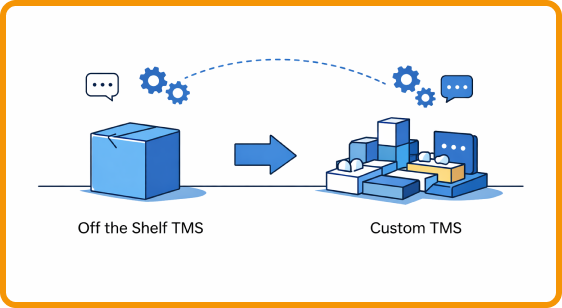
Off-the-shelf TMS products force rigid workflows, generic rate logic, and limited integration options that don’t match how your operation actually runs. A custom TMS aligns planning, execution, billing, and carrier connectivity with your business logic, eliminates manual workarounds, and gives you consistent, automated control over transport operations.

Сontact us

Built For Freight Operations With Complex Rules

Growing freight operations rarely fail because of volume. They fail because systems stop reflecting how the business actually works. A custom TMS becomes relevant when your operation starts bending software instead of the other way around.

3PLs and freight brokers managing multiple contracts

If every customer has different rate logic, accessorial rules, approval flows, and carrier agreements, generic systems turn into spreadsheets with a UI. A custom TMS models your actual contract structure and keeps quoting, dispatch, and billing aligned.

Carriers running their own fleet

When dispatching, driver management, compliance, maintenance, and telematics live in separate tools, coordination slows down. A unified TMS connects fleet operations directly to order execution and billing, reducing manual handoffs.

Shippers with private or mixed fleets

Owning part of the transport chain requires visibility beyond shipment status. Planning, dock scheduling, internal fleet capacity, and service-level control must operate inside one system rather than across emails and exports.

Operations with hybrid networks

Different legs of the journey follow different rules. Linehaul optimization, terminal transfers, and final-mile execution need coordinated planning and shared data. A custom TMS aligns these layers without duplicating workflows.

Businesses operating across regions or compliance frameworks

When documentation, customs logic, approval flows, or audit trails vary by region, hardcoded software limits flexibility. Custom workflows enforce compliance without adding parallel manual processes.

High-volume teams dealing with complex pricing models

As pricing evolves beyond flat rates into lane rules, customer tiers, fuel adjustments, and performance-based agreements, spreadsheet logic becomes fragile. A structured rate engine inside the TMS keeps margins predictable at scale.

A Transportation Management System Built Around Your Operation

Off-the-shelf platforms assume your workflows are average. Growing freight networks rarely are. TwinCore builds custom TMS software aligned with your contracts, carriers, fleet structure, and pricing logic — so the system reflects how you actually operate.

Launch fast without committing blindly

Start with a focused production-ready scope. Validate dispatch logic, carrier rules, and integrations in real operations before expanding the system.

Replace fragile legacy systems

Stabilize outdated codebases, modernize architecture, and eliminate workarounds that slow dispatch, billing, and reporting.

Unify orders, fleet, and billing

Bring shipment execution, fleet management, contract rates, and invoicing into a single source of truth instead of parallel tools and spreadsheets.

Enable mobile execution in the field

Equip drivers and dispatchers with a purpose-built mobile interface for route visibility, document capture, and real-time communication.

Build pricing logic that matches reality

Model contract rates, fuel adjustments, lane rules, and accessorials directly in your system — not in hidden spreadsheets.

Automate repetitive decision points

Load assignment, rate comparison, tendering, and exception routing can execute automatically while preserving operational control.

Strengthen carrier and partner connectivity

Integrate EDI, carrier APIs, telematics, accounting, and BI tools as part of the architecture — not as afterthought connectors.

Gain real-time operational visibility

Track shipments, fleet activity, margins, and exceptions from a unified dashboard built on consistent data definitions.

Core Features Included in Custom TMS Development

Order & Dispatch Management Functionality

Core order and dispatch management logic is engineered as part of your custom TMS development — including shipment creation, load consolidation, carrier assignment, automated tendering, contract-based rating, and exception workflows tailored to your freight operations.

Route Planning & Optimization Engine

We build route planning and optimization functionality directly into your transportation management system, supporting multi-stop routing, time windows, driver constraints, cost-per-mile calculations, and real-time operational adjustments.

Contract Rate & Pricing Management

Custom TMS software includes a structured rate engine that supports contract rates, fuel surcharges, accessorial charges, lane-based pricing, and carrier-specific agreements — eliminating spreadsheet-based pricing logic.

Real-Time Tracking & Telematics Integration

Your transportation management system integrates with carrier APIs, EDI providers, GPS, ELD, and IoT devices to deliver real-time shipment tracking, ETA prediction, geofencing events, and automated exception alerts.

Freight Billing & Audit Automation

Custom TMS development includes automated freight invoicing, contract validation, billing reconciliation, dispute management, and audit trails designed to reduce revenue leakage and manual financial processes.

Logistics Analytics & Performance Reporting

We implement operational dashboards and logistics analytics inside your TMS software to track OTIF performance, carrier KPIs, cost-per-mile, dwell time, margin by lane, and shipment profitability in real time.

Key Capabilities Delivered in Custom TMS Development

Smart Route Optimization & Load Planning

Static routing logic collapses when real-world constraints shift - traffic, delivery windows, fuel costs, capacity limits, last-minute orders. A custom TMS uses intelligent routing and load-planning algorithms that adapt to these variables automatically. Routes are optimized for utilization, cost, and service reliability, while loads are consolidated based on actual constraints across depots and equipment. The impact is immediate: fewer empty miles, lower fuel spend, and a more predictable fleet operation.

Real-Time Shipment Visibility

When shipment data lives across separate carrier portals, delays surface too late for teams to react. Integrated GPS, telematics, and event tracking bring real-time visibility directly into your TMS, allowing dispatchers and customers to see accurate statuses, exceptions, and ETA changes as they happen. This improves response times, reduces service failures, and builds trust with every update your system sends out.

Inventory Synchronization

Disconnected inventory data leads to stockouts, overstocking, slow fulfillment, and inaccurate demand planning. A custom TMS that synchronizes with WMS or ERP systems ensures that shipment data, stock levels, and order flows stay aligned across the supply chain. With a single source of truth, replenishment planning becomes proactive, forecasting becomes accurate, and operations avoid the costly mismatches created by data silos.

Automated Order Processing

Manual entry and spreadsheet-driven workflows introduce delays, errors, and inconsistent order handling. Automated order flows move shipments from customer request to dispatch, rating, and invoicing with minimal human intervention. This cuts processing time, reduces administrative overhead, and ensures every order follows the same reliable, audit-ready path.

Compliance, Security & Documentation

Transport documentation - from bills of lading to customs forms and certificates - becomes a bottleneck when managed manually. A custom TMS automates generation, validation, and storage of all required documents while enforcing access control, encryption, and audit logs. This lowers compliance risk, shortens handling time, and ensures every shipment meets industry, regional, and cross-border requirements.

Analytics & Operational Intelligence

Without clear operational metrics, teams rely on assumptions instead of data. Built-in dashboards track cycle times, OTIF, dwell time, cost per mile, carrier performance, route efficiency, and more. Predictive and historical analytics help logistics teams negotiate rates, plan capacity, and identify inefficiencies that drain profitability.

Multi-Modal Transport Support

Freight rarely moves through a single mode anymore - and platforms that can’t support modal complexity slow operations down. A custom TMS unifies FTL, LTL, parcel, rail, ocean, air, and intermodal workflows in one system. Teams can compare service times, costs, and constraints across modes to build smarter, faster, and more efficient routing decisions.

Customer & Carrier Portals

When collaboration happens through email chains and outdated portals, response time and accuracy suffer. Custom portals give carriers and customers dedicated access to the data and actions they need: load tracking, document uploads, rate management, tendering, billing history, and status updates. This reduces admin time, improves transparency, and turns your TMS into a shared operational hub instead of a closed internal system.

Build TMS Using .NET

Build TMS using .NET when you need an enterprise-grade transportation management system that fits Microsoft environments and scales predictably. .NET is a strong choice for high-throughput APIs, contract rating engines, billing logic, and secure data layers, especially when your organization relies on Azure, SQL Server, Microsoft Dynamics, or Active Directory for identity and access control. It’s also a practical fit for long-lived systems where maintainability, audit trails, and compliance matter as much as speed.

Build TMS Using Blazor

Build TMS using Blazor when you want a unified C# stack and a consistent enterprise UI without splitting domain logic across separate front-end and back-end codebases. Blazor works well for dispatcher consoles, operations dashboards, admin portals, and forms-heavy workflows where role-based access control, security, and long-term maintainability are priorities. This approach is often chosen by teams that already build on .NET and want faster delivery with fewer moving parts.

Build TMS Using React

Build TMS using React when your system requires highly interactive interfaces and real-time visibility. React is a strong fit for live maps, exception management, multi-role dashboards, and control panels powered by REST/GraphQL plus WebSockets for streaming updates. Teams typically choose React for TMS front ends when usability drives adoption and the UI needs to stay fast under constant operational changes.

Build TMS Using Angular

Build TMS using Angular when you need an opinionated, enterprise-grade front end with strong structure and long-term UI consistency. Angular is well suited for regulated logistics environments, complex role-based access control, and large multi-team programs where governance, typing, and predictable state management reduce risk. It’s commonly used for dispatcher applications and internal operational systems that must remain stable for years.

Build TMS Using Node.js

Build TMS using Node.js for event-driven services that power real-time shipment tracking, telematics ingestion, geofencing events, and notification workflows. Node.js is often used to build lightweight microservices for streaming updates, high-frequency carrier status events, and integrations with IoT devices where low latency and throughput matter. It’s a practical choice when your TMS needs a real-time data layer alongside core dispatch, rating, and billing services.

Enterprise TMS Integrations & Intelligent Data Architecture

A custom transportation management system is only as strong as the ecosystem it connects to. We engineer end-to-end TMS integrations and structured data flows that eliminate manual handoffs, prevent data mismatches, and ensure every operational decision is based on consistent, real-time information.

ERP & Financial Systems Integration

Deep integration with SAP, Oracle, Microsoft Dynamics, Odoo, and other ERP systems — including GL posting, cost allocation, tax logic, automated reconciliation, and financial data synchronization.

WMS & OMS Synchronization

Real-time warehouse management system (WMS) and order management system (OMS) integration — inventory sync, ASN/EDI events, pick/pack/ship workflows, returns processing, and cross-dock coordination.

CRM & Customer Portals

Integrated CRM connectivity and custom customer portals with SLA visibility, rate transparency, shipment tracking, notifications, and secure document exchange.

Carrier APIs, EDI & Connectivity Layer

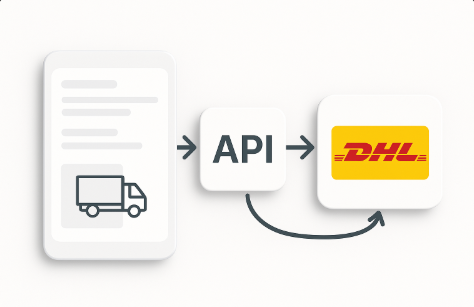
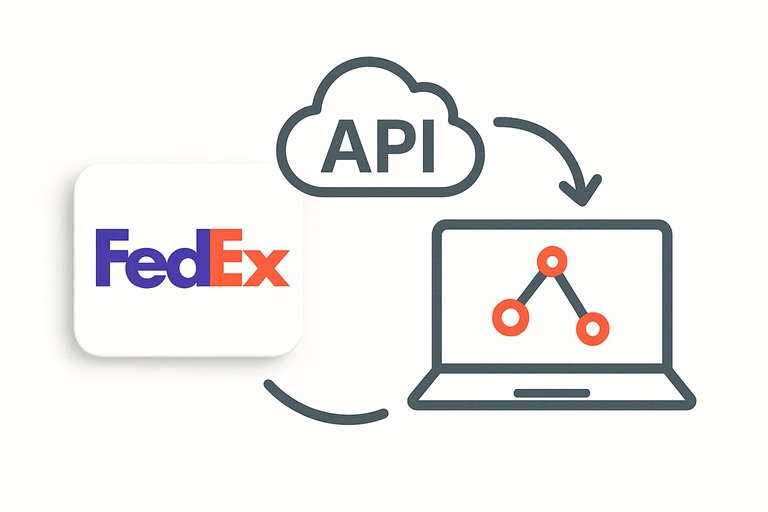
Carrier API integration, EDI transactions (204, 210, 214), automated tendering, status updates, proof-of-delivery capture, and rating APIs built directly into your TMS architecture.

Telematics & IoT Data Integration

GPS tracking, ELD connectivity, geofencing events, temperature and door sensors, ETA predictions, and exception alerts streamed directly into your transportation management system.

AI & Machine Learning Integration

Embedded AI models for predictive ETA, dynamic route optimization, automated carrier selection, anomaly detection, demand forecasting, and pricing intelligence — integrated into your TMS workflows, not isolated in external dashboards.

Regional and Country-Specific TMS Capabilities

Many logistics operations run across multiple countries, but decisions are still made locally: by law, by language, by infrastructure, and by customer expectation. Your TMS needs to respect that.

DACH (Germany, Austria, Switzerland)

  • Support for Lkw-Maut and additional CO₂-related road charges, including transparent cost breakdowns
  • Tools to reduce empty mileage and improve fleet and asset utilization
  • Full handling of eCMR and other digital documentation flows
  • CO₂ monitoring and reporting aligned with ESG requirements in the region
  • Localization for German-language interfaces and DACH-specific workflows and regulations
  • Support for ADR (dangerous goods), including documentation and routing rules
  • Planning logic that respects pallet, space, and m³ optimization for regional distribution

United Kingdom & Ireland

  • Rating models that handle complex surcharges, fuel adjustments, and zone-based pricing
  • Post-Brexit cross-border and customs workflows with document automation
  • Support for DVS / FORS-driven compliance in urban delivery areas
  • High-density last-mile routing for London and other large cities
  • CO₂ and sustainability reporting aligned with local ESG frameworks

North America (USA & Canada)

  • Multi-state and cross-border operations with varied tax rules and surcharges
  • ELD- and FMCSA-aware processes for hours-of-service and safety compliance
  • Mileage-based rating (including PC-Miler-style integrations), accessorials, and brokered freight conditions
  • High-volume FTL/LTL planning, appointment scheduling, and dock constraints
  • Blended linehaul plus last-mile workflows for regional and national networks
  • Advanced contract logic for 3PLs, asset-based carriers, and brokerage operations

Nordics & Scandinavia

  • Temperature-controlled and cold-chain transport flows, including monitoring and alerts
  • Routing that combines road, ferry, and cross-border legs
  • CO₂ tracking and sustainability analytics in line with Nordic ESG expectations
  • Local labor and driving rules built into planning logic
  • Seasonal and winter-specific routing constraints (weather, road access, restrictions)

Middle East & GCC

  • Fleet monitoring tailored to high-temperature environments
  • Customs, free-zone, and bonded-area workflows with the right documentation flows
  • Routing and planning for heavy-haul and specialized loads
  • Interfaces and workflows localized for Arabic and English
  • Multi-country GCC operations with border and permit handling

LATAM

  • Cross-border movements and customs flows between key LATAM corridors
  • Localization for regional taxes, surcharges, documentation, and compliance
  • Combined truck, ocean, and air flows in a single TMS
  • Driver documentation, safety, and security workflows
  • Support for local payment models, including cash-on-delivery and regional billing practices

Australia & New Zealand

  • Long-distance routing in low-density geographies
  • Compliance for local dangerous goods regulations
  • Fleet and route planning for remote sites, mining, agriculture, and long-haul operations
  • Handling of multi-state rules and heavy-vehicle permits

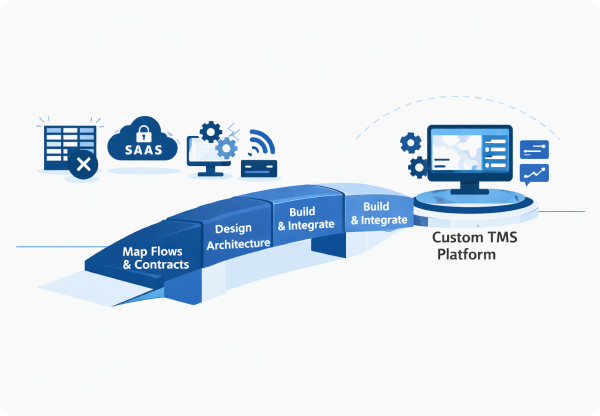
Delivery Model & Timeline

Predictable stages, measurable outcomes.

Discovery (1-2 weeks)
Process mapping, integration inventory, success metrics (cycle time, exception rate, billing accuracy).
MVP (4-8 weeks)
Critical paths only: dispatch, rating, tracking, or billing. Production-ready slice with CI/CD and monitoring.
Pilot (8-12 weeks)
Additional modules, TMS integration with ERP/WMS, user roles, data migration plan, training.
Scale & Support (ongoing)
Performance tuning, advanced analytics, new carrier/EDI endpoints, change management. SLA-backed support.

Why TwinCore for Custom TMS Development

Transportation systems fail in predictable places: rates that don’t reflect real contracts, routing logic that can’t adapt to exceptions, integrations that break under real traffic, and workflows that look good in demos but collapse in production.

The focus here is not on shipping generic features, but on building systems that match how logistics businesses actually operate. That means designing data models around real-world contracts, structuring routing logic to handle edge cases, and treating integrations as core infrastructure rather than side functionality.

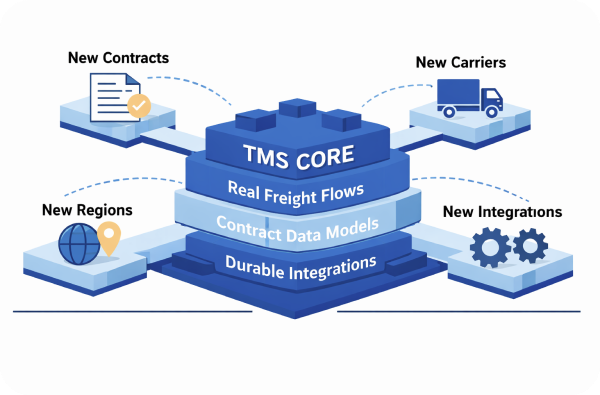
The architecture is built to handle change. New carriers, new pricing rules, new regions, and new operational constraints don’t require rebuilding the platform from scratch. They extend what already exists.

The difference is not in promises. It’s in understanding where TMS platforms usually break when real scale appears, and designing around those failure points from day one.

Ready to Build a TMS That Matches Your Operations?

If your current tools are limiting your logistics operation – whether through missing functionality, poor integrations, or architecture that can’t grow with you – we can help you design and build a TMS that actually reflects how your business runs. Share what your network looks like today and what needs to change. We’ll propose an architecture and a delivery path that gets you there with less risk and more control.

Сontact us

What our clients say about us

  • TwinCore has elevated the client's customers to the next level of supply chain management. The team is highly cost-efficient from a project management standpoint, and internal stakeholders are particularly impressed with the service provider's team dynamic.

    Alex Lopatkin
    Alex Lopatkin
    Amous
  • TwinCore delivered a fully functional solution on time, meeting expectations. The highly organized team employed a DevOps approach, swiftly responded to needs and concerns, and led a productive, enjoyable workflow. Their receptiveness to client requests and feedback stood out.

    Bruno Maurer
    Bruno Maurer
    Managin Director, N-tree
  • Thanks to TwinCore’s work, the client has gained a user-friendly, stable, and scalable SaaS platform. The team manages the engagement well by being reliable and punctual; they deliver tasks on time. Their resources are also highly flexible, resulting in a truly seamless engagement with the client.

    Mischa Herbrand
    Mischa Herbrand
    Executive, CIN
  • TwinCore successfully audited the apps and converted them into modern web apps, meeting expectations. They completed the project on time and within the agreed budget. Communicating through virtual meetings, the team provided updates and responded to the client's concerns.

    JH
    Joe Holme
    IT Director, GDD Associates
  • TwinCore delivered a fully functional solution on time, meeting expectations. The highly organized team employed a DevOps approach, swiftly responded to needs and concerns, and led a productive, enjoyable workflow. Their receptiveness to client requests and feedback stood out.

    A
    Anonymous
    Managing Director, Marketing Company

Related Topics

Frequently Asked Questions


Why build a custom TMS if SaaS options already exist?

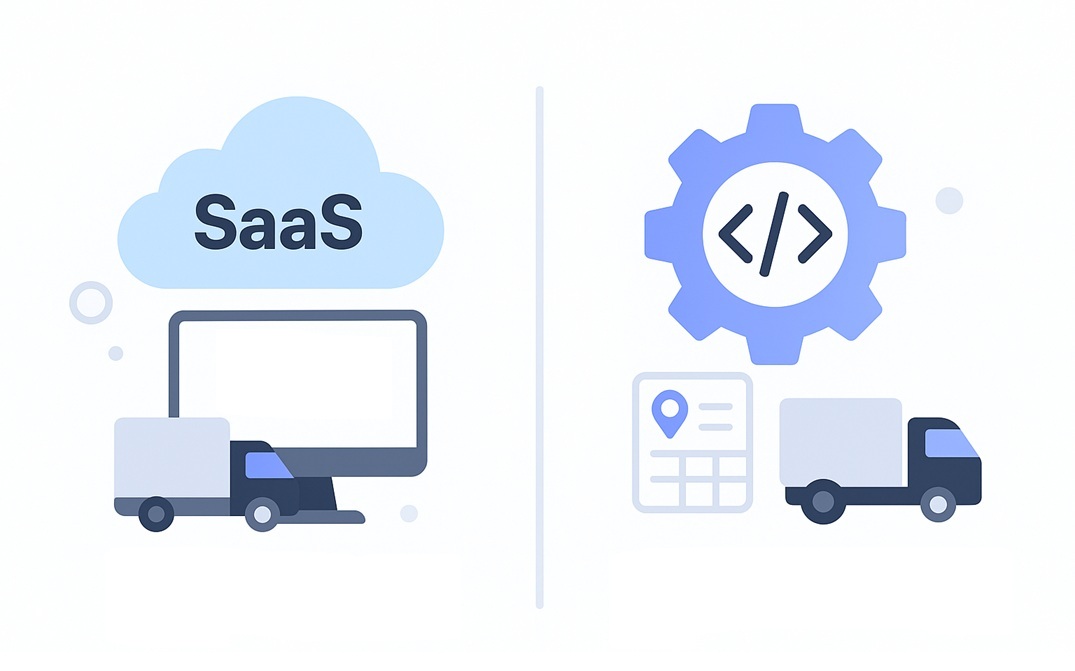
Because a SaaS TMS is a rented tool - it works only the way its provider designed it. You adapt your processes to fit the software. A custom TMS is the opposite: the system adapts to your workflows, rules, and integrations. You decide what features matter, how data flows, and who owns it. No user limits, no feature paywalls, and full control over security and scalability.


What’s the real advantage of customizing a Transportation Management System?

A custom TMS gives you freedom - to connect every system, automate your own logic, and grow without rewriting code around someone else’s API. You get a platform built for your logistics model, not for “average companies.”


Can our custom TMS connect to ERP, WMS, and CRM systems we already use?

Absolutely. Integration is a cornerstone of TMS software development. We connect directly to ERP (SAP, Oracle, Odoo), WMS, CRM, accounting, and telematics APIs. Data stays synchronized across the whole supply chain with no manual imports or duplicate entries.


How does a custom TMS help reduce transportation costs?

By combining route optimization, load planning, and carrier analytics under one logic. The system identifies underused capacity, automates tendering, and tracks carrier performance. Over time, data-driven adjustments reduce fuel waste, empty miles, and billing errors.


What kind of reporting and analytics does a custom TMS include?

You get dashboards for OTIF performance, cost per mile, dwell time, carrier scorecards, and cycle time - with filters by lane, region, or mode. Predictive analytics highlight risk before it becomes downtime. All metrics can connect to BI tools or data lakes.


How does a custom TMS improve supply chain visibility?

By turning fragmented systems into a single data flow. Every shipment, invoice, and sensor event appears in one dashboard. Real-time status updates, predictive ETAs, and exception alerts help teams act instead of react.


What about open-source TMS platforms - are they worth considering?

Open-source TMS software can be a great foundation if you want flexibility without vendor lock-in. We often build on open frameworks to speed up delivery while keeping ownership in your hands. The key is using them as a base - not as an unmodified product.


How do major enterprise TMS platforms like SAP or Oracle compare to a custom-built solution?

SAP and Oracle offer proven ecosystems, but they’re heavy, expensive, and slow to adapt. A custom TMS delivers only what you need - faster integration, lower overhead, and the freedom to evolve. You get the same reliability without the license chains.

Scroll to top