30+
professionals
100+
success projects
1 week
trial offer
Clutch rating

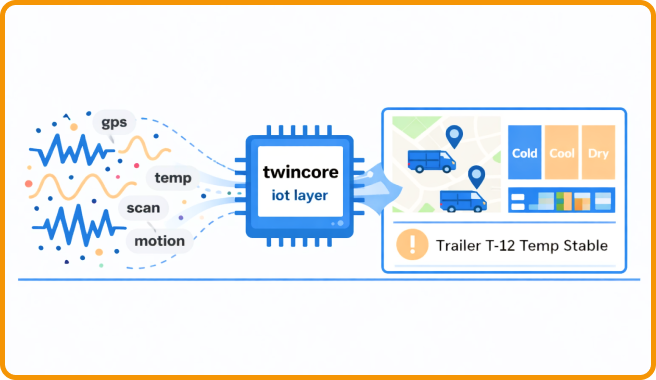
Most logistics teams already have devices, sensors, and telematics in place. GPS units on vehicles, temperature probes in trailers, scanners in warehouses, tags on assets – the hardware is there.

What’s usually missing is one connected layer that turns all of those signals into clear visibility, predictable operations, and better decisions inside the systems you actually use: TMS, WMS, ERP, OMS and routing tools.

TwinCore builds Logistics & IoT solutions that bridge the physical world and your logistics platforms. We connect vehicles, warehouses, cargo, and assets into a single real-time data flow and embed that intelligence directly into your day-to-day workflows.

Contact us

At a Glance: What You Get

  • Real-time location & condition monitoring for shipments and assets
  • Fleet telematics integrated with routing, dispatch and TMS workflows
  • IoT-powered cold chain visibility with automated alerts
  • Smart warehouse sensors, RFID, and automated inventory updates
  • Predictive maintenance for vehicles and equipment based on real data
  • Hardware-agnostic approach that works with your existing vendors
  • High-volume event pipelines built specifically for logistics operations
  • One IoT layer that connects your entire logistics stack end to end

IoT Solutions That Improve Fleet Visibility, Asset Tracking and Real-Time Decision Making

When IoT data is scattered across devices, vendors and incompatible APIs

Most logistics teams rely on a mix of telematics providers, sensor vendors, tracking tools, and legacy systems that were never meant to work together. Data structures differ, APIs are unreliable, integrations break under load, and every “simple” IoT addition risks turning into technical debt.

We build unified IoT architectures with clean event models, resilient pipelines, and predictable integrations that fit naturally into your existing systems. Instead of adding another dashboard to the pile, IoT signals become part of your core operational flow — stable, structured and production-ready.

When customers expect real-time visibility and IoT-powered features, but building the infrastructure yourself is unrealistic

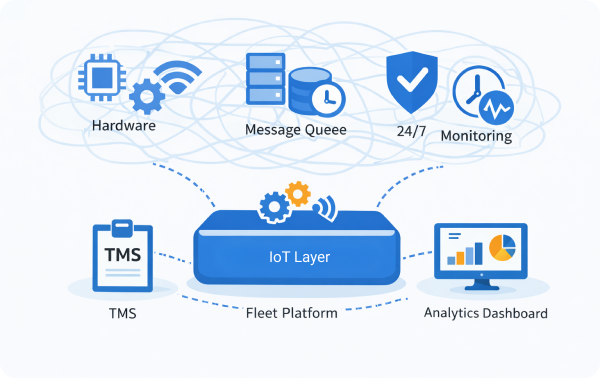
Logistics platforms face rising expectations: temperature and humidity tracking, cold chain monitoring, real-time movement, exception alerts, device analytics, and proof-of-condition data. Building this from scratch means hardware decisions, protocols, messaging queues, time-series storage, APIs, and 24/7 reliability - a full IoT product inside your product.

We help teams add IoT capabilities without becoming IoT vendors. You get production-grade telemetry flows, device management, and event processing that feel like a seamless part of your platform, not a bolt-on experiment that drags down engineering velocity.

When fleet, warehouse and operations teams need real-world signals they can trust - not more dashboards

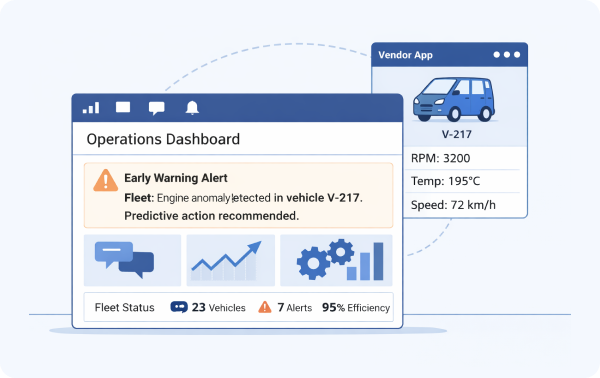
Operational failures rarely come out of nowhere. Engines show early anomalies, trailers drift outside temperature thresholds, pallets take unexpected detours, and warehouse congestion builds long before orders begin to slip. But when data comes from isolated vendor apps, teams see problems only after they’ve already become expensive.

We turn sensors, telematics and device data into actionable intelligence: early warnings, accurate alerts, and real-time visibility embedded directly in your TMS, WMS, ERP or internal tools. Operations get signal instead of noise, and decisions are made with facts instead of assumptions.

Struggling to Get True Real-Time Visibility?

Most operations don’t actually lack data. They lack useful, connected data.

Telematics platforms, sensor dashboards, and IoT portals all exist in isolation. Operations teams jump between screens, export CSV files, manually copy status updates, and still end up discovering problems too late.

If this sounds familiar, you’re not alone:

GPS and telematics

GPS and telematics data live in one platform, temperature sensors in another, and warehouse signals in a third

TMS, WMS and ERP

Your TMS, WMS and ERP rarely receive live updates from the physical world

Cold chain issues

Cold chain issues and cargo damage are often discovered only after delivery

Raw data feeds

IoT vendors provide raw data feeds, but not the workflows your people need

Integrations are brittle

Integrations are brittle, noisy, or hard to maintain at scale

High-volume IoT traffic

High-volume IoT traffic overwhelms systems that weren’t designed for it

No unified event model

There is no unified event model for vehicles, assets, equipment and cargo

Phone calls, chats and screenshots

Your team still relies on phone calls, chats and screenshots to close visibility gaps

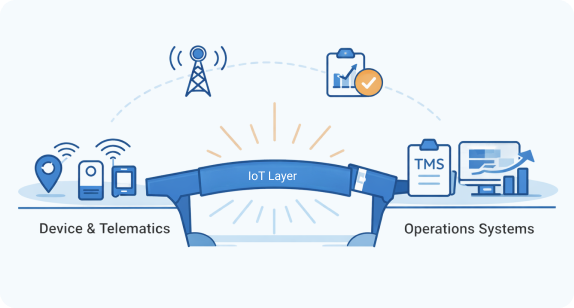
We designed our Logistics & IoT service specifically to fix these issues by giving you one, integration-first IoT layer that connects everything and feeds clean data into your logistics systems.

How Our Logistics & IoT Layer Works

Devices & Sensors

We work with the devices you already have or help you choose new ones where needed: GPS trackers, telematics units, ELD devices, temperature and humidity sensors, door and vibration sensors, RFID tags, warehouse IoT, and more.

Connectivity & Ingestion

We connect to IoT clouds, telematics APIs, MQTT brokers, webhooks, gateways and other data sources. This is where raw signals enter the system, regardless of vendor or protocol.

Event Processing & Normalization

We clean, validate, and normalize events. Duplicate pings, malformed data, or inconsistent formats are handled here. The result is a unified event model for vehicles, cargo, assets and warehouse events that your other systems can easily consume.

Integration with TMS, WMS, ERP, OMS & Custom Platforms

Normalized events are pushed into your logistics stack via APIs, webhooks, queues or direct adapters. TMS can update shipment status, WMS can adjust inventory or trigger checks, ERP can log relevant events, and your custom applications can react in real time.

Automation, Alerts & Analytics

Once everything flows through a consistent layer, we define rules, alerts and views: cold chain alerts, ETA deviations, geofence entries, downtime thresholds, incident notifications and long-term analytics for performance and maintenance.

Key Logistics & IoT Use Cases

Shipment Tracking & Condition Monitoring

When shipments move through multiple legs, carriers and climates, it’s not enough to know where they are; you also need to know how they are.

We combine location tracking with condition monitoring to give you:

  • real-time GPS for each shipment or container
  • temperature and humidity data for cold chain and sensitive goods
  • door open/close events to detect unauthorized access or risky handling
  • shock and tilt alerts for fragile cargo
  • notifications when something deviates from your rules

Fleet Telematics & Driver Behavior

Fleet operations generate a constant stream of data: vehicle positions, speeds, idling, fuel usage, harsh events, and more. On its own, this information is interesting. Connected to dispatch and routing, it becomes powerful.

We integrate telematics into your logistics stack so you can:

  • track vehicles in real time inside the same tools that manage routes and loads
  • monitor idling and fuel usage to reduce waste
  • detect harsh braking, speeding and unsafe behaviors
  • tie telematics to maintenance schedules and workshop systems
  • combine telematics with route optimization for better planning and ETAs

Smart Warehousing & Inventory IoT

Warehouses often hide issues until they become big problems: misplaced inventory, unnoticed environmental changes, inefficient handling and slow incident response.

With IoT in the warehouse, you can:

  • use sensors to monitor temperature, humidity or specific conditions in storage areas
  • deploy RFID and tag-based tracking to keep inventory locations accurate
  • track equipment such as forklifts, dock doors and critical assets
  • trigger alerts when thresholds are crossed or unusual patterns appear
  • feed all of this data into WMS and TMS so planning aligns with reality

Asset & RTI Tracking (Pallets, Containers, Equipment)

Returnable transport items (pallets, crates, roll cages, containers) and mobile equipment are easy to lose and hard to track with spreadsheets and memory.

We help you:

  • attach lightweight trackers or tags to high-value or frequently lost assets
  • track their movements between sites, partners and customers
  • identify where assets accumulate and where they go missing
  • reduce replacement and recovery costs
  • provide clear accountability across your network

Predictive Maintenance for Vehicles & Equipment

Unplanned breakdowns create delays, missed slots and unhappy customers. IoT data makes it possible to move from reactive maintenance to a more predictive model.

By combining sensor and telematics data, we help you:

  • identify abnormal patterns in engine performance or equipment behavior
  • set up rules that flag developing issues before they become failures
  • prioritize inspection or service based on actual usage and risk
  • reduce costly downtime and emergency repairs

ESG, CO₂ & Compliance Monitoring

Regulators and customers increasingly expect detailed visibility into how logistics operations affect the environment and product safety.

With IoT integrated into your logistics systems, you can:

  • measure fuel-based emissions more accurately across your fleet
  • track temperature and other conditions for regulated products
  • maintain reliable logs for audits and compliance checks
  • support ESG and sustainability reporting with credible, device-based data

Outcomes You Can Expect

Every operation is different, but companies that roll out Logistics & IoT solutions in a structured way typically see:

Fewer surprises

problems are detected early instead of after delivery

Less spoilage and damage

especially for cold chain and sensitive cargo

Reduced manual work

fewer calls, fewer ad hoc checks, fewer spreadsheets

More predictable fleet and warehouse operations

supported by clear, real-time data

Lower unplanned downtime

as maintenance becomes more proactive

Better customer experience

with honest, live information instead of vague status

Stronger foundations for analytics

event data you can actually trust and reuse

Why TwinCore for Logistics & IoT

Logistics & IoT is not just about connecting sensors and pushing data into a dashboard. It is about making sure that every meaningful signal flows into the right system, at the right time, in the right format.

We focus on:

Integration-first design

We start from your TMS, WMS, ERP, routing tools and custom platforms, then design IoT flows that fit into that landscape, not clash with it.

Hardware-agnostic approach

We work with your existing telematics and IoT vendors where possible, and only recommend new hardware when it’s truly necessary. The architecture is built so you can swap or add vendors without rebuilding everything.

Systems that handle real-world volume and noise

Logistics environments are messy. Devices misbehave, connectivity is imperfect, and data can be incomplete. We design event pipelines that handle these realities with retries, filtering, monitoring and clear failure paths.

Deep logistics experience

Our IoT work doesn’t exist in isolation. It sits on top of the same logistics framework we use for custom TMS, fleet management, route optimization and pricing systems. That means the IoT layer is naturally aligned with how your operations are actually run.

How We Deliver

Discovery

We start by mapping your current reality:

  • which devices and vendors you use
  • what platforms you rely on (TMS, WMS, ERP, OMS, custom tools)
  • where visibility gaps hurt the most
  • what regulations, SLAs or quality standards you must meet

This gives us a shared picture of where Logistics & IoT can add real value.

Architecture

Next, we design:

  • a unified event model for your IoT and telematics data
  • the ingestion and processing layer for that data
  • integration points with your key systems
  • rules for alerts, automation and long-term storage

The result is a clear blueprint that engineering, operations and stakeholders can align around.

Pilot

We then implement a pilot focused on one or two high-impact use cases – for example:

  • cold chain monitoring for a specific route or product line
  • telematics integration for a portion of your fleet
  • warehouse sensors in a single facility

The goal is to validate flows in a real environment, refine what works, and remove friction before scaling out.

Rollout

After a successful pilot, we extend:

  • more vehicles, lanes or depots
  • more warehouses or regions
  • more device types and partners

We phase rollout to minimize operational disruption and give teams time to adapt.

Scale & Support

Once the solution is in place, we:

  • monitor performance and event throughput
  • adjust rules, alerts and thresholds
  • onboard new vendors and device types as your network evolves
  • support your internal teams as they build on top of the IoT layer

The system is designed to grow with your logistics operations, not hold them back.

Ready to Bring Real-Time IoT Visibility into Your Logistics Stack?

If your devices and telematics platforms live in their own world while your operations team still runs on guesswork and manual checks, it’s time to connect the two.

TwinCore can help you design and build a Logistics & IoT layer that turns physical signals into reliable, actionable data inside your logistics systems.

Contact us

What our clients say about us

  • TwinCore has elevated the client's customers to the next level of supply chain management. The team is highly cost-efficient from a project management standpoint, and internal stakeholders are particularly impressed with the service provider's team dynamic.

    Alex Lopatkin
    Alex Lopatkin
    Amous
  • TwinCore delivered a fully functional solution on time, meeting expectations. The highly organized team employed a DevOps approach, swiftly responded to needs and concerns, and led a productive, enjoyable workflow. Their receptiveness to client requests and feedback stood out.

    Bruno Maurer
    Bruno Maurer
    Managin Director, N-tree
  • Thanks to TwinCore’s work, the client has gained a user-friendly, stable, and scalable SaaS platform. The team manages the engagement well by being reliable and punctual; they deliver tasks on time. Their resources are also highly flexible, resulting in a truly seamless engagement with the client.

    Mischa Herbrand
    Mischa Herbrand
    Executive, CIN
  • TwinCore successfully audited the apps and converted them into modern web apps, meeting expectations. They completed the project on time and within the agreed budget. Communicating through virtual meetings, the team provided updates and responded to the client's concerns.

    JH
    Joe Holme
    IT Director, GDD Associates
  • TwinCore delivered a fully functional solution on time, meeting expectations. The highly organized team employed a DevOps approach, swiftly responded to needs and concerns, and led a productive, enjoyable workflow. Their receptiveness to client requests and feedback stood out.

    A
    Anonymous
    Managing Director, Marketing Company

Related Topics

Frequently Asked Questions


Do we need to replace our existing telematics or IoT vendors?

Not necessarily. In most cases, we integrate with your current providers first. If there are critical gaps – for example, no way to access data programmatically – we can recommend alternatives, but the goal is to work with what you already have.


Can you handle multiple device types and vendors at the same time?

Yes. The architecture is vendor-neutral and designed for mixed environments. We treat each device or platform as a data source and normalize everything into a consistent event model.


How does IoT data show up in our TMS, WMS or ERP?

We define clear API contracts and integration points so your existing systems receive meaningful events instead of raw sensor noise. That can be through direct APIs, message queues, webhooks or dedicated adapters, depending on your landscape.


What about the volume of data? Will this overload our systems?

High-volume IoT is a core design consideration. We use buffering, batching, filtering, retry logic and monitoring so your business systems receive only the events that matter, at a rate they can handle.


How long does it take to see value from a Logistics & IoT project?

That depends on scope, but a focused pilot around one or two use cases (such as cold chain monitoring or fleet telematics integration) can usually be delivered in weeks, not months. From there, we extend based on what delivers the most operational impact.


Scroll to top