30+
professionals
100+
success projects
1 week
trial offer
Clutch rating

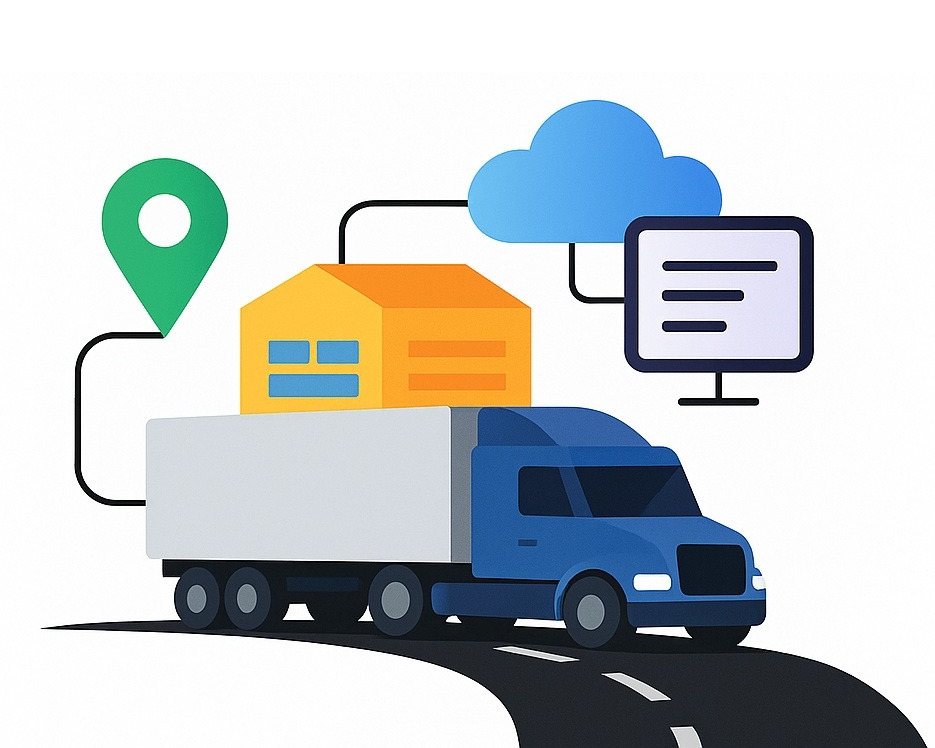
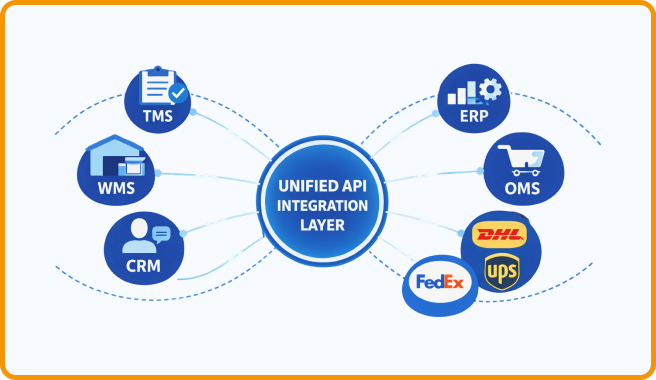
TwinCore builds custom logistics API integrations that connect your TMS, WMS, ERP, OMS, CRM, carriers, and delivery platforms into one real-time operational network.

Disconnected systems mean manual copy-paste workflows, delayed tracking updates, mismatched statuses between tools, and endless portal-hopping just to sync orders and shipments. Without a unified API layer, adding partners or carriers becomes a heavy engineering project, data consistency suffers, and visibility across the supply chain stays fragmented instead of real time.

Contact us

Shipping Carrier API Integrations

We integrate the major global carriers and regional specialists you rely on. If a carrier exposes an API, we can integrate it. If it doesn’t, we can wrap their portal or file interface in a custom adapter.

DHL eCommerce

DHL eCommerce

This DHL integration focuses on e-commerce operations, so you can connect it to your online store or order management system for order fulfillment, labeling, and tracking.

DHL Express

DHL Express

This API offers a convenient tool for document creation alongside basic shipping service features.

FedEx

FedEx

It’s a software interface you can use for calculating shipping rates, creating labels, and tracking your orders delivered by FedEx.

FirstMile

FirstMile

With this API, you’ll be able to optimize your shipments by picking the most convenient routes and transportation offered by dozens of carriers available.

Royal Mail

Royal Mail

If you use Royal Mail as your carrier, tracking orders and their labeling as well as integration with your online shop will be nothing but a smooth experience.

UPS

UPS

You’ll get a complete integration with all relatable shipping services and relatable features such as tracking, labeling, and price calculations.

USPS

USPS

In addition to standard features like tracking and labeling, this API includes inventory management for packages shipped across the United States.

CS Logistics

CS Logistics

The company offers an in-depth data solution that can help you improve your company’s customer experience.

Deliver-IT

Deliver-IT

This carrier provides an API that will let you track and label orders, and even help your customers claim returns hassle-free.

Swyft

Swyft

The Sway technology developed by this company provides you with a network of warehouses and vehicle fleets you need for next-day shipping or middle-mile/last-mile delivery.

ERP, WMS, OMS, and CRM Integrations

We connect logistics systems with your core business applications so data stays consistent everywhere:

ERP integrations

SAP, Oracle, Microsoft Dynamics, NetSuite, Odoo and others

WMS and OMS integrations

pick/pack/ship, ASN, inventory levels, returns

CRM integrations

SLAs, customer rules, notifications, account-specific constraints

Typical flows:

  • Order confirmed in OMS to shipment automatically created in TMS
  • Shipment delivered to ERP updated for invoicing; WMS adjusts inventory
  • Customer record in CRM to drive service options, routing rules, and alerts

Your team works in the tools they already use while APIs keep everything in sync.

EDI Integrations for Freight and Logistics

Large shippers and carriers still depend on EDI. We make it work alongside modern APIs instead of against them.

We handle:

EDI 204 Load Tenders

Receive, validate, and process shipment tenders from shippers and brokers without manual intervention.

EDI 214 Shipment Status Updates

Translate carrier status messages into real-time shipment milestones your systems can act on.

EDI 210 Freight Invoices

Normalize carrier invoices for automated auditing, reconciliation, and payment workflows.

Other logistics EDI messages

Support additional EDI transaction sets required by your partners and industry standards.

Behind the scenes we translate EDI into structured events your systems understand, with validation, retries, logging, and monitoring. To your TMS and ERP it looks like a clean API; to your partners it behaves like compliant EDI.

Logistics IoT and Telematics Integrations

Operational truth often comes from devices, not just business systems. We integrate:

GPS and telematics platforms

Connect systems like Samsara, Geotab, Verizon, and Teltonika to stream vehicle location and movement data.

ELD providers

Ingest hours-of-service and compliance data directly from electronic logging devices.

Environmental sensors

Capture temperature, humidity, door, and shock events to protect sensitive and high-value freight.

Yard, warehouse, and asset tracking hardware

Track trailers, containers, equipment, and inventory across yards and facilities.

These signals are linked to vehicles, loads, and stops inside your systems. That powers accurate ETAs, condition monitoring for cold chain, geofence events, and exception alerts in real time.

What Logistics API Integrations Enable

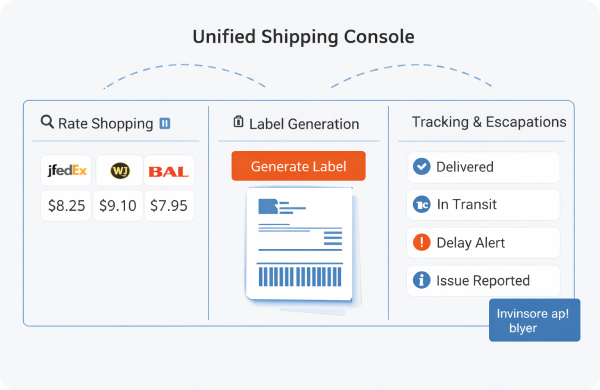
Unified shipping workflows without carrier portals and manual handoffs

When rates, booking, labels, tracking and delivery confirmations all live across different carrier sites, operations slow down, errors multiply, and teams lose visibility. A unified logistics API layer lets all shipping actions happen inside your TMS or order management system:

  • rate shopping across carriers from a single workflow
  • label generation without switching tools
  • tracking and exceptions consolidated into one view
  • returns and re-shipments triggered directly from your internal system

This removes the operational drag caused by inconsistent portals and replaces it with a predictable, automated flow.

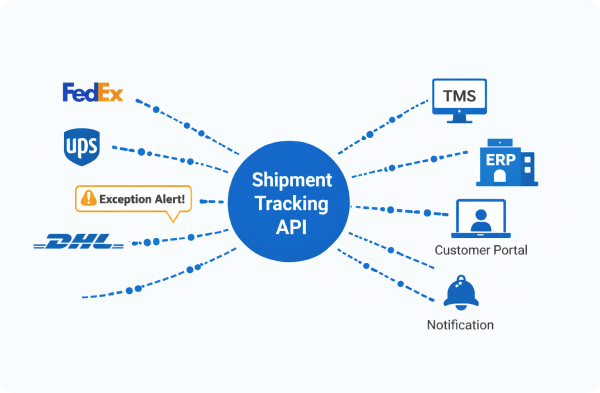
Real-time shipment visibility across carriers and systems

Tracking data often arrives late, is inconsistent between systems, or disappears into vendor dashboards that no one checks on time. With a centralized shipment tracking API:

  • all statuses flow into the TMS, ERP, customer portal and notifications
  • operations teams see delays and exceptions immediately
  • customers receive accurate, real-time updates without contacting support

Visibility stops being a guessing game and becomes a reliable operational signal.

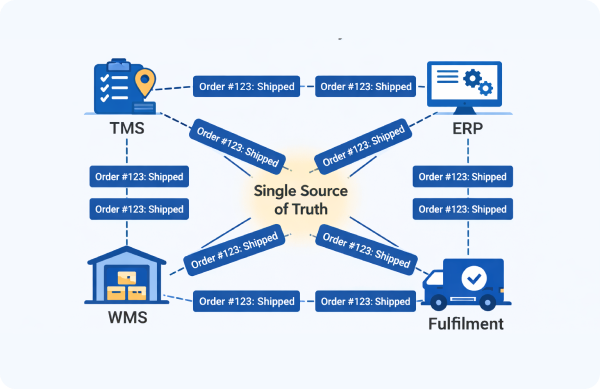
Clean, synchronized data across TMS, ERP, WMS, and fulfillment tools

Disconnected integrations create mismatched statuses, incorrect charges, duplicated data and unreliable reporting. API-driven logistics integrations ensure that:

  • order, shipment and invoice statuses stay consistent everywhere
  • charges and surcharges match across systems
  • fulfillment and inventory remain accurate inside WMS/OMS
  • analytics and BI run on a single, trustworthy dataset

This eliminates the data chaos that slows down planning, billing and customer communication.

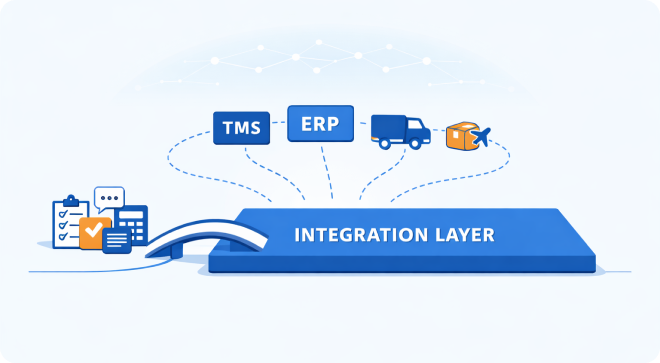
Faster carrier and partner onboarding with a reusable integration layer

Adding a new carrier shouldn’t require a multi-week development project or risky one-off scripts. A flexible integration layer allows new partners to be onboarded by extending:

  • a carrier adapter
  • mappings for unique data formats
  • validation, throttling, and monitoring rules

This keeps engineering focused while letting operations expand the network quickly.

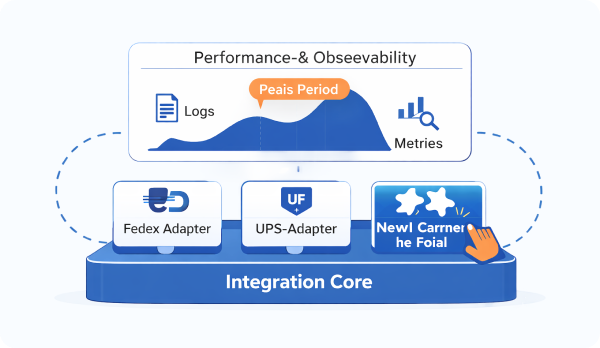
Integration infrastructure that scales for volume and peak periods

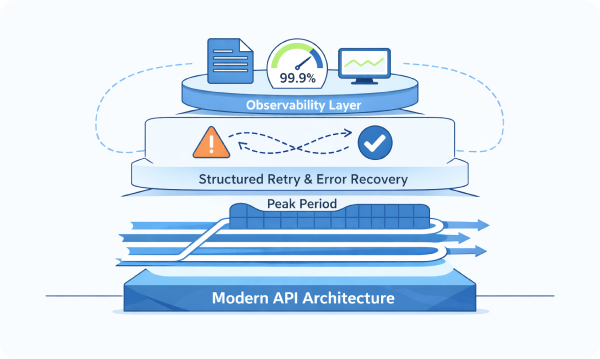
Logistics integrations fail when they rely on fragile point-to-point connections, poor error handling or systems not built for volume. A modern API architecture ensures:

  • high-throughput processing during busy cycles
  • structured retries and error recovery
  • observability across pipelines for clear insight into failures and delays

As shipment volume grows, integrations remain stable - not another bottleneck.

Business Outcomes of Logistics API Integrations

There are several major benefit your business can achieve after integrating with logistics carriers:

Real-time monitoring and alerting

You’ll always have important data such as shipping rates, tracking, and inventory levels at your fingertips to make quick yet well-informed decisions.

Process automation across shipping workflows

The amounts of repetitive and manual tasks will decrease, letting your teams focus on more important tasks.

Inventory and fulfillment data consistency

Your company will never face over or understocking risks as you’ll always know how many items you have in your stock at the moment.

Faster, more reliable order fulfillment

Whichever order you have to deliver, the integration will offer you the best route and transportation method for the most optimal price.

Compliance reporting and procurement workflows

You’ll be able to create documents for compliance and reporting in a couple of clicks and error-free.

Cost reduction through fewer errors and less manual work

Once you save time and effort as well as pick the most optimal routes, you’ll save much of your operational expenses.

How We Deliver Logistics API Integration Projects

Integration discovery and mapping

We start by mapping:

  • existing systems and carriers
  • critical events (order placed, shipped, delayed, delivered, invoiced, returned)
  • current manual steps and bottlenecks

From there we define target data flows and responsibilities for each system.

API and data contract design

We design a unified integration layer:

  • consistent data models for orders, shipments, events, rates, invoices
  • clear API contracts between your systems and the integration platform
  • translation rules for carriers, EDI messages, and IoT data

This avoids one-off point integrations that are hard to maintain.

Build the Logistics Integrations You Actually Need

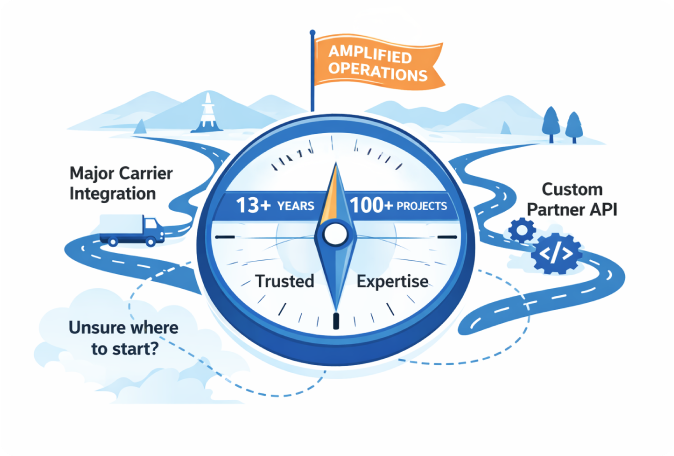
Being integrated with a major logistics carrier or just with a small company you partner with is a good amplifier of your business operations, delivery time, and customer experience. Whether you need to integrate with a big carrier or write a brand-new API for integration with your partner company, you can always count on TwinCore.
Our team has more than 13 years of experience in custom logistics software development, and we have successfully finished more than 100 successful projects. Even if you don’t know where to start and what integrations you need, you can still get in touch with us. Our team of experts will answer all your questions and provide you with a detailed roadmap of how we can help you advance your business processes.
TwinCore will help you build any integration you need

Ready to Connect Your Logistics Stack?

If your teams are still acting as the “middleware” between systems, it’s time to replace manual work with a proper integration layer.

TwinCore designs and builds logistics API integrations that connect carriers, platforms, and internal systems into one reliable, real-time network.

Talk to our logistics engineering team to map your current systems and design the integrations you actually need.

Contact us

What our clients say about us

  • TwinCore has elevated the client's customers to the next level of supply chain management. The team is highly cost-efficient from a project management standpoint, and internal stakeholders are particularly impressed with the service provider's team dynamic.

    Alex Lopatkin
    Alex Lopatkin
    Amous
  • TwinCore delivered a fully functional solution on time, meeting expectations. The highly organized team employed a DevOps approach, swiftly responded to needs and concerns, and led a productive, enjoyable workflow. Their receptiveness to client requests and feedback stood out.

    Bruno Maurer
    Bruno Maurer
    Managin Director, N-tree
  • Thanks to TwinCore’s work, the client has gained a user-friendly, stable, and scalable SaaS platform. The team manages the engagement well by being reliable and punctual; they deliver tasks on time. Their resources are also highly flexible, resulting in a truly seamless engagement with the client.

    Mischa Herbrand
    Mischa Herbrand
    Executive, CIN
  • TwinCore successfully audited the apps and converted them into modern web apps, meeting expectations. They completed the project on time and within the agreed budget. Communicating through virtual meetings, the team provided updates and responded to the client's concerns.

    JH
    Joe Holme
    IT Director, GDD Associates
  • TwinCore delivered a fully functional solution on time, meeting expectations. The highly organized team employed a DevOps approach, swiftly responded to needs and concerns, and led a productive, enjoyable workflow. Their receptiveness to client requests and feedback stood out.

    A
    Anonymous
    Managing Director, Marketing Company

Related Topics

Frequently Asked Questions


What can Logistics API Integrations actually automate?

They can automate everything from label generation and rate selection to pickup scheduling and tracking updates. Instead of switching between carrier portals and manual exports, all data flows in real time across your internal systems, carrier APIs, and customer touchpoints.


Do we need to switch carriers to use your integration platform?

Not at all. Our platform connects to hundreds of carriers globally — including DHL, FedEx, UPS, regional providers, and freight networks. We integrate with your existing logistics partners, so you keep your contracts, but streamline how everything works behind the scenes.


Can Logistics API Integrations handle international shipping?

Yes. We support cross-border logistics, including multi-language labeling, customs document automation, and dynamic carrier selection based on destination or delivery time. Everything is structured for compliance with customs, taxes, and duties in supported regions.


Will our internal team need to maintain the API connections?

No. We handle all updates, maintenance, and carrier API changes. Our integration layer is built to absorb updates from carriers and 3rd parties without breaking your workflows. Your tech team stays focused on core business — we cover the plumbing.


How fast can we go live with an integration?

Most clients go live in a few weeks. We start with a system audit, map your workflows, and plug in prebuilt connectors. Compared to custom-building each integration in-house, our process is faster, safer, and requires fewer internal resources.


What happens when a carrier API goes down or changes format?

Our platform includes monitoring and fallback logic. If a carrier service fails, we can retry, switch to a backup carrier, or alert your team. We proactively handle API updates so you don’t experience disruptions or failed shipments.


Scroll to top