30+
professionals
100+
success projects
1 week
trial offer
Clutch rating

Logistics lives and dies on a series of daily decisions: how to build loads, which routes to run, how to price capacity, where to shift resources, and how to react when disruptions appear. These decisions are made under pressure, across fragmented systems, and with incomplete information - which is exactly where AI can finally deliver real value.

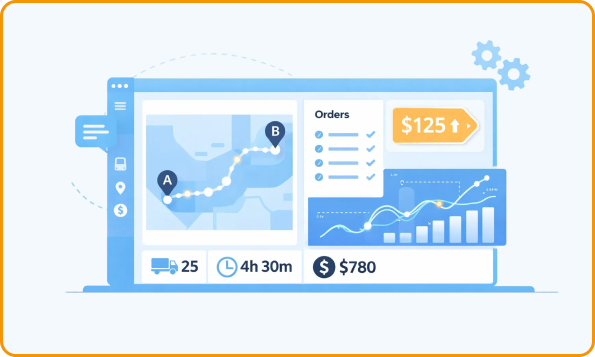
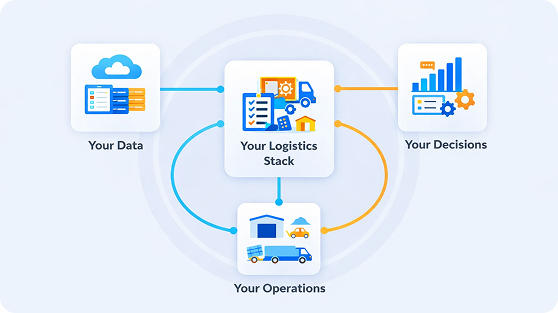
AI for Logistics is a practical, integration-first service that strengthens those decisions inside the tools your teams already use. We add AI-driven planning, forecasting, pricing, and risk intelligence directly into your TMS, routing engine, fleet platform, IoT layer, WMS and ERP. No extra dashboards, no isolated prototypes - just smarter operations powered by data you already generate.

Contact us

At a Glance: What You Get

  • AI-powered route optimization and load planning
  • Demand and volume forecasting for lanes, regions and customers
  • Dynamic pricing and tender intelligence for freight and logistics services
  • Warehouse and fulfillment optimization driven by real data
  • Risk and anomaly detection across routes, partners and operations
  • Predictive maintenance models for fleets and equipment
  • AI copilots that help planners and managers reason about complex trade-offs
  • Solutions integrated directly into your logistics stack, not bolted on the side

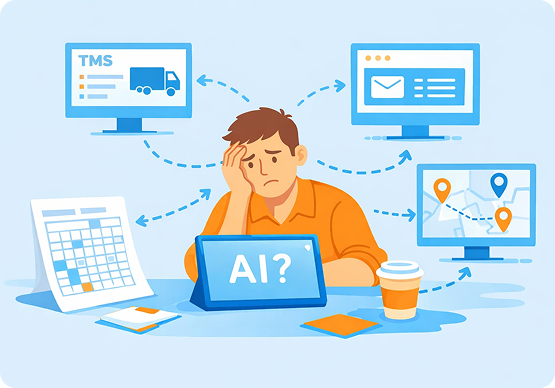
Struggling to Make AI Useful in Logistics?

There is no shortage of AI talk in logistics. The gap is between slides and production.

You might recognize some of these issues:

  • You’ve tried “AI projects” that never moved beyond prototypes
  • Data is scattered across TMS, WMS, ERP, telematics and spreadsheets
  • Vendors pitch generic AI platforms with little understanding of your network
  • Route planning and load building are still manual and time-consuming
  • Pricing decisions depend heavily on gut feeling and past experience
  • Forecasts exist, but no one trusts them enough to make real decisions
  • Models are hard to maintain, and no one owns them long-term

We built our AI for Logistics offering to cut through that noise and focus on a small set of high-impact, realistic use cases.

Where AI Actually Helps in Logistics

AI for Route Optimization & Load Planning

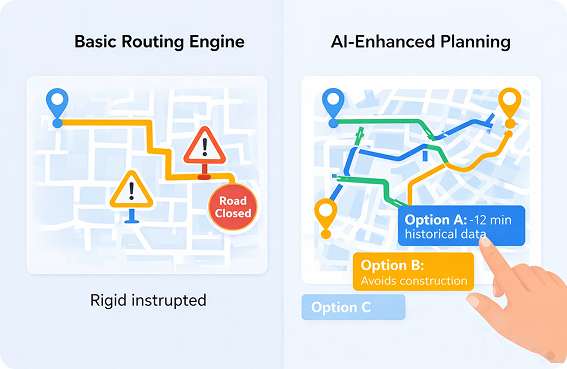
Static routing engines struggle when conditions constantly shift - traffic, service windows, last-minute orders, skill constraints, depot limitations, or equipment availability. Our AI models combine optimization algorithms with real-world operational patterns to:

  • recommend stronger routes based on historical performance, congestion, and constraints
  • improve load consolidation and lane balancing across depots
  • adjust plans dynamically when delays, cancellations, or new orders appear
  • suggest how to redistribute capacity across regions or fleets

This doesn’t replace planners. It gives them smarter starting points, faster recalculations, and options that reduce empty miles, fuel waste, and service failures.

AI for Demand & Volume Forecasting

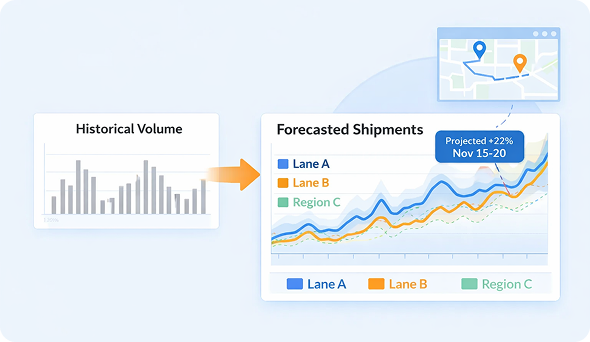
Routing and capacity planning becomes expensive guesswork when tomorrow’s volume is unclear. We build forecasting models that help teams:

  • anticipate shipment volumes by lane, customer, product, and region
  • identify peaks, troughs, seasonality, and abnormal demand behavior
  • plan staffing, fleet allocation, and procurement with fewer surprises
  • feed volume expectations directly into routing, warehouse, and carrier decisions

The goal is not perfect predictions, but a more predictable operation that avoids overstaffing, undercapacity, and costly last-minute fixes.

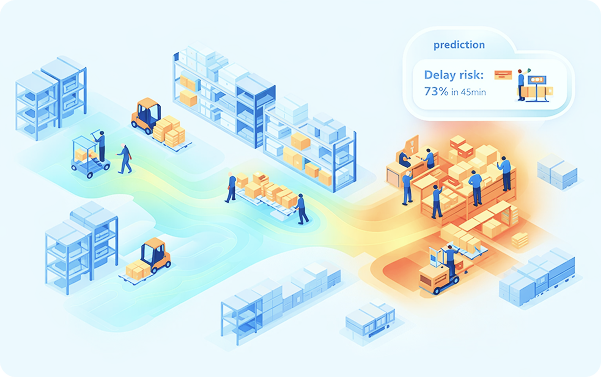
AI for Warehouse & Fulfillment Operations

Warehouses generate enormous data streams - scan events, movement patterns, congestion hotspots - but most of it never informs decisions. AI unlocks that value by helping you:

  • detect bottlenecks in picking, packing, staging, and putaway
  • improve slotting and storage based on real movement and velocity
  • predict where fulfillment delays are likely to emerge
  • support labor planning with accurate workload expectations

These insights feed back into WMS and TMS, so warehouse adjustments align with transportation schedules and customer commitments instead of working against them.

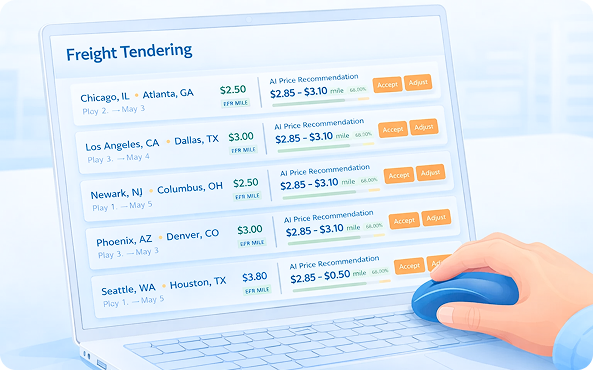
AI for Dynamic Pricing & Tendering

Rate sheets and gut feeling can’t keep up with volatile freight markets. We build AI models that:

  • score tenders based on probability of winning and expected profitability
  • recommend competitive pricing ranges using demand, historical performance, and capacity signals
  • flag unprofitable lanes, customers, or contract terms
  • support negotiations with data, not intuition

You stay in control of commercial decisions - but with clearer visibility into trade-offs, risk, and margin impact.

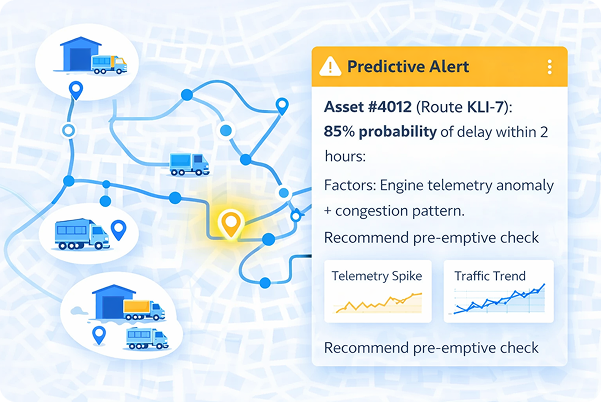
AI for Risk, Exceptions & Predictive Maintenance

Logistics networks produce early warning signs long before failures occur: repeated exceptions, late statuses, sensor anomalies, abnormal vendor behavior, or unexpected route deviations. Our AI systems surface these signals by:

  • detecting anomalies in transit times, routes, carrier performance, and event sequences
  • identifying lanes, partners, or assets with elevated operational risk
  • predicting maintenance needs based on telematics, usage, and environmental conditions
  • alerting teams early enough to prevent costly disruption

Instead of reacting to breakdowns or service failures, teams can intervene before they escalate.

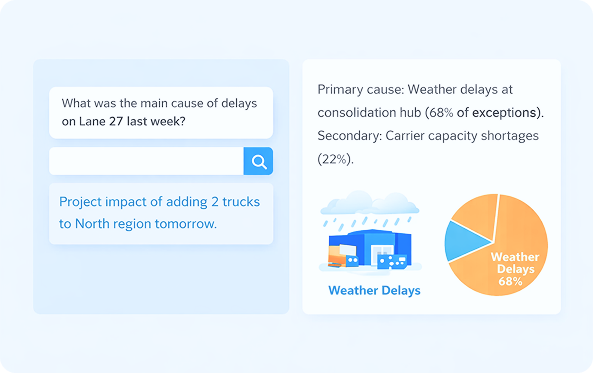
AI Copilots & Decision Support for Logistics Teams

Dashboards don’t always help when teams need clear answers fast. AI copilots let people ask direct questions and get responses grounded in their own operational data.

We build logistics-specific copilots that:

  • explore “what-if” scenarios for routing, allocation, pricing, and capacity
  • help operations investigate incidents across multiple systems
  • provide explanations for performance issues on specific lanes, fleets, or customers
  • generate structured reports, case summaries, and insights automatically

The goal isn’t to automate human judgment - it’s to make complex situations clearer, faster, and easier to act on.

Outcomes You Can Expect

The exact numbers depend on your business, but AI for Logistics done right usually leads to:

Better planning quality

more realistic routes, loads and capacity plans


Less manual work

planners spend more time choosing between good options, less time building them from scratch

Improved service levels

fewer missed commitments, more predictable delivery performance

Healthier margins

more clarity around pricing, costs and profitability per lane or customer

Reduced waste and downtime

fewer empty miles, reduced spoilage, more proactive maintenance

Stronger internal alignment

decisions grounded in shared data instead of fragmented reports

Our focus is not on vanity metrics, but on the parts of your operation where decisions have real financial and service impact.

How We Build AI into Your Logistics Stack

Data & Systems Mapping

We start by understanding:

  • which systems you use (TMS, WMS, ERP, telematics, IoT, custom tools)
  • what data is already available and in what shape
  • where decisions are currently made and how
  • which problems are worth solving first

This stage keeps us from designing models in a vacuum.

Use Case Selection

Instead of chasing every possible AI idea, we prioritize a small set of use cases that are:

  • feasible with your data and systems
  • clearly tied to measurable outcomes
  • aligned with the way your teams actually work

Typical starting points are route optimization, forecasting, dynamic pricing or risk detection.

Data Pipelines & Modeling

We then:

  • build or refine data pipelines from your systems into a usable format
  • engineer features that reflect real logistics behavior
  • select or train models suited to each use case (optimization, ML, or hybrid approaches)
  • validate results with your team, not just with metrics

The goal is models that are good enough to support real decisions, not perfect academic constructs.

Integration into Workflows

AI only matters if it shows up where people actually work.

We integrate model outputs into:

  • routing and planning tools
  • TMS decision screens
  • pricing workflows
  • internal portals and dashboards
  • alerts and notification systems

Monitoring, Tuning & Scale

Once in production, models and data flows:

  • are monitored for quality, drift and performance
  • are adjusted as your network, customers or markets change
  • can be extended to new regions, fleets, products or business units

We treat AI as part of your long-term logistics infrastructure, not as a one-off project.

Why TwinCore for AI in Logistics

Most AI vendors show you impressive demos that live outside your core systems. We take a different approach:

Logistics-first

we already build TMS, routing, fleet, API and IoT solutions, so we understand the context where AI will live

Integration-first

we start from your existing stack and integrate models into real workflows, not side dashboards

Practical use cases

we focus on a handful of scenarios where AI can clearly improve planning, pricing and risk – not on generic “transformation” slogans

Stable engineering

we design data pipelines and models to survive real-world conditions, volume and imperfect data

You’re not getting a lab experiment. You’re getting an extension of your logistics systems that helps people make better decisions.

Ready to Make AI a Useful Part of Your Logistics Stack?

If you’re tired of AI promises that don’t survive contact with real operations, it may be time to approach it differently: start with your systems, your data and your decisions.

TwinCore helps you design and implement AI for Logistics that fits how your network actually runs and supports the people who keep it moving.

Talk to our AI & logistics engineering team

Contact us

What our clients say about us

  • TwinCore has elevated the client's customers to the next level of supply chain management. The team is highly cost-efficient from a project management standpoint, and internal stakeholders are particularly impressed with the service provider's team dynamic.

    Alex Lopatkin
    Alex Lopatkin
    Amous
  • TwinCore delivered a fully functional solution on time, meeting expectations. The highly organized team employed a DevOps approach, swiftly responded to needs and concerns, and led a productive, enjoyable workflow. Their receptiveness to client requests and feedback stood out.

    Bruno Maurer
    Bruno Maurer
    Managin Director, N-tree
  • Thanks to TwinCore’s work, the client has gained a user-friendly, stable, and scalable SaaS platform. The team manages the engagement well by being reliable and punctual; they deliver tasks on time. Their resources are also highly flexible, resulting in a truly seamless engagement with the client.

    Mischa Herbrand
    Mischa Herbrand
    Executive, CIN
  • TwinCore successfully audited the apps and converted them into modern web apps, meeting expectations. They completed the project on time and within the agreed budget. Communicating through virtual meetings, the team provided updates and responded to the client's concerns.

    JH
    Joe Holme
    IT Director, GDD Associates
  • TwinCore delivered a fully functional solution on time, meeting expectations. The highly organized team employed a DevOps approach, swiftly responded to needs and concerns, and led a productive, enjoyable workflow. Their receptiveness to client requests and feedback stood out.

    A
    Anonymous
    Managing Director, Marketing Company

Related Topics

Frequently Asked Questions


Do we need a data lake or “big data platform” before starting?

No. It helps to have your data reasonably accessible, but many high-value use cases can start with the systems you already have, as long as we can access and clean the data from them.


Can you work with our existing TMS, WMS and ERP?

Yes. Our approach is integration-first. We connect to your current tools via APIs, databases, event streams or batch exports and then push results back into the systems where your teams work.


Which AI use cases usually deliver value fastest?

In most organizations, early wins come from better route and load planning, demand and volume forecasting for specific lanes or regions, and targeted pricing or margin insight for a set of core customers.


How do you handle model drift and changing conditions?

We set up monitoring for model performance and data quality, schedule regular retraining where needed, and adjust features or model choices as your network, customers or market conditions change.


Will AI replace our planners and operations team?

No. The most successful AI deployments in logistics augment planners and operations teams rather than replace them. The aim is to give them stronger options, clearer visibility and better reasoning tools, not to fully automate judgment.


Scroll to top