30+
professionals
100+
success projects
1 week
trial offer
Clutch rating

Make Loads Executable Before They Reach the Dock

Transportation efficiency depends on how freight is actually loaded, not only on how routes are calculated. Poor weight distribution, axle overloads, incorrect stacking, or unload sequences that don’t match the route create delays and rework long before the truck leaves the yard.

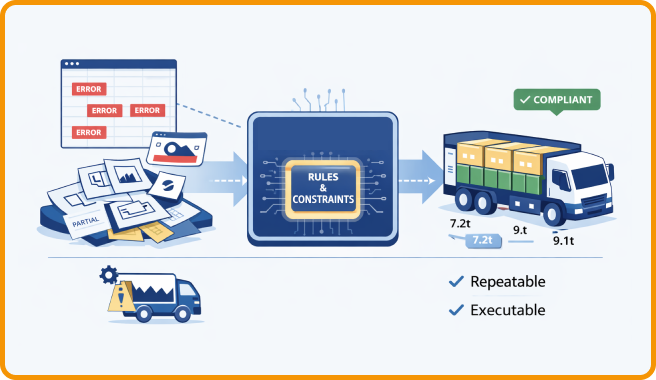
TwinCore builds load planning software that converts your loading rules into a consistent, repeatable process. The system plans loads across weight and volume, enforces stacking and handling constraints, supports consolidation logic, and produces load plans your warehouse and transport teams can execute without manual fixes.

Load Planning Capabilities That Improve Utilization and Execution

3D Load Building with Practical Editing

Generate load plans fast, visualize how space is used, and adjust layouts when exceptions show up. Many planning tools succeed specifically because they combine automated planning with a manual editor for real-world corrections.

Axle Weight, Center of Gravity, and Compliance Checks

Plan loads with axle limits, permissible total weight, and center-of-gravity logic in mind, so teams don’t discover problems at the gate or on the road. This is a common differentiator in modern loading tools.

Stacking, Handling, and Damage-Prevention Rules

Model what can and cannot be stacked, fragile zones, rotation/orientation limits, and separation rules (virtual walls / non-stackable groups). These constraints matter as much as fit if you want fewer damages and fewer reworks.

Load Consolidation and Capacity Utilization Logic

A route is only efficient if assets are filled correctly. Load planning should maximize utilization across weight, volume, stacking, and handling rules, reduce empty miles, and prevent uneven loading that creates risk or delays.

Integrations That Turn Load Planning into an Operational System

TMS / OMS Integration

Bring in orders, shipment attributes, service constraints, and delivery requirements automatically, so planning starts from clean data instead of spreadsheets.

WMS + Item Master Data

Load quality depends on accurate dimensions, weights, packaging rules, and handling restrictions. Sync item master and packaging data so the plan reflects what can actually be loaded.

Warehouse Execution

Export loading sequences, bay-level instructions, and load documentation to reduce dock confusion and speed up loading. Tools that win here usually emphasize step-by-step and execution-ready output.

Reporting, Cost Attribution

Track utilization (cube/weight), consolidation rate, damages/exceptions, and rework frequency. The goal is to connect load decisions with measurable cost outcomes.

Where Generic Load Planning Stops Scaling

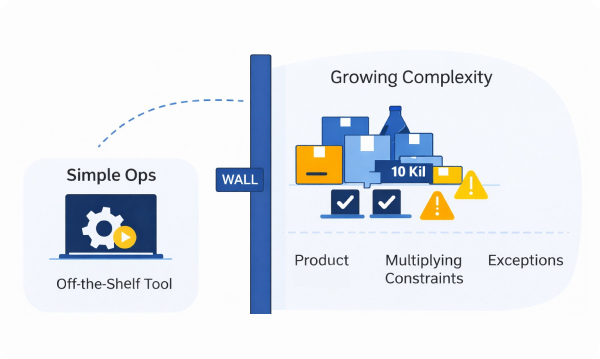
Standard load planning tools tend to work while operations stay relatively simple. As product variety grows, constraints multiply, and exceptions become part of daily work, teams start compensating manually to make plans usable on the dock.

Custom load planning becomes relevant when loading rules directly affect cost and service quality. Weight distribution, stacking and handling limits, unload order, consolidation logic, and warehouse execution need to be applied consistently, not adjusted on the fly. When these rules are embedded into the planning logic, utilization improves and day-to-day loading becomes predictable instead of reactive.

Why Teams Build Load Planning with TwinCore

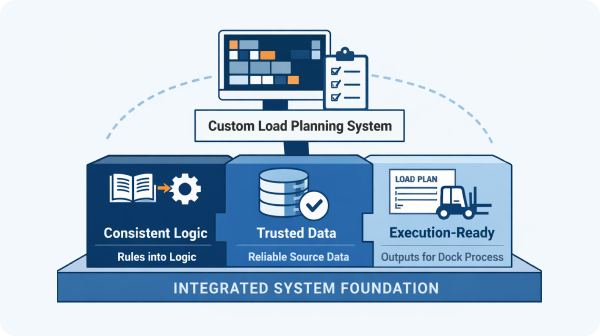
Load planning at TwinCore is built as part of logistics systems that run daily operations, not as a separate visualization tool. Our work focuses on how loads are actually prepared, checked, and executed across warehouse and transport workflows.

We translate loading rules into consistent system logic, connect planning to reliable source data, and design outputs that fit real dock processes. The result is load plans that remain usable under normal operational pressure, without relying on manual fixes or last-minute adjustments.

Ready to Improve Utilization Without Breaking Execution?

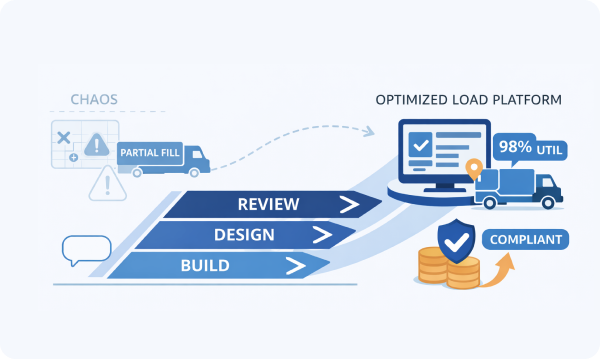
If your team spends time reworking loads, shipping partially filled trucks, or discovering compliance issues too late, load planning is already costing you money. TwinCore can review your current constraints, data sources, and workflow, then propose a load planning solution that fits your operation.

What our clients say about us

  • TwinCore has elevated the client's customers to the next level of supply chain management. The team is highly cost-efficient from a project management standpoint, and internal stakeholders are particularly impressed with the service provider's team dynamic.

    Alex Lopatkin
    Alex Lopatkin
    Amous
  • TwinCore delivered a fully functional solution on time, meeting expectations. The highly organized team employed a DevOps approach, swiftly responded to needs and concerns, and led a productive, enjoyable workflow. Their receptiveness to client requests and feedback stood out.

    Bruno Maurer
    Bruno Maurer
    Managin Director, N-tree
  • Thanks to TwinCore’s work, the client has gained a user-friendly, stable, and scalable SaaS platform. The team manages the engagement well by being reliable and punctual; they deliver tasks on time. Their resources are also highly flexible, resulting in a truly seamless engagement with the client.

    Mischa Herbrand
    Mischa Herbrand
    Executive, CIN
  • TwinCore successfully audited the apps and converted them into modern web apps, meeting expectations. They completed the project on time and within the agreed budget. Communicating through virtual meetings, the team provided updates and responded to the client's concerns.

    JH
    Joe Holme
    IT Director, GDD Associates
  • TwinCore delivered a fully functional solution on time, meeting expectations. The highly organized team employed a DevOps approach, swiftly responded to needs and concerns, and led a productive, enjoyable workflow. Their receptiveness to client requests and feedback stood out.

    A
    Anonymous
    Managing Director, Marketing Company

Related Topics

Frequently Asked Questions


What’s the difference between load planning and load optimization?

Load planning is the executable plan: how items are arranged, constrained, and sequenced for loading/unloading. Optimization is the algorithmic layer that searches for better utilization while respecting constraints like stacking rules, axle limits, and handling restrictions.


Which constraints can be modeled?

Typical constraints include weight/volume limits, axle-weight patterns, center of gravity, stacking/fragile rules, orientation limits, separation rules (zones/virtual walls), and unload sequence requirements. Many commercial tools highlight these exact categories because that’s what breaks simple loading.


Can the system support consolidation?

Yes. Consolidation logic can group shipments by rules like zone, service level, customer profile, and time windows, then build fuller loads while preserving SLAs. That’s also how TMS platforms describe load planning + consolidation in practice.


What data is needed to get started?

At minimum: item dimensions/weights (and packaging rules), shipment/order lines, vehicle/container specs, and your hard loading constraints. If you have historical loads plus actual outcomes (rework, damages, utilization), validation and tuning get much faster.


How do you validate that the better load is actually better?

By comparing against baseline KPIs: utilization (cube/weight), number of partial loads, loading time, rework frequency, damage rates, and constraint violations. If the plan looks good in 3D but creates dock friction, it fails.


Scroll to top