
 LinkedIn
 Twitter
 Facebook
 Youtube


Getting routes right shouldn’t depend on spreadsheets, guesswork, or whatever limitations your current SaaS tool comes with. When your business runs dozens or hundreds of daily stops, mixed fleets, strict delivery windows, and cost pressure from all sides, generic route planners simply can’t keep up. This page is about one thing: giving you a route optimization engine that actually fits your operations, instead of forcing your operations to fit into someone else’s template.
If your routes still depend on spreadsheets, guesswork, or whatever limits your current SaaS tool has, you’re not just wasting fuel. You’re burning dispatcher time, stressing drivers, missing SLAs, and leaving money on the road.
We build custom route optimization and load planning software that actually matches your fleet, geography, constraints, and service commitments instead of forcing your operation into a generic template.
Core Capabilities for Routing, Loading, and Consolidation
Route Optimization Engine Built Around Your Constraints
Most routing engines simplify operations into a handful of toggles — which works until your network needs to respect real delivery windows, SLAs, driver qualifications, fleet limitations, depot rules, cold-chain requirements, or multi-day schedules. A custom routing engine models the world as it actually works, not the oversimplified version SaaS tools assume. It supports:
- multi-stop, multi-depot, multi-day routing
- capacity, weight, volume and pallet constraints
- time windows and service-time restrictions
- differentiated equipment types and zoning rules
- linehaul + last-mile combinations
- customer-specific priorities and exceptions
Routing becomes predictable, scalable, and aligned with how your operation truly runs.
Load Planning & Capacity Utilization
A route is only efficient if the assets behind it are used correctly. Custom load-planning logic ensures vehicles are filled based on real constraints — not just geography or evenly distributed volume. It helps teams:
- maximize utilization across weight, volume, stacking and handling rules
- cut fuel spend and reduce empty miles
- prevent uneven loading that creates risk or delays
- build plans that match the actual capabilities of your fleet
Routing and load planning operate together, so every mile delivers maximum economic value.
Shipment Consolidation for More Efficient Runs
Whether the operation is LTL, FTL, cross-dock or last-mile, consolidation rules directly affect margin. Custom consolidation logic allows you to:
- group shipments by zones, service levels, customer profiles or time windows
- build milk-run cycles that reduce total distance
- maintain SLAs while lowering total trip count
- automatically detect consolidation opportunities
This improves asset utilization, lowers cost per stop, and strengthens the economics of each lane.
Real-Time Replanning When Reality Changes
In logistics, the first plan is rarely the final one. Traffic, last-minute orders, failed deliveries, capacity changes, equipment issues or driver availability all shift the picture throughout the day. A dynamic engine gives teams the ability to:
- recalculate routes instantly
- insert new orders into active runs
- reassign vehicles based on real availability
- push updated instructions to drivers within seconds
Static planning gives you a schedule. Real-time replanning gives you the control to keep operations profitable and on track when conditions change.
Integrations That Make Routing Actually Work
Route optimization doesn’t live on an island. To be useful, it needs clean data in and clear actions out. We treat routing as part of your logistics engine and integrate it with the systems you already use:
Telematics & GPS
- Live vehicle locations, speed, traffic patterns, idle events, ETAs, and anomalies
- Direct feedback loops into the routing engine so plans reflect what’s happening on the road
TMS / OMS / WMS
- Orders, stops, shipment data, constraints, depot locations, and statuses flow between systems
- Routing decisions are made with full context instead of partial data
Driver apps
- Mobile apps provide step-by-step routes, stop details, and live updates
- Drivers can submit proof of delivery and exceptions directly from the app
Billing & rate engines
- Mileage, stops, service times, and exceptions feed into billing rules
- Invoices, surcharges, and adjustments can be automated with confidence
Who Uses Custom Route Optimization Software
Custom routing isn’t just for massive enterprises. It becomes valuable whenever complexity starts destroying efficiency. It fits operations such as:
- Last-mile delivery companies with tight windows and hundreds of daily stops
- Distribution networks moving goods between hubs, depots, and customers
- 3PLs and carriers managing mixed fleets and multi-modal operations
- Retailers and wholesalers running regional or national delivery cycles
- Manufacturers with their own transport units and recurring routes
- Field-service organizations managing technicians, tools, and time-bound jobs
If routes are simple and low-volume, standard SaaS tools are often enough. If routes are messy, high-stakes, and constantly changing, custom software is usually the only thing that scales.
Why TwinCore for Route Optimisation & Load Planning Systems
Route optimization looks straightforward on slides and demos. It becomes difficult when it has to survive real-world constraints: delivery windows that don’t align, changing traffic, driver hour limits, vehicle restrictions, customer preferences, and constant exceptions.
Most ready-made tools handle ideal cases well. Real operations live in edge cases.
Our approach focuses on:
- Accurate constraint modelling from the start: Time windows, stop dependencies, vehicle rules, contract limitations, and priority logic are treated as first-class concepts, not add-ons.
- Architecture built for change: New depots, new carrier rules, new optimization strategies, and new service models can be introduced without rewriting the planner every time the business evolves.
- Operational trust, not just theoretical optimality: The goal is not a mathematically perfect route that nobody follows, but stable, repeatable planning that dispatch teams actually trust and adopt.
Ready to make routing a strength instead of a daily problem?
If you’ve outgrown generic route planners and want software that matches how your logistics actually runs, we can help. We’ll review your current planning process, constraints, data sources, and systems, then design a route optimization and load planning solution that improves real metrics: mileage, utilization, on-time performance, and planner workload.
Talk to our logistics engineering team and let’s see what a routing engine built for your operation would look like.
Related Topics
-
 How to Integrate DHL API into Your Logistics Software
Learn how DHL API improves logistics automation in eCommerce and enterprise software. Use...
Read more -
 How to Integrate FedEx API into Your Logistics Software
See how FedEx API connects with your logistics or eCommerce software. Automate labels,...
Read more -
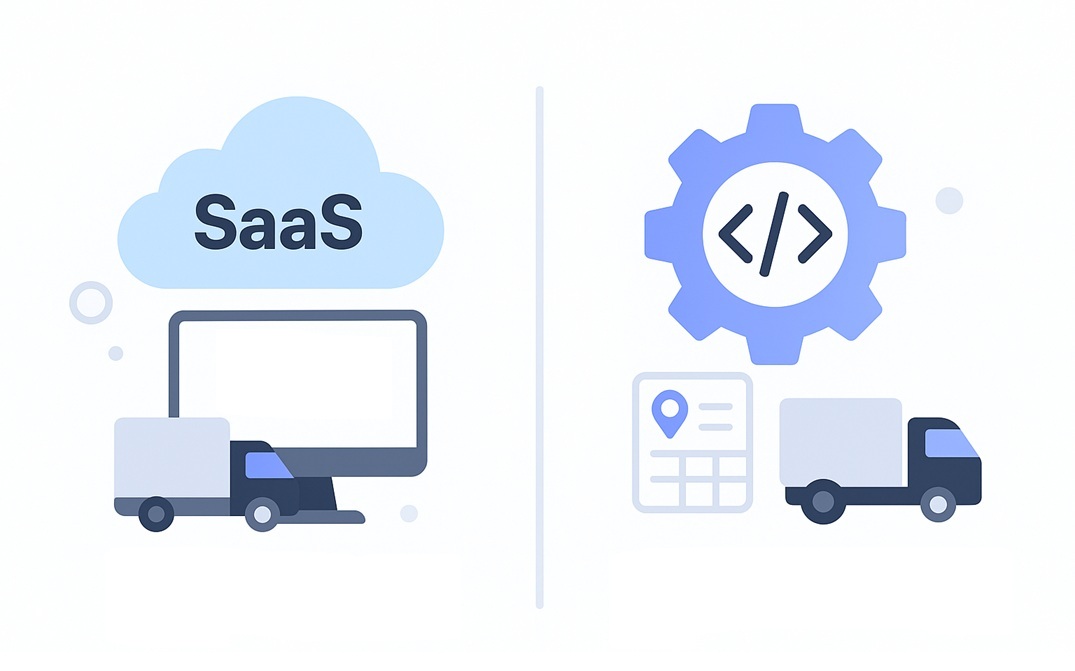 SaaS TMS vs Custom TMS: Why the Trade-Off Defines Your Logistics Future
Compare custom logistics software vs off-the-shelf solutions. Find out what fits your...
Read more -
 From Spreadsheets to Automation: A Fleet Manager’s Guide to Going Digital
Say goodbye to spreadsheets. Learn how digital fleet management software improves...
Read more -
 Everything You Need to Know About Dynamic Route Optimization
Are you constantly scuffling with visitors' jams, overlooked transport home windows, and...
Read more -
 Logistics and Supply Chain Trends 2024
The Supply Chain and Logistics Industry trends are experiencing unprecedented...
Read more -
 What Is Fleet Management Technology?
Managing a fleet of vehicles, whether 25 or 250,000, is a complex task involving...
Read more -
 Custom WMS Software Development
You’ve certainly got your clothes falling out of the shelf right onto your head at least...
Read more -
 How to Improve Logistics Operations
Logistics and transportation industry is notorious for being extremely immune to changes:...
Read more


Frequently Asked Questions
Because SaaS tools are built for the average case, and your operations aren’t average. If you have tricky delivery windows, complex constraints, mixed fleets, cross-dock logic, or multi-depot networks, you quickly hit the limits of SaaS. Custom routing works around your business, not against it.
Yes. Route optimization only works well when it’s tied into your logistics data. Orders, constraints, vehicle data, telematics, and billing flow in and out seamlessly. No manual re-entry, no CSV hell.
Seconds. When a driver misses a stop, traffic slows down, or a new order appears, the system recalculates and updates the mobile app instantly. No waiting until “the next planning cycle.”
No. You can start with routing only. Later, if you want, you can expand into fleet management, order management, rate engines, or full TMS functionality. Everything is modular.
We model your rules explicitly: time windows, loading times, constraints, zoning, priorities, fixed stops, driver skills, and dozens of other factors. You get the exact logic you use on the ground - except automated and scalable.
