LinkedIn
 Twitter
 Facebook
 Youtube


Most logistics software looks fine in a demo, until you try to scale it, integrate it, or modify a workflow that doesn’t fit the vendor’s template. That’s when things start breaking: routing logic, rating rules, billing flows, driver management, telematics feeds, exceptions, and integrations - all turning into brittle patches.
The TwinCore Logistics Framework is built to prevent exactly that. It’s a modular engineering foundation for building TMS platforms, fleet systems, rate engines, shipment tools, routing engines, and custom logistics applications - fast, safely, and without reinventing the wheel every time.
You get full control, faster delivery, and a system that evolves instead of boxing you in.
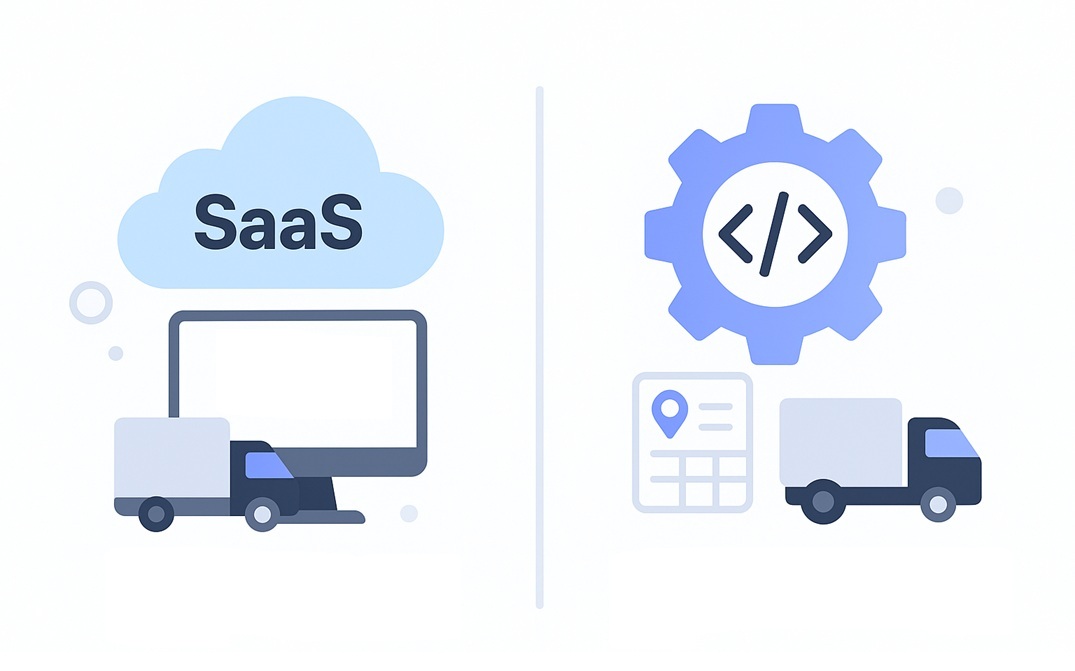
Why we built a framework instead of SaaS
Most logistics SaaS platforms fail teams with complex operations. They lock workflows into rigid templates, restrict integrations, and force businesses into artificial “feature tiers.”
A framework avoids all of that:
- No per-seat pricing
- No “enterprise plan” limits
- No hard-coded logic that can’t be changed
- No dependence on a vendor’s roadmap
You get long-term ownership, full flexibility, and the ability to model logistics exactly as it happens in your business.
Built on modern, scalable engineering principles
The Framework is used in production across complex logistics environments. It’s designed for high volume, unpredictable flows, data-heavy operations, and constant exceptions.
.NET microservices & modular architecture
Each domain - routing, orders, drivers, vehicles, pricing, billing, inspections — lives in its own bounded context. No more monoliths where one change breaks three other workflows.
API-first and integration-ready
Logistics always depends on integrations: carriers, telematics, ELDs, ERPs, WMS, OMS, accounting, rate engines, marketplaces. The Framework is built to integrate cleanly, not fight the ecosystem.
Event-driven logistics workflows
Logistics is events: order created, ETA updated, vehicle departed, shipment delayed, inspection failed. Everything is modeled as events so visibility and automation come naturally.
Future-proof for AI and optimization tools
Route optimization, automated dispatching, anomaly detection, AI agents - plug them in without restructuring the system.
Solution patterns: fast ways to build full systems
Instead of listing individual modules here, the Framework focuses on solution patterns - common system types we can assemble quickly, then tailor to each business.
Full Transportation Management System
A complete TMS for carriers, brokers, 3PLs, freight forwarders, or mixed operations, combining routing, order handling, fleet, rates, and integrations.
Fleet Management Platform
Built around drivers, vehicles, inspections, service schedules, compliance and telematics - for logistics companies or enterprises with large vehicle inventories.
Rate Engine / Pricing Platform
A high-performance rating engine with configurable rules, tariffs, surcharges, and API endpoints for carrier integrations or custom pricing logic.
Shipment / Freight Platform
A flexible foundation for building a digital freight marketplace, shipment aggregator, or carrier network with real-time status tracking and partner integrations.
These patterns use the same architectural base - but every implementation is customized around the company’s workflows, data model, and operational structure.
Solution patterns: fast ways to build full logistics systems
The TwinCore Logistics Framework is built around repeatable architecture patterns that accelerate development, eliminate fragile one-off integrations, and give teams a stable foundation for scaling. Instead of forcing every company into a single product, the Framework adapts to different logistics models and operational realities - reducing development time while ensuring long-term flexibility.
Custom TMS
A full Transportation Management System for carriers, brokers, 3PLs and freight forwarders. The pattern includes routing, order flows, carrier selection, fleet coordination, pricing and billing logic, compliance rules, real-time visibility, and integrations with ERP/WMS/CRM and carrier APIs. Teams get a TMS architecture that mirrors real operations instead of being compressed into “off-the-shelf” constraints.
Fleet Management Platform
Designed for operations where uptime, inspections, maintenance cycles and asset utilization determine overall performance. This pattern unifies telematics, DVIR workflows, preventive maintenance, fuel tracking, compliance, driver interactions, and fleet health analytics into one connected ecosystem. Built for modern, sensor-enabled fleets that require reliable data, not fragmented vendor dashboards.
Rate Engine / Pricing Platform
A configurable pricing foundation that handles complex transportation tariffs without relying on spreadsheets or brittle custom scripts. It supports multi-layered accessorials, dynamic fuel logic, contract rules, lane-specific adjustments, scenario testing, and real-time rating APIs. This pattern creates a single, accurate source of truth for quoting, billing and financial analysis across the logistics network.
Shipment / Freight Platform
A flexible base for building digital freight systems: marketplaces, load boards, shipment aggregators, or partner networks. Includes shipment lifecycle management, real-time tracking, event pipelines, exception handling, document flows, and collaboration tools for carriers and shippers. Designed for teams that need scalable freight orchestration without reinventing the same infrastructure from scratch.
Why a modular framework is safer than building a system from scratch
Custom logistics software is powerful, but starting from zero is expensive and unpredictable. A framework removes the risky part:
- Faster delivery. You’re not spending months building the same boilerplate logistics logic every other company also needs.
- Cleaner architecture. Each part of the system stays isolated, so new features don’t break old ones.
- Easier maintenance. Teams can work in parallel without stepping on each other’s code.
- Room to evolve. Add new workflows, integrations, or entire modules without rewriting the foundation.
- Lower cost over time. You invest in logic that’s unique to your business, not in reinventing fundamentals.
And the biggest benefit: you stay in control. No per-seat pricing, no “enterprise contract terminology,” no hidden dependency on a vendor’s roadmap.
Why a modular framework is safer than building from zero
A from-scratch logistics platform is one of the riskiest engineering projects a company can take on. A framework eliminates most of that risk:
- Faster delivery – you don’t rebuild basic logistics logic
- Cleaner architecture – bounded contexts avoid spaghetti-code failures
- Easier maintenance – teams work in parallel safely
- Room to evolve – add modules and workflows without rip-and-replace
- Lower long-term cost – invest only in logic that’s unique to your business
And the most important factor: you own the system. Not a vendor. Not a subscription model. Your architecture, your data, your future.
Who the Framework is built for
This approach works for two main groups:
- Logistics companies building long-term infrastructure. Carriers, brokers, 3PLs, dispatch centers, freight forwarders, and hybrid operations that need systems tuned to their exact workflows.
- Enterprise businesses with large fleets or complex movements. Retailers, distributors, manufacturers, field service companies, and utilities - anyone who runs vehicles, drivers, and time-sensitive operations.
If your business moves things or people and your current tools can’t keep up, this framework gives you a future-proof base to build on.
Why Companies Choose TwinCore for Logistics Architecture
Designing logistics systems comes down to structure, not buzzwords. Most problems appear later, when systems start to scale, integrations multiply, and small shortcuts turn into operational friction.
Teams work with TwinCore because of how we approach this work:
- We start with how the business actually runs, not with templates.
- We design systems so they can be extended without breaking existing logic.
- We treat integrations as part of the core system, not side projects.
- We pay attention to long-term maintainability, not just speed of delivery.
Our experience comes from practical work with complex environments: legacy platforms, carrier and ERP integrations, regulatory constraints, and teams that rely on systems every day to keep operations running.
The focus is simple: build software that stays useful as the business grows.
Ready to build smarter logistics software?
If you’re looking for a faster, safer way to develop a TMS, a fleet platform, a pricing engine, or something completely custom, the TwinCore Logistics Framework gives you a proven foundation without limiting your creativity.
Tell us what you’re trying to build - we’ll help you shape the right architecture and assemble the components that fit your operations.
Let’s talk about your logistics system.