Most companies waste months trying to force ChatGPT or no-code tools into their operations, and still end up with manual work. A US-based company hired TwinCore to build a custom AI Agent Platform where business users create, launch, and monitor AI agents that perform research, data extraction, competitor monitoring, and content generation. Fourteen reusable agent types, each running an explicit execution graph rather than a chat thread.

Country
USA (Florida)
Project duration
12 months, PoC running internally by week 4; core platform in production use by week 12
Team
  • 3 full-stack developers
Project url
Internal platform, not public-facing
Outcome
Manual research and monitoring workflows replaced by supervised, structured agent runs with full audit trail; 14 reusable agent types across 6 workflow categories

About the client

The client is a Florida-based company of roughly 20–50 employees serving B2B sales and marketing teams that need lead lists, competitor reports, and market scans on a recurring schedule. Their internal workflows were largely manual: a small research team switched between spreadsheets, websites, documents, and search tools to complete tasks that repeated every week. They had already tried Make.com plus OpenAI Assistants and it stalled at single-purpose flows that broke on edge cases.

“We can see what every agent is doing, fix it when it goes wrong, and pull the results straight into our CRM. That was the part missing from every off-the-shelf tool we tried.”

Founder
Founder
Florida-based B2B company (name withheld at client request)
14

reusable AI agent types deployed across 6 workflow categories

2–3 days

company-research cycle instead 10–15 working days

5.5 hours/week

median reclaimed across 4 researchers, measured via weekly task log audit at month 6

Field-level

confidence scoring and full per-run audit trail shipped in week 12, eliminating downstream CRM imports of unflagged low-confidence records

Custom AI Agent Platform for Business Workflow Automation

What client received

  • Custom AI Agent Platform

    Problem: The client ran multiple different AI workflows with no unified system. Each task required a separate tool or manual process.

    Result: TwinCore built a platform where users create, configure, launch, and manage different AI agent types from one interface.

    Recurring research and monitoring workflows moved into the platform during the first months of production use, replacing the prior mix of spreadsheets, manual web sessions, and one-off tools.
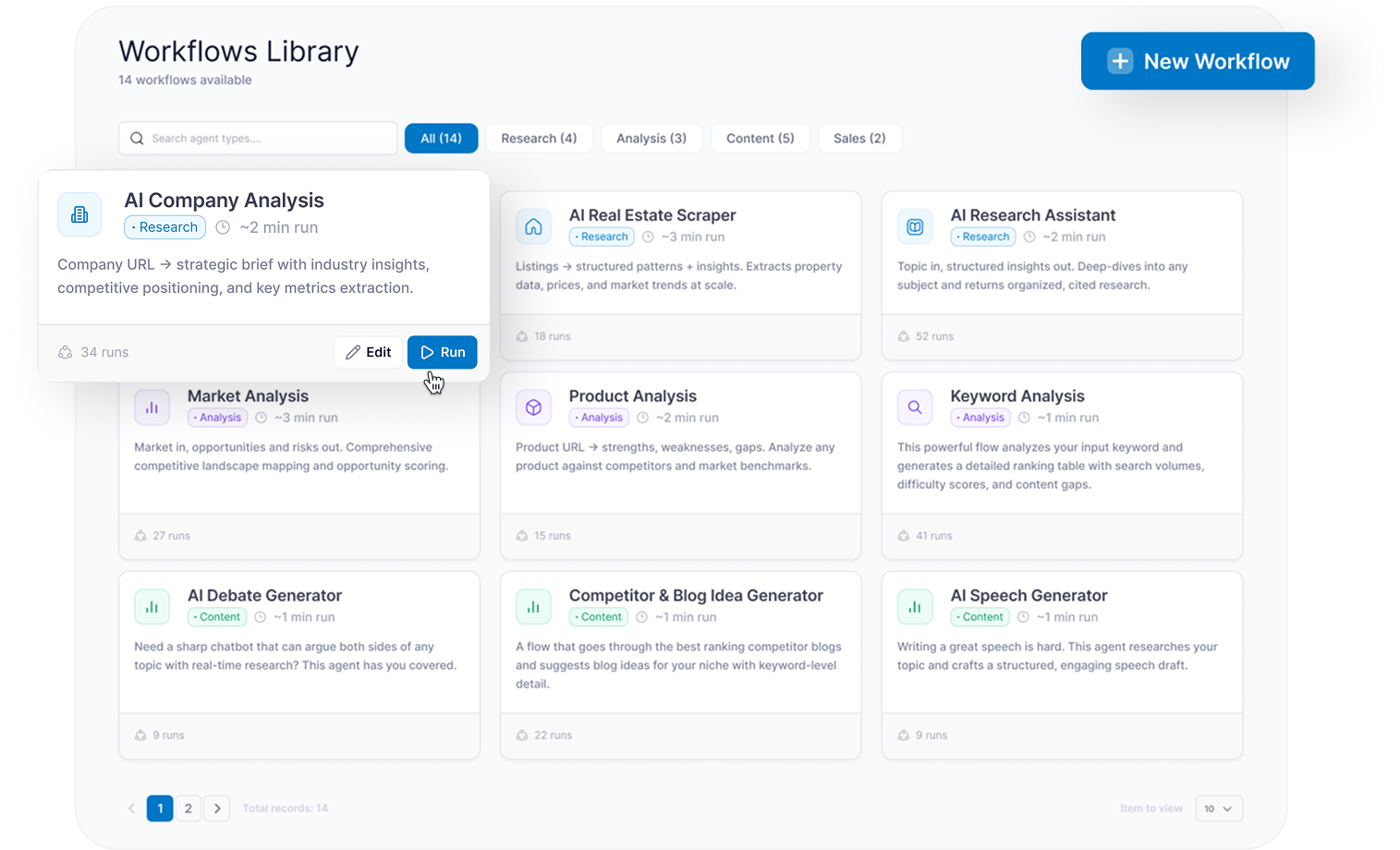
  • Reusable Workflows Library: 14 agent types

    Problem: Research, scraping, analysis, and content tasks each require different logic, inputs, and outputs. No single template covers them all.

    Result: The platform ships with 14 agent types. Confirmed templates include AI Company Analysis, AI Real Estate Scraper, AI Research Assistant, Market Analysis, Competitor Research, Keyword Analysis, and Blog Idea Generator. Additional agents cover lead enrichment, document Q&A, scheduled site monitoring, and content briefing workflows.

    New agent types are added in days, not weeks: a config file, a class implementing the agent contract, and prompt templates. No platform rebuild.
  • AI-assisted and manual configuration

    Problem: Non-technical users need a fast way to create agents; technical users need control over sources, rules, and run behavior.

    Result: Two creation modes are available: Describe with AI (plain English input) and Configure manually (category, sources, parameters).

    Business users now create agents without engineering involvement; technical users keep full control over sources and run behavior.
  • Real-time agent execution monitoring

    Problem: AI workflows have no value if users cannot see what the agent is doing or why a run failed.

    Result: The platform tracks run status, progress, crawled pages, results found, logs, warnings, errors, and retries, visible in real time.

    100% of runs tracked with full audit trail and retry history.
  • Structured results and export

    Problem: Business teams need usable output they can act on, not raw text or unstructured AI responses.

    Result: Agents return structured results with named fields, confidence scores, per-record statuses, and CSV / Excel export.

    Output feeds directly into sales, marketing, operations, or reporting workflows, no manual cleanup.

Project Goal

The goal was to replace fragmented manual workflows with a single, controllable AI automation platform. The client needed business users to create new agent types, configure agent behavior, choose between AI-assisted and manual setup, upload files, select an LLM, start and monitor agent runs, review structured results, and export processed data. The core objective: move AI from a chat interface to repeatable business workflow automation.

Before vs after

Workflow Before After
Company research 10–15 working days across two analysts, manual web and spreadsheet 2–3 days of supervised agent runs with structured export
Competitor monitoring Weekly manual checklist across a fixed set of sources Scheduled runs, structured diff, alerts on change
Lead enrichment Throughput capped by manual lookup speed per researcher Throughput is review-bound, not lookup-bound — reviewers approve agent-extracted records instead of gathering them
Data quality and consistency Mixed formats, manual cleanup before reporting Named fields, confidence scores, ready for CRM import
Adding a new workflow New tool, new training, new spreadsheet template New agent type added in config + class, no platform rebuild

Technologies used

.NET
ASP.NET Core
Entity Framework Core
React
TypeScript
OpenAI GPT-4o
Anthropic Claude
Google Gemini
LangChain
LangGraph
Langfuse
RAG
Elastic Vector Search
Playwright
Hangfire
OpenAPI 3
Swagger
REST API
Excel / CSV processing
SQL Server
PostgreSQL
Docker
Azure
Azure DevOps
Azure Application Insights
Role-based access control
Scroll to top