30+
professionals
100+
success projects
1 week
trial offer
Clutch rating

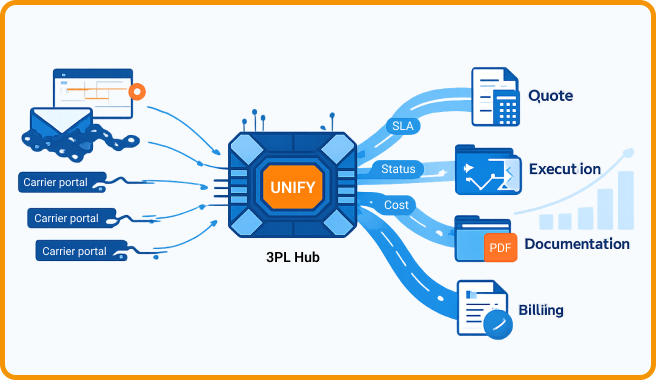
TwinCore designs custom software for 3PL and freight operations that brings core service processes into a single, controlled workflow: from quoting and order intake to execution, documentation, invoicing, and client visibility.

This is a solution for 3PL providers that operate under their own rules, carrier mix, cargo types, and customer requirements, and need a system that reflects how their service is actually delivered.

Contact us

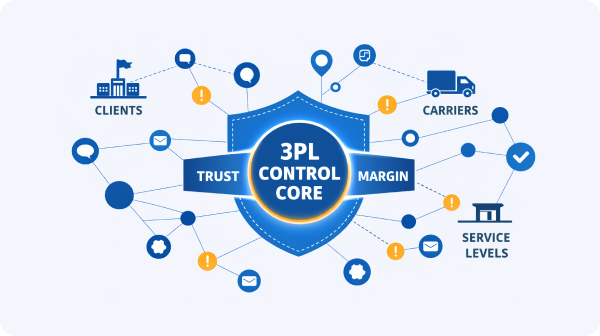
When Growth Breaks Control in 3PL Operations

Most 3PL operations don’t break suddenly. They become harder to control as volume grows, customer expectations increase, and exceptions become part of daily work.

Data starts to live across email threads, spreadsheets, carrier portals, and internal tools. Shipment statuses are inconsistent. Operations teams spend time searching instead of managing. Finance reconciles after the fact instead of controlling margin. Each exception turns into a delay, a dispute, or a manual workaround.

As complexity increases, onboarding new clients slows down, SLA control becomes reactive, and operational transparency weakens. Growth continues, but predictability and control do not.

Manual load

Reduce manual handling across orders and exceptions

Status sync

Eliminate status inconsistencies across carriers

SLA control

Improve SLA control before issues escalate

Margin visibility

Restore margin visibility across services and clients

What a 3PL System Must Control to Deliver Service at Scale

A 3PL system is not just about moving freight.

It is about delivering a service with defined rules, contractual obligations, visibility for clients, and verifiable proof of execution.

That means the system must support pricing logic, contracts, exceptions, documentation, and financial accuracy as first-class elements, not as add-ons. Client transparency, carrier coordination, and dispute readiness are just as important as shipment tracking.

Contract-aware pricing and execution logic

ensure pricing and operations follow contracts accurately while reducing manual errors

Built-in exception and SLA monitoring

track exceptions and SLA performance automatically to prevent issues before they escalate

Client-ready visibility without internal noise

provide clients clear, relevant insights without exposing internal complexities

Verifiable proof across execution and billing

maintain transparent records to validate every step of service and financial transactions

End-to-End 3PL Software Covering the Full Service Lifecycle

The structure below reflects how service delivery works in practice, from the first quote to the final invoice.

Contract-Based Quoting That Protects Margin

Pricing is often the first bottleneck in 3PL operations.

We build quoting workflows that reflect contract rules, tariffs, surcharges, zones, and exceptions. Quotes can be generated quickly, follow predefined logic, and include approval steps when required. Templates support repeatable pricing for common customer profiles, while auditability ensures that pricing decisions remain traceable.

Order Management as the Single Source of Operational Truth

Orders are the backbone of the service.

Orders can be created manually or received via API or EDI. Each order carries its SLA, status, exceptions, and ownership. Changes are tracked with a full audit history, so responsibility is always clear. This creates a single operational record that connects execution, documentation, and billing.

Carrier and Partner Coordination Without Ad-Hoc Workarounds

3PL operations depend on coordination with carriers and partners.

We support carrier and partner profiles with service capabilities, constraints, and commercial terms. Booking and dispatch workflows are aligned with execution requirements, and communication with partners follows a controlled process rather than ad-hoc messages. Performance and reliability can be monitored without adding overhead.

Controlled Shipment Execution with Client-Ready Visibility

Execution is where most service risk appears.

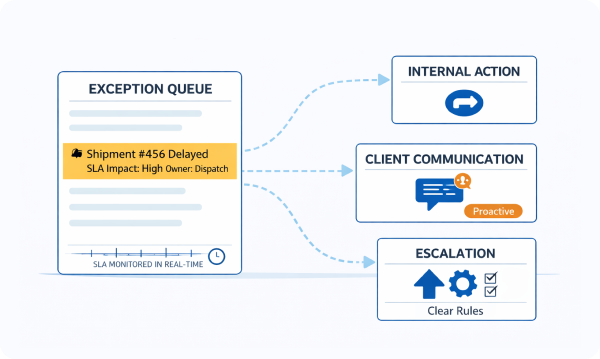
We unify tracking events into consistent shipment statuses, regardless of carrier formats. Incidents are surfaced through a controlled queue with prioritization and escalation. Client-facing visibility can be provided through portals or notifications when required, without exposing internal complexity.

Documentation and POD as Verifiable Evidence

Documents are central to 3PL service quality.

Shipping documents and proof of delivery are collected, stored, and linked directly to the order. PODs are searchable, retrievable, and available as evidence for clients, audits, or disputes. This removes reliance on inboxes and manual follow-ups.

Execution-Based Billing and Structured Dispute Resolution

Billing is generated based on what actually happened, not what was planned.

Invoices are created from execution data, with clear alignment between services delivered and charges applied. Discrepancies between planned and actual execution are visible. Disputes follow a defined workflow with reasons, status, and supporting documents, reducing friction for both finance teams and clients.

Role-Based Visibility Without KPI Noise

Different teams need different views, but all based on the same data.

Operational, commercial, financial, and management views are supported without turning reporting into a KPI exercise. Dashboards and reports focus on daily control, service performance, and margin visibility rather than metric overload.

Integrations Designed for Predictable 3PL Growth

3PL businesses live on integrations with clients and partners.

We design integrations so client onboarding is predictable and fast, and so statuses, documents, and financial data remain consistent across systems. API and EDI connections are built around what clients and carriers actually use, not theoretical standards.

Client systems, carrier platforms, accounting tools, and CRM or ERP environments are connected as part of a single operational flow, rather than a set of fragile point-to-point links.

Faster client onboarding cycles

accelerate the process of bringing new clients onboard while maintaining accuracy and compliance

Fewer integration-related incidents

reduce errors and failures during system integrations to ensure smoother operations

Consistent data across systems

keep information synchronized and reliable across all platforms for better decision-making

Lower long-term integration maintenance cost

minimize ongoing expenses and effort required to maintain integrations over time

Exception and SLA Management Built Into Daily Execution

Exceptions are not failures. They are part of 3PL operations.

We design exception handling as a defined process: what constitutes an issue, who owns it, what actions are triggered, and how it is communicated internally and externally. SLAs are monitored during execution, not reviewed after delivery, and escalations follow clear rules instead of informal intervention.

Operational Control That Holds After Go-Live

A 3PL system must remain manageable after go-live.

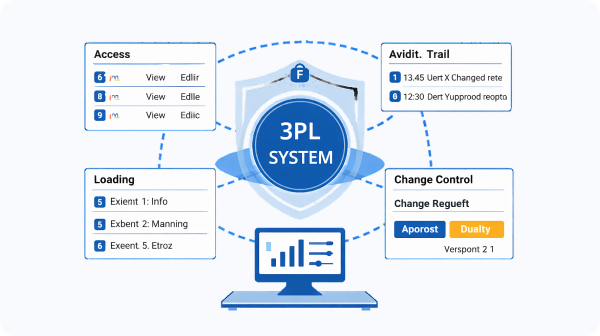
Role-based access, audit trails, logging, and change control are built in from the start. This provides accountability, supports compliance, and reduces operational risk as teams and client volumes grow. The system remains understandable and supportable, rather than becoming another opaque tool.

Scale without losing system clarity with TwinCore

Many solutions solve isolated parts of the problem: pricing, tracking, or reporting. They perform well in isolation but break down when exceptions, documents, and billing need to work together.

TwinCore designs 3PL systems around the full service lifecycle, from quote to invoice, with visibility and proof at every step. This supports the service model of a 3PL business rather than just the movement of freight, and allows operations to scale without increasing chaos.

Role-based access and auditability

ensure clear permissions and track every action

Safer change management

make system updates without causing disruptions

Lower operational risk over time

minimize errors and maintain stability as you grow

Systems teams can actually support

empower teams to manage and maintain systems effectively

Technology foundation

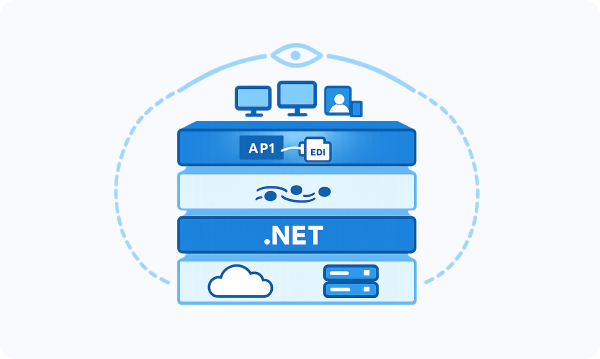
Solutions can be deployed in cloud or on-prem environments. The backend is built on .NET, with modern role-based frontends. Event-driven processing supports shipment statuses and documents. Integrations follow an API-first approach, with EDI where required. Monitoring and logging are included to keep integrations stable over time.

Where this approach becomes necessary

This approach becomes relevant in freight operations where service delivery is shaped by contracts, exceptions, and coordination across multiple parties. As the number of clients, carriers, and service levels grows, small operational errors start to have a direct impact on trust, margins, and dispute volume.

It is especially effective in environments where new clients are onboarded regularly, documentation flows are heavy, and execution needs to remain transparent and defensible. In these conditions, predictable control over orders, execution, and billing becomes a foundation for sustainable growth rather than an operational advantage.

Related logistics services


Standardize quoting and protect margin with contract-based rating logic.

Onboard new clients and carriers without turning integrations into operational chaos.

Coordinate exceptions and handoffs across multi-party operations.

What our clients say about us

  • TwinCore has elevated the client's customers to the next level of supply chain management. The team is highly cost-efficient from a project management standpoint, and internal stakeholders are particularly impressed with the service provider's team dynamic.

    Alex Lopatkin
    Alex Lopatkin
    Amous
  • TwinCore delivered a fully functional solution on time, meeting expectations. The highly organized team employed a DevOps approach, swiftly responded to needs and concerns, and led a productive, enjoyable workflow. Their receptiveness to client requests and feedback stood out.

    Bruno Maurer
    Bruno Maurer
    Managin Director, N-tree
  • Thanks to TwinCore’s work, the client has gained a user-friendly, stable, and scalable SaaS platform. The team manages the engagement well by being reliable and punctual; they deliver tasks on time. Their resources are also highly flexible, resulting in a truly seamless engagement with the client.

    Mischa Herbrand
    Mischa Herbrand
    Executive, CIN
  • TwinCore successfully audited the apps and converted them into modern web apps, meeting expectations. They completed the project on time and within the agreed budget. Communicating through virtual meetings, the team provided updates and responded to the client's concerns.

    JH
    Joe Holme
    IT Director, GDD Associates
  • TwinCore delivered a fully functional solution on time, meeting expectations. The highly organized team employed a DevOps approach, swiftly responded to needs and concerns, and led a productive, enjoyable workflow. Their receptiveness to client requests and feedback stood out.

    A
    Anonymous
    Managing Director, Marketing Company

Related Topics

Frequently Asked Questions


Starting with an MVP without limiting future growth

Yes, projects often start with a focused MVP. A typical first scope includes order management, shipment tracking, document handling, and invoicing. This creates an operational backbone that teams can use immediately, while keeping the architecture open for expansion. Additional workflows, client-specific logic, or automation are added once the core execution is stable and validated in daily use.


Client onboarding without operational disruption

New client onboarding is treated as a structured process rather than a one-off integration. API and EDI connections are designed around standardized data models, with clear validation and mapping rules. This allows new clients to be onboarded without introducing custom logic into the core system or creating downstream inconsistencies. As a result, onboarding remains predictable even as client volume grows.


Unified shipment statuses across carriers

Carriers and partners report events in different formats and with different semantics. We normalize these events into a single status model that reflects the 3PL’s operational view, not the carrier’s internal terminology. This ensures that operations, customer service, and clients see consistent shipment states regardless of which carrier is involved.


Document handling and proof of delivery

Documents are managed as part of the operational workflow, not as attachments scattered across inboxes. Shipping documents and proof of delivery are linked directly to orders and shipments, indexed, and searchable. PODs are stored together with timestamps, locations, and related events, making them usable for customer communication, audits, and dispute resolution.


Dispute management and evidence retention

Disputes are handled through a defined workflow with clear status, ownership, and supporting evidence. The system retains execution data, documents, timestamps, and event history so claims can be reviewed and resolved based on facts rather than reconstruction. This reduces friction for both operations and finance teams and shortens resolution cycles.


Deployment and hosting options

Solutions can be deployed in cloud environments or on-prem infrastructure, depending on security, compliance, and operational requirements. The architecture is designed so hosting decisions do not limit future scalability or integrations.


Post-release support and integration stability

Support does not end at go-live. We provide ongoing maintenance, monitoring, and controlled change management for integrations. When external APIs or EDI partners change, updates are handled in a managed way to prevent silent failures and operational disruptions. This keeps the system stable as partners, volumes, and requirements evolve.


Scroll to top