30+
professionals
100+
success projects
1 week
trial offer
Clutch rating

Hire In-House Blazor Developers for Scalable .NET Applications

Need a Blazor developer who can ship inside a real .NET codebase? TwinCore provides Blazor engineers from our in-house team on an outstaffing basis. Start with one developer or scale to a small squad as your roadmap grows.

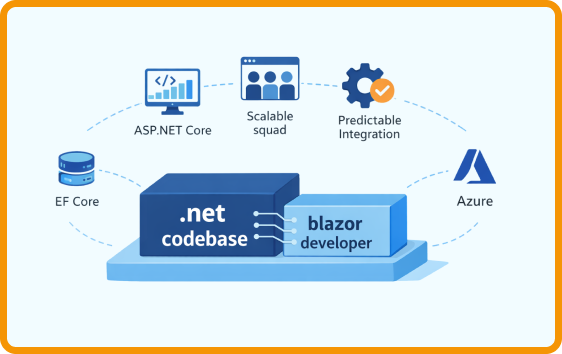
We build Blazor Server and Blazor WebAssembly apps for dashboards, portals, internal tools, and B2B platforms. Expect clean component architecture, predictable state management, and smooth integration with ASP.NET Core, EF Core, Azure, and existing APIs.
Contact Us
Hire Blazor Developers

Meet Our Blazor Developers

  • Igor P
    10+ projects
    Igor P
    Blazor developer
    Availability
    full time, part time, hourly
    Experience
    10+ years
    .NET
    Net.Core
    Nopcommerce
    Kentico
    Azure
    Blazor
    + other
    Blazor-savvy developer with a detail-oriented mindset and a creative approach. If you're looking for someone who can deliver fast, maintainable, and functional Blazor-based solutions — this candidate checks every box.
  • Igor G
    10+ projects
    Igor G
    Blazor developer
    Availability
    full time, part time, hourly
    Experience
    10+ years
    .NET
    Net.Core
    Nopcommerce
    Kentico
    Azure
    React
    Angular
    Blazor
    + other
    Self-driven and endlessly curious, this Blazor developer thrives on continuous learning. Equipped with a strong .NET background and a deep understanding of modern web technologies, he’s ready to grow alongside your product and push boundaries.
  • Pavel
    10 projects
    Pavel
    Blazor developer
    Availability
    full time, part time, hourly
    Experience
    6+ years
    .NET
    Net.Core
    Angular
    React
    Blazor
    Azure
    + other
    From building responsive UI components to architecting real-time Blazor apps — this candidate has done it all. With proven experience and a results-oriented approach, he’s ready to join your team and make an immediate contribution.
  • Maksym
    8 projects
    Maksym
    Blazor developer
    Availability
    full time, part time, hourly
    Experience
    4+ years
    ASP.NET
    Nopcommerce
    React
    Blazor
    Azure
    + other
    Looking for someone who can move fast without breaking things? This Blazor developer combines speed with precision and can start adding value to your project from day one.
Previous
    Next

    Blazor Development Services Our Team Covers

    Blazor Web Application Development

    Our Blazor developers build and extend applications using Blazor Server and Blazor WebAssembly inside active products. They focus on performance, maintainable structure, and predictable behaviour, so new features don’t break existing logic.

    Custom Blazor Component Development

    Your assigned Blazor developer designs reusable, well-structured UI components that fit your existing design system. This reduces repetitive work, improves testability, and allows multiple developers to work in parallel without UI drift or fragile dependencies.

    Integration with the Microsoft .NET Ecosystem

    Blazor works best when it stays close to .NET - and so do our engineers. They integrate directly with ASP.NET Core, Entity Framework, Azure services, SignalR, and existing APIs. The result is a clean, predictable architecture without unnecessary abstraction layers or brittle workarounds.

    Blazor Migration Services

    When modernising legacy applications, our Blazor developers handle migrations incrementally and safely. They move UI layers from Razor Pages, MVC, Angular, or mixed front-end stacks to Blazor, while keeping business logic stable and reducing technical debt over time - without freezing product development.

    Blazor Progressive Web App (PWA) Development

    If your product needs offline access or mobile-friendly workflows, our developers implement Blazor PWAs that behave like native apps. This includes offline support, background data sync, and push notifications - useful for field teams and mobile-first internal tools.

    Blazor Support and Maintenance

    Beyond feature delivery, our Blazor developers take responsibility for ongoing stability. They handle updates, performance issues, and security fixes as part of daily work, ensuring clean deployments and predictable releases so your internal team can focus on roadmap decisions instead of firefighting.

    Blazor Project Experience Across Real Products

    Production-Level .NET Experience from Day One

    Our developers work daily in .NET-based systems with ASP.NET Core, C#, Azure, and SQL Server. That means zero onboarding into the stack and no framework-level uncertainty. They step into established architectures and contribute immediately, following existing patterns instead of reinventing them.

    Feature Ownership, Not Task Execution

    Once embedded, a developer owns features end to end. They clarify scope, implement changes, review impact, and support releases. Context stays with one person, decisions are traceable, and responsibility doesn’t get fragmented across teams or vendors.

    Component Architecture That Supports Ongoing Development

    UI work is structured around reusable Blazor components designed for long-term use. This keeps changes localized, reduces regression risk, and allows the product to evolve without constant refactoring. The approach supports both fast delivery and sustained development over time.

    Performance-Aware Implementation

    Performance decisions are made deliberately, not reactively. Our developers manage rendering behavior, async data flows, and state boundaries so the UI remains responsive as functionality grows. The focus is stability under real usage, not benchmark demos.

    Clean Integration with Existing Infrastructure

    Our developers work within established environments, integrating with internal APIs, databases, Azure services, and real-time communication layers such as SignalR. The goal is predictable data flow and maintainable integrations, without brittle glue code or unnecessary abstractions.

    Typical Blazor Work We Take On

    We regularly work on internal dashboards, admin interfaces, operational tools, and customer-facing portals built on .NET backends. Most engagements involve extending or stabilizing existing systems rather than starting from scratch.

    How to Hire Blazor Developers from TwinCore

    Leave your contact information and short overview of your product, current setup, and what you need help with.
    Scope & Fit Alignment
    We follow up to clarify goals, timelines, and the type of Blazor expertise you’re looking for.
    Developer Match
    Based on your context, we identify the Blazor developer or developers from our team whose background aligns with your architecture, domain, and delivery pace.
    Technical Discussion
    If needed, you can speak directly with the developer, walk through relevant experience, and align on ownership, workflows, and expectations.
    Kickoff & Onboarding
    The developer joins your workflow, gets access to the codebase, and starts contributing within your existing process.

    Blazor Developer Engagement Models

    Time and material
    The time and material model is a flexible approach to outstaffing where you pay for the specific time and resources used on your project. This model aligns well with the Agile principles and is particularly suitable for projects with evolving requirements or uncertain scopes.
    Part-time
    You hire our professionals who will work a particular number of hours per week according to your current project needs. Please, remember that we offer part-time outstaffing for projects that require at least 80 working hours of our experts per month.
    Full-time
    Our tech experts will work on your project as full-time employees. However, we’re ready to offer our help for projects that need at least 160 working hours of our professionals per month.

    Who Typically Chooses Blazor

    SaaS and B2B Products with Complex Interfaces

    Blazor is often used in SaaS platforms and B2B products built around dashboards, admin panels, and internal tools. In these cases, tight integration with existing services and steady performance matter more than flashy UI patterns or constant framework updates.

    Teams with an Established .NET Stack

    When ASP.NET, C#, and Azure are already part of daily development, Blazor keeps things straightforward. There’s no need to introduce a parallel front-end ecosystem or maintain two different stacks just to move the product forward.

    Teams Looking to Simplify Front-End Work

    Some teams come to Blazor after spending too much time managing front-end complexity. Fewer moving parts, one language across the stack, and easier debugging can make day-to-day development calmer, especially as the product grows.

    Product Teams Thinking Long Term

    Blazor tends to be chosen for products that are expected to live for years. Strong typing, reusable components, and a stable tooling ecosystem make it easier to evolve the product without constant rewrites or architectural resets.

    Why Hire In-House Blazor Developers from TwinCore

    When you add Blazor developers to an existing product, the main concern is not the framework itself, but how quickly and safely someone can become productive inside your codebase. TwinCore provides in-house Blazor developers who are used to working within real .NET systems, following established architecture, and taking responsibility for production-ready features. You can start with a trial period to validate the fit in real work, and if collaboration doesn’t click, we handle developer replacement without disrupting delivery.
    What you get with TwinCore:
    • In-house Blazor developers with hands-on experience in live .NET products

    • A trial period to validate technical fit and day-to-day collaboration

    • Developer replacement if the match isn’t right, without slowing down your project

    • Engineers who integrate into existing codebases instead of rewriting them

    • Clear feature ownership and accountability inside your product team

    • Predictable delivery through pull requests, reviews, and direct communication

    • Clean integration with ASP.NET Core, databases, APIs, and cloud services

    • Flexible engagement for long-term development or focused delivery phases

    • Stable, maintainable code designed for ongoing product evolution

    • Continued support and feature development by the same developers who know the system

    How Teams Evaluate and Start Working with Blazor Developers

    Teams already know they need Blazor expertise. The real challenge is avoiding lost time and failed starts - whether that comes from short-term freelancers or long internal hiring cycles. This approach is designed to reduce risk and get a developer productive inside a real product, without unnecessary friction.
    Review Relevant Experience
    Instead of relying on generic CVs or marketplace profiles, teams look at real Blazor and .NET experience in production systems. This avoids the common freelancer problem: strong claims on paper, but limited experience working inside long-living codebases.
    Align on Scope and Expectations
    Early alignment around architecture, priorities, and ways of working helps prevent mismatches that often happen with HR-driven hiring. The goal is clarity upfront, not discovering gaps weeks into the engagement.
    Technical Discussion
    A short technical discussion replaces multi-stage interview loops. It’s usually enough to understand how the developer approaches existing code, handles trade-offs, and communicates - without dragging the process out for months.
    Trial Period in Real Work
    Instead of unpaid test tasks or theoretical assignments, teams validate the fit through a short trial period inside the actual codebase. This quickly shows how the developer works with real constraints, existing patterns, and live requirements — something freelancers and interview processes rarely reveal in advance.
    Start Delivery with Continuity
    Once the fit is confirmed, the developer continues working as part of your team. If priorities change or the collaboration needs adjustment, continuity is maintained - without restarting the hiring process or losing momentum.

    Start with a Blazor Developer from Our Team

    Related Topics

    Frequently Asked Questions


    How quickly can we onboard a Blazor developer from your team?

    We typically onboard within 3–5 business days. After a short discovery call to clarify your requirements, we’ll shortlist Blazor developers with relevant experience. You can review CVs, interview candidates, and get started immediately without lengthy onboarding. We prioritise responsiveness, clarity, and minimal delays on your side.


    Do your Blazor developers work with both Blazor Server and WebAssembly?

    Yes — our developers are experienced in both Blazor Server and Blazor WebAssembly. We help clients choose the right approach depending on their app’s needs: real-time updates, offline support, scalability, or browser performance. Each model has trade-offs, and we’ll guide you through architecture planning before any code is written.


    Can I hire just one developer, or only full teams?

    You’re free to start with a single developer, build a small team, or expand later — we’re flexible by design. Whether you need a short-term contributor or a long-term embedded expert, we offer engagement models that adapt to your internal workflows and communication style.


    How do you ensure code quality and long-term maintainability?

    Our team follows clean coding standards, modular architecture, and consistent naming conventions. We use peer reviews, automated tests, and version control best practices. You’ll also receive proper documentation and technical onboarding materials, ensuring your app remains scalable and easy to maintain, even years after launch.


    What types of businesses typically use your Blazor services?

    We’ve helped clients in logistics, real estate, fintech, and healthcare — building anything from internal tools and admin dashboards to public-facing platforms. Blazor works well for businesses that want long-term .NET integration, strong performance, and consistent UI across web and desktop environments.


    Do you provide ongoing support and updates after launch?

    Absolutely. Once your Blazor app goes live, we offer optional support and maintenance packages — from bug fixes and security patches to performance tuning and feature extensions. You can scale the support level up or down depending on your app’s complexity and user base.


    Scroll to top