30+
professionals
100+
success projects
1 week
trial offer
Clutch rating

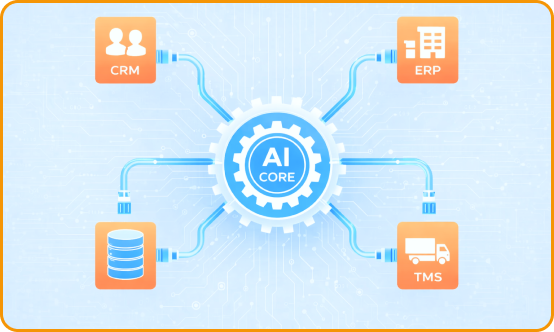
We design, build, and deploy production-grade AI agents that connect directly to your systems. These aren't passive text generators. They are active workers capable of making decisions, calling APIs, and executing complex workflows inside your CRM, ERP, or TMS.

You choose the stack (C#, Python, or the Microsoft Agent Framework) and the deployment model. Then, we handle the hard engineering: memory management, tool execution, and the strict guardrails needed to keep the AI from going rogue.
Build AI Agents

Why Most Corporate AI Projects Fail

If you don't solve this, you are left with expensive "AI wrappers" that your staff ignores because they don't actually save time.

Passive tools can’t take real action


Most tools just generate text. They can't check inventory, reset passwords, or process refunds. They are passive.

No-code agents break at real complexity


"No-code" agent builders are great for toys but break when you need to handle OAuth2 flows, complex JSON schemas, or legacy SOAP APIs.

PII safety and compliance are non-negotiable


Pasting customer data into public models is a compliance nightmare. You need guarantees that PII is scrubbed before inference.

Production Architecture: How We Build AI Agents

We don't just wrap a prompt around OpenAI and call it a day. We build resilient systems.

The Cognitive Engine Layer (Reasoning)

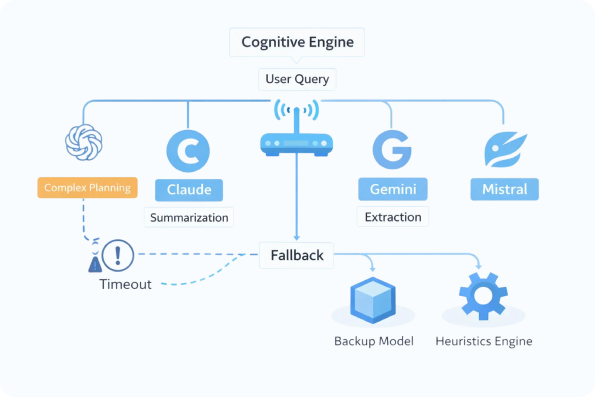
We separate the reasoning layer from the model. This allows us to switch backends without rewriting logic.
  • Router architecture. We use GPT-5 for complex planning and cheaper models (like GPT-4o-mini or Haiku) for summarization and simple extraction to optimize costs.
  • Fallback logic. If the primary model times out, the system automatically degrades to a backup model or a heuristic rules engine.
We remain engine-neutral: OpenAI, Anthropic Claude, Google Gemini, Mistral, Cohere. Your model choice stays aligned with cost, latency, and data policy.

The Action Layer (Tools)

We treat tools as dependencies.
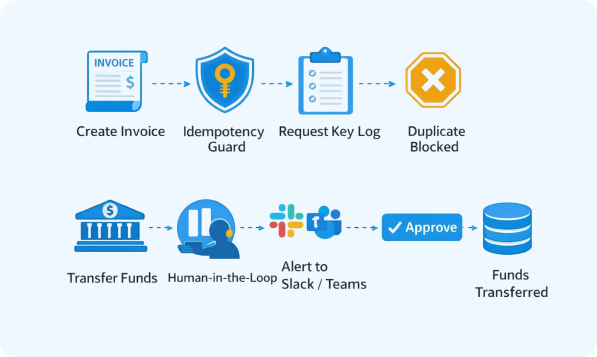
  • Idempotency. We design write-actions to be idempotent. If an agent tries to "Create Invoice" twice, the system detects the duplicate request key and prevents double-billing.
  • Human-in-the-loop. Critical actions ("Transfer Funds" or "Delete User") trigger a "suspension" state. The agent pauses, sends a Slack/Teams notification to a supervisor, and only resumes execution once a human clicks "Approve".
We implement orchestration that coordinates sequences, handles failures, and maintains SLAs.

Guardrails & Security Layer

You cannot trust an LLM with raw access. We implement a security gateway.
  • Input/output validation. We use libraries like Guardrails AI or NeMo to scan prompts for jailbreaks and scan responses for PII (Personally Identifiable Information) leaks before they leave the secure enclave.
  • Scoped permissions. The agent creates its own ephemeral OAuth tokens. It literally cannot access data that it wasn't explicitly granted for that specific session.
We implement observability with traces, alerts, and cost controls.

Choose Your AI Agent Tech Stack

We don't force a language on you. We build where your team lives.

Build AI Agents in C#

Stack: .NET 8/9, Microsoft Semantic Kernel, Azure OpenAI SDK.
Best for: Enterprise environments using Azure, Dynamics 365, and heavily typed backends. We treat prompts like functions. We use Semantic Kernel to orchestrate plugins that interface natively with your internal C# microservices. This provides compile-time safety and deep integration with Aspire for observability. Your agents fit right into your existing CI/CD pipelines and logging stacks (Serilog/AppInsights).

Build AI Agents in Python

Stack: Python 3.12, LangGraph (for cyclic flows), LangChain, Pydantic.
Best for: Complex logic, research, and data-heavy operations. We use LangGraph to build stateful, multi-actor applications. Unlike linear chains, graphs allow us to build loops ("Review document -> Criticize -> Revise -> Repeat until score > 90%"). We use Pydantic heavily to validate every single byte of data the AI produces, ensuring strict adherence to your schema.

Build AI Agents with Microsoft Agent Framework

Stack: Copilot Studio, Power Platform, Azure AI Studio.
Best for: Rapid internal tool deployment within M365. We build custom copilots that live inside Microsoft Teams. These agents respect your entra ID (formerly Azure AD) governance policies automatically. We extend them with custom "Skills" (Azure Functions) to bridge the gap between "standard chat" and "proprietary business logic".

What You Actually Get

This is not a demo or a chatbot — it’s a production-ready system designed to deliver concrete operational value from day one.

Reduced "Human Middleware"

Agents handle the repetitive "swivel-chair" work (copying data from email to ERP), freeing up staff for exceptions.

Faster triage

Zero wait times for complex queries that require lookups across multiple databases.

Standardized processes

The agent follows the SOP exactly every time. No skipped steps, no "forgotten" fields.

Measurable ROI

We track "Task Success Rate" and "Cost Per Transaction", not just vague "user sentiment".

Types of AI Agents We Build

Not all problems require a massive autonomous solution. We select the specific agent architecture that matches the complexity of your workflow.

Retrieval Augmented Generation (RAG) Agents

These agents synthesize answers from your proprietary data. They connect to Vector Databases (knowledge bases) and SQL Databases (structured data) simultaneously.
Use Case: Policy Q&A, Technical Support Assistant, Contract Analysis.
Tech Specs: Hybrid search (Keyword + Semantic), rigorous citation (the agent links to the source document), and "No-Answer" fallbacks if data is missing.

Transactional & Workflow Agents

These deterministic agents are designed to execute linear, multi-step processes where consistency is critical. They follow a strict Directed Acyclic Graph (DAG) of actions. They do not "improvise". They follow the Standard Operating Procedure (SOP) exactly.
Use Case: User Onboarding, Password Resets, Order Processing, Invoice Payment.
Tech Specs: Hard-coded tools, strict state management, and rollback capabilities if a step fails.

Reasoning & Planning Agents (ReAct)

These agents are given a goal, not a script. They use the ReAct (Reason + Act) pattern to break a high-level objective into sub-tasks, select the right tools for each step, and self-correct if an approach fails.
Use Case: "Plan a logistics route avoiding weather delays", "Investigate this security alert", "Research and write a market report".
Tech Specs: Iterative thought loops, dynamic tool selection, and scratchpad memory to store intermediate results.

Multi-Agent Swarms

This solution is awesome for tasks too complex for a single context window. We build systems where specialized agents collaborate under a "Manager" or "Router" agent. One agent might be the "Researcher", another the "Writer", and a third the "Reviewer".
Use Case: Software development (Coder + QA + Product Owner), Complex Financial Audits, Supply Chain Optimization.
Tech Specs: Uses patterns like Microsoft Autogen or LangGraph. Agents communicate via message passing, handling hand-offs and approvals autonomously.

Coding & Data Analysis Agents

These are agents equipped with a sandboxed code execution environment. They write and run Python or SQL code to calculate the answer mathematically.
Use Case: "Analyze this CSV for trends", "Generate a visualization of Q3 sales", "Refactor this legacy C# class".
Tech Specs: Secure containerized execution (Docker sandbox), read/write access to specific repositories, and Jupyter notebook integration.

Features of Our AI Agents

  • Router architecture

    Dynamically switches between expensive models (for planning) and cheap models (for summarizing) to optimize cost.
  • Stateful memory

    Persists conversation and task context (using Redis/Postgres) so agents handle long-running processes over days.
  • RAG integration

    Connects to your internal wikis and policy documents (Vector DBs) to ground answers in truth.
  • Model Context Protocol (MCP)

    Instead of writing brittle, custom glue code, we build MCP Servers that expose your internal APIs and databases. This makes your tools universally accessible to any MCP-compliant client (like Claude Desktop, Cursor, or your custom agent fleet) without re-engineering.
  • Deterministic function calling

    Forces the LLM to output valid JSON for API payloads. Idempotency logic. Prevents duplicate actions (e.g., ensuring an agent doesn't pay an invoice twice).
  • Legacy integration

    We build wrappers for SOAP, XML, or even distinct file drops to make old systems AI-compatible.
  • Human-in-the-loop

    Critical actions (like "Delete User" or "Approve >$1k") pause execution and wait for human confirmation via Slack/Teams.
  • Traceability

    We implement full OpenTelemetry integration. View traces of every thought, tool parameter, and API response.

Who We Serve

We build AI agents that understand the specific protocols, data standards, and compliance requirements of your industry.

Logistics & Supply Chain

We help you manage fragmented data across legacy TMS, WMS, and numerous email chains. TwinCore can create logistics AI agents for:
  • Automated tendering. Agents parse incoming load emails, check capacity in your TMS (MercuryGate, TMW), and auto-reply with quotes.
  • Document reconciliation. Computer Vision agents extract data from Bills of Lading (BOL) and match them against invoices to flag discrepancies.
  • EDI translation. Agents act as dynamic translators between rigid EDI sets (204, 214) and human-readable updates.

Healthcare

We help you manage high administrative burden and strict interoperability standards (HL7/FHIR). TwinCore can create healthcare AI agents for:
  • Intake automation. HIPAA-compliant agents listen to patient intake, transcribe audio, and draft SOAP notes mapped to ICD-10 codes.
  • Interoperability. Agents capable of querying FHIR servers to retrieve patient history and summarize it for clinicians.
  • Prior authorization. Automated extraction of payer policy documents (RAG) to pre-validate procedure requests before submission.

IoT (Internet of Things)

We help you manage massive streams of telemetry data that humans can't monitor in real-time. TwinCore can create IoT AI agents for:
  • Predictive maintenance. Agents monitor MQTT streams from edge devices. If vibration/heat thresholds are breached, the agent creates a ticket in your maintenance platform (Maximo/SAP) and schedules a tech.
  • Anomaly detection. Instead of static alerts, agents analyze multi-variable patterns to distinguish between a sensor glitch and a critical failure.
  • Device management. Agents that can autonomously issue firmware rollbacks if post-update metrics show degradation.

Software Development

We help you manage developer burnout from repetitive tasks, documentation, and "toil". TwinCore can create software development AI agents for:
  • Intelligent QA. Agents that run E2E test suites (Playwright/Selenium), analyze the failure logs, and auto-draft a Jira bug report with the stack trace and reproduction steps.
  • Documentation upkeep. Agents that watch Git repositories and automatically update API documentation (Swagger/OpenAPI) when code signatures change.
  • PR Reviews. First-pass code review agents that check for security vulnerabilities, linting errors, and adherence to style guides before a human reviewer looks at it.

Hybrid Approaches: Code Meets No-Code

Not every step needs heavy engineering. We pair no-code orchestration with code modules so you can launch AI workflow automation fast, keep governance tight, and scale safely. Orchestration handles triggers, routing, approvals, scheduling, and monitoring. Critical logic and integrations run in secure services that your IT can audit.
Platforms we use (fit-for-purpose):

n8n

self-hosted or cloud; complex flows, private infrastructure, advanced branching

Make (Integromat)

visual mapping for marketing, ops, and reporting pipelines

Zapier

quick SaaS glue for standard point-to-point automations

Pipedream

event-driven workflows with code where you need it

Relay.app

human-in-the-loop approvals, handoffs, and scheduled tasks at team scale

What you get out of the box

Version Control

Versioned workflows with role-based access and audit logs

Monitoring

Run history, dashboards, and error alerts for every integration

Guardrails

Guardrails around agent actions: limits, approvals, safe fallbacks

Escalation

A path to move any step from no-code to code when volume or risk grows
How does this work with agents? The orchestrator starts the job, enforces rules, and tracks results. Then, the agent plans and executes actions via tools/APIs. You get speed where it matters and control where it counts.

AI Agent Deployment Options: Cloud / Self-Hosted / Hybrid

Different teams have different constraints. We deploy AI agents where they make the most sense for your governance, cost, and latency requirements.

Cloud (Managed)

  • Fastest path to value; managed runtime, scaling, and updates
  • Ideal for iterative delivery and rapid A/B of AI workflow automation
  • VPC/peering options; secrets in managed vaults; SSO and RBAC
  • Lower operational overhead for small teams

Self-Hosted (On-Prem or Private Cloud)

  • Full data residency and network isolation; run agents behind your firewall
  • Docker/Kubernetes, private registries, enterprise secrets management
  • Aligns with strict compliance (finance, healthcare, public sector)
  • Deterministic cost model; no vendor lock-in on engines or tools

Hybrid

  • Sensitive data/AI evaluation on-prem; low-risk orchestration in the cloud
  • Best balance of agility and control for multi-region organizations
  • Useful when integrating legacy ERP/EMR/TMS systems with modern agent stacks
  • Cloud for burst workloads; local for regulated ones

Why Us

Engineers, Not Prompt Jockeys

We are software architects first. We understand connection pooling, async/await patterns, and API security.

Stack Neutrality

We don't force you into a proprietary platform. We build in C#, Python, or Node.js so you can maintain it.

Deployment Flexibility

We are comfortable with air-gapped, on-premise environments, not just public cloud.

Evaluation Rigor

We build automated test suites ("Evals") to grade agent performance before every release.

Comparison Table

Feature SaaS "Agent Builders" (Zapier/GPTs) Big Consultancy TwinCore Development
Connectivity Limited to public APIs Enterprise but slow Native Integration (SQL, Private APIs)
Logic/Reasoning Linear / Simple Over-engineered Graph-based / Cyclic (Retry logic)
IP Ownership Platform owns the runtime You own it (eventually) You own Source Code from Day 1
Deployment Public Cloud Only Hybrid Any (Cloud, On-Prem, Edge)
Cost Model Monthly Subscription High Hourly Rates Project / Milestone Based

AI Agent Delivery Process

1
Discovery (1-2 Weeks)
We map your workflow, define the "Tools" the agent needs, and assess data feasibility.
2
Architecture & POC (2-4 Weeks)
We build a basic agent that connects to one tool and proves the core reasoning loop.
3
MVP Build (4-6 Weeks)
We add memory, error handling, multiple tools, and integration with your UI.
4
Pilot & Tuning
Deployed to a limited user group. We use this time to tune prompts and fix edge cases based on real data.
5
Scale & Handover
Full deployment. We transfer repositories, set up CI/CD pipelines, and train your team.

What our clients say about us

  • TwinCore has elevated the client's customers to the next level of supply chain management. The team is highly cost-efficient from a project management standpoint, and internal stakeholders are particularly impressed with the service provider's team dynamic.

    Alex Lopatkin
    Alex Lopatkin
    Amous
  • TwinCore delivered a fully functional solution on time, meeting expectations. The highly organized team employed a DevOps approach, swiftly responded to needs and concerns, and led a productive, enjoyable workflow. Their receptiveness to client requests and feedback stood out.

    Bruno Maurer
    Bruno Maurer
    Managin Director, N-tree
  • Thanks to TwinCore’s work, the client has gained a user-friendly, stable, and scalable SaaS platform. The team manages the engagement well by being reliable and punctual; they deliver tasks on time. Their resources are also highly flexible, resulting in a truly seamless engagement with the client.

    Mischa Herbrand
    Mischa Herbrand
    Executive, CIN
  • TwinCore successfully audited the apps and converted them into modern web apps, meeting expectations. They completed the project on time and within the agreed budget. Communicating through virtual meetings, the team provided updates and responded to the client's concerns.

    JH
    Joe Holme
    IT Director, GDD Associates
  • TwinCore delivered a fully functional solution on time, meeting expectations. The highly organized team employed a DevOps approach, swiftly responded to needs and concerns, and led a productive, enjoyable workflow. Their receptiveness to client requests and feedback stood out.

    A
    Anonymous
    Managing Director, Marketing Company

Related Topics

Frequently Asked Questions


How do you handle long-running processes?

If an agent needs to "wait for approval" or "wait for shipment arrival", we don't keep the LLM open. We persist the agent state (the graph snapshot) to a database. When the event hook fires (a webhook from Slack), we rehydrate the state and resume execution exactly where it left off.


Can the agent use our internal legacy API?

Yes. If you have an API (SOAP, REST, or even XML-RPC), we can write a wrapper "tool" for it. For systems without APIs, we can even integrate headless browser agents (using Playwright) to navigate web portals. However, we advise using APIs whenever possible for stability.


How do you test an AI agent?

You can't just unit test text. We use Evals. We create a dataset of "Golden Questions" and "Golden Answers". Every time we update the prompt or code, we run an automated suite that grades the agent's response accuracy, JSON syntax, and tool usage correctness before it is deployed to production.


Who owns the IP?

You do. We are a work-for-hire engineering firm. The code, the prompt engineering, the RAG knowledge base, and the specific agent configurations belong to you. We hand over the repositories and documentation at the end of the engagement.


What if the LLM starts acting weird?

We implement drift detection. We monitor the "semantic distance" of answers. If the agent starts deviating from established patterns or if error rates on tool calls spike, the system triggers a circuit breaker. It is reverting to a safe mode or alerting an engineer immediately.


Scroll to top