30+
professionals
100+
success projects
1 week
trial offer
Clutch rating

Last-Mile & Delivery Management Software

TwinCore builds last-mile and delivery management solutions for logistics teams that need consistent control over daily delivery operations.

The focus is on execution: planning routes and stops, managing changes during the day, handling exceptions, communicating with customers, and capturing proof of delivery without adding operational noise.

This approach is designed for delivery environments where plans change constantly and service quality depends on how well exceptions are handled, not on how perfect the initial route looks.

Contact us

When Last-Mile Volume Turns Into Operational Chaos

Last-mile operations rarely fail because of one large issue. They become difficult to manage when volume grows, time windows tighten, and every delivery day produces dozens of small deviations.

Routes are often planned manually or adjusted throughout the day. New orders arrive after planning is done. Deliveries are delayed or rescheduled. Customers change availability. Couriers improvise. Dispatchers spend most of their time reacting instead of coordinating.

Over time, this creates predictable operational friction:

Route planning

route planning takes hours while reality changes every hour

Time enforcement

time windows, priorities, and delivery types are hard to enforce consistently

Failed deliveries

failed deliveries and returns are handled ad-hoc

Proof collection

proof of delivery is collected manually or goes missing

Address standardization

addresses, access notes, and customer instructions are not standardized

Status inconsistency

delivery status differs between OMS, CRM, and courier communication

Dispatch visibility

dispatch has no single, reliable picture of what is happening

Incident escalation

incident escalation is informal and inconsistent

Support overload

support teams are overloaded with “Where is my order?” questions

Delivery Management Is an Execution Workflow

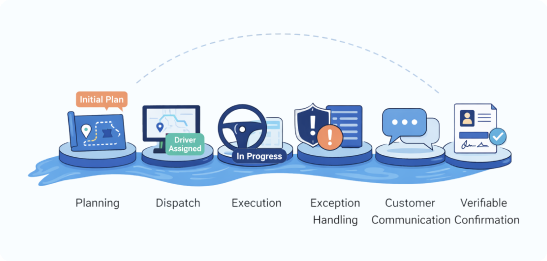
Effective last-mile delivery is not about building better routes. It is about managing a full execution process. That process includes planning, dispatch, execution, exception handling, customer communication, and verifiable confirmation of delivery.

The system must support dispatchers and couriers during the day, not just generate an initial plan in the morning.

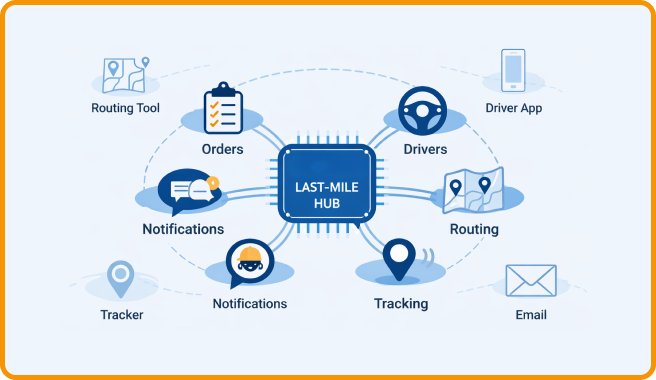
What We Build: End-to-End Last-Mile Execution Management

The solution is structured around the full delivery workflow, with each part designed to reduce manual coordination and improve control.

Order Intake That Captures Real Delivery Constraints Early

Deliveries are created or imported from OMS, WMS, or CRM systems and enriched with delivery-specific requirements.

Time windows, service type, access instructions, contacts, and special conditions are captured early so planning reflects real constraints.

Route Planning That Supports Replanning Mid-Day

Routes are planned around stops, priorities, and operational constraints rather than idealized assumptions.

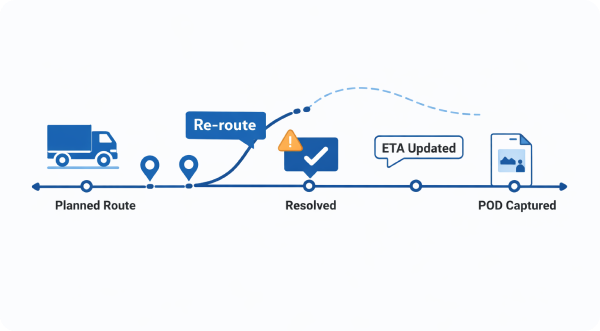
Workload is balanced across couriers or vehicles, and replanning is supported when orders are added, canceled, or delayed during the day.

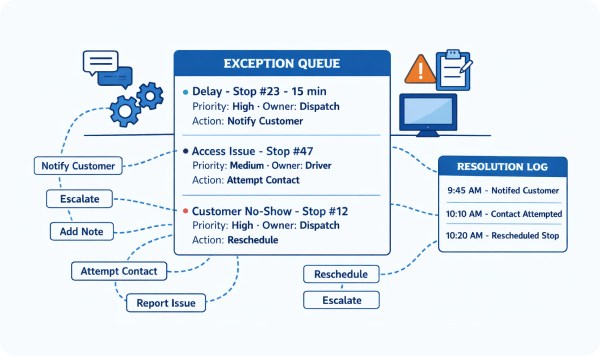
Live Dispatch Control With a Structured Incident Queue

Dispatchers work with a live view of routes and stops.

Assignments, changes, and progress are visible in real time, and operational incidents are collected into a controlled queue with clear escalation paths.

Courier Workflow for Stops, Status, Photos, Signatures

Where required, couriers work with a dedicated workflow that supports their day on the road.

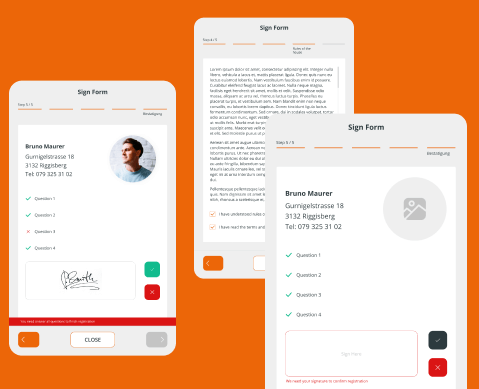
Route lists, navigation, checklists, stop statuses, photos, signatures, and comments are captured directly during execution. Offline operation is supported in environments with unstable connectivity, so execution does not depend on constant network access.

Customer Notifications and Tracking Driven by Execution Events

Customer communication is part of the delivery process, not a separate afterthought.

Status updates, ETA changes, delays, and reschedules are triggered based on execution events and rules. Tracking links or customer-facing status views can be provided when required, with consistent messaging across channels.

Proof of Delivery and Returns as Verifiable Records

Delivery confirmation is captured as structured evidence.

Signatures, photos, timestamps, and location data are stored together with the delivery record.

Failed deliveries trigger predefined next steps, such as rescheduling, return initiation, or customer contact, reducing manual decision-making. Return workflows are supported when reverse logistics is part of the operation.

Operational Visibility Into Completion, Exceptions, and Root Causes

Operations teams need visibility into what actually happened during delivery days.

Reports and dashboards provide insight into route execution, stop completion, service issues, and exception patterns. The focus is operational control, not metric overload.

Exception Handling That Doesn’t Blow Up Your Day

In last-mile operations, exceptions drive the day.

Delays, refusals, access issues, damaged items, and customer no-shows are expected scenarios.

The system supports a structured exception process with clear reasons, priorities, escalation paths, and standard response options.

Integrations That Keep OMS/WMS/CRM and Delivery Status in Sync

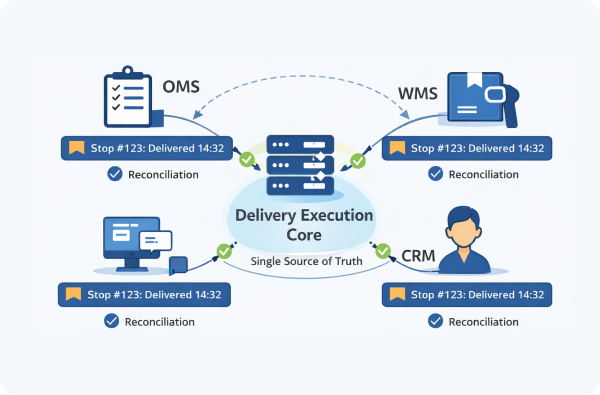
Last-mile delivery operates as part of a broader operational ecosystem, where planning, execution, proof of delivery, and customer communication are already tied to other systems. Delivery management needs to fit into that structure without creating parallel processes or additional reconciliation work.

We integrate delivery workflows with the systems that already support your operation, such as order management, warehouse systems, customer data, mapping services, telematics, and financial tools when required. The emphasis is on consistency rather than connectivity: delivery status, proof of delivery, and customer updates remain aligned wherever they are accessed. Dispatch, operations, and support teams work from the same operational picture, and changes made during execution are reflected across systems without manual intervention.

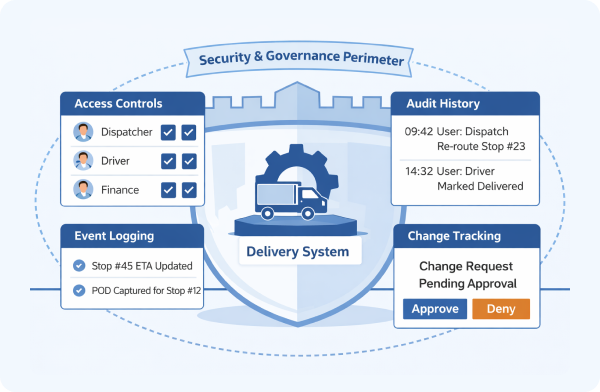
Operational Control After Go-Live (Access, Audit, Change Tracking)

Delivery systems must remain reliable under pressure. Access control, audit history, event logging, and change tracking are built in so teams can understand what changed and why.

This is especially important in last-mile environments where small execution issues can escalate quickly into customer complaints.

Why TwinCore Focuses on Execution

Last-mile delivery places most of its pressure on execution rather than on initial planning. Routes change during the day, customers are unavailable, priorities shift, and issues need to be handled while deliveries are still in progress. Systems built primarily around static planning or visual optimization tend to lose relevance once these conditions appear.

TwinCore designs last-mile delivery management around how delivery days actually unfold. The focus is on supporting adjustments during execution, handling exceptions in a structured way, keeping customer communication consistent, and capturing reliable proof of delivery as part of the process. This creates delivery operations that remain manageable under load, scale without increasing coordination overhead, and reduce strain on dispatch, support, and field teams as volume grows.

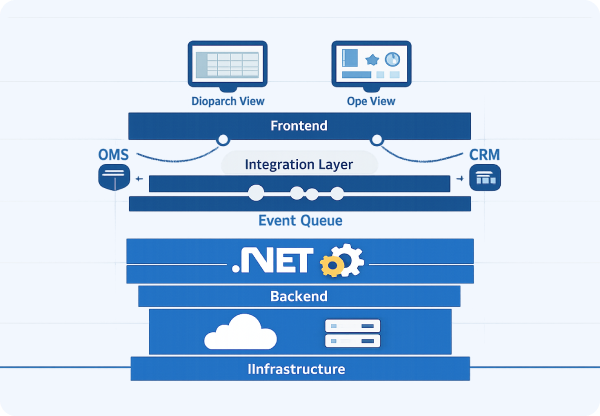
Technology foundation

Solutions can be deployed in cloud or on-prem environments. The backend is built on .NET, with modern role-based frontends for dispatch and operations. Event processing and queues are used to handle status updates reliably. Monitoring, logging, and alerts are implemented so issues are detected early. Integrations are handled through a dedicated layer for OMS, WMS, CRM, and related systems.

Where Last-Mile Execution Management

This delivery model fits operations where execution is shaped by constraints rather than by static plans.

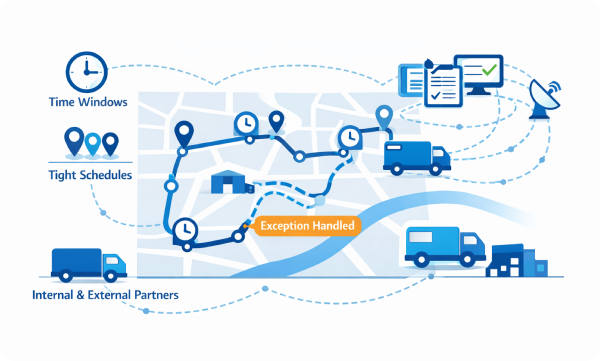
It works best in environments where deliveries are spread across multiple stops, time windows are tight, and daily performance depends on how well teams handle changes, delays, and customer availability. In these settings, success is determined less by route geometry and more by coordination, visibility, and controlled response to exceptions.

The approach is especially relevant where delivery is performed by a mix of internal teams and external partners, where customer experience is closely tied to delivery accuracy, and where operational pressure increases as volume grows. As delivery complexity rises, having a system that reflects real execution conditions becomes a necessity rather than an optimization.

Related logistics services

Custom Route Optimization & Load Planning


Improve route quality and planner speed when constraints and time windows are tight.

Keep OMS/WMS/CRM status sync stable so customers and support see the same truth.

Track OTIF, exceptions, and delivery cost drivers with consistent definitions.

What our clients say about us

  • TwinCore has elevated the client's customers to the next level of supply chain management. The team is highly cost-efficient from a project management standpoint, and internal stakeholders are particularly impressed with the service provider's team dynamic.

    Alex Lopatkin
    Alex Lopatkin
    Amous
  • TwinCore delivered a fully functional solution on time, meeting expectations. The highly organized team employed a DevOps approach, swiftly responded to needs and concerns, and led a productive, enjoyable workflow. Their receptiveness to client requests and feedback stood out.

    Bruno Maurer
    Bruno Maurer
    Managin Director, N-tree
  • Thanks to TwinCore’s work, the client has gained a user-friendly, stable, and scalable SaaS platform. The team manages the engagement well by being reliable and punctual; they deliver tasks on time. Their resources are also highly flexible, resulting in a truly seamless engagement with the client.

    Mischa Herbrand
    Mischa Herbrand
    Executive, CIN
  • TwinCore successfully audited the apps and converted them into modern web apps, meeting expectations. They completed the project on time and within the agreed budget. Communicating through virtual meetings, the team provided updates and responded to the client's concerns.

    JH
    Joe Holme
    IT Director, GDD Associates
  • TwinCore delivered a fully functional solution on time, meeting expectations. The highly organized team employed a DevOps approach, swiftly responded to needs and concerns, and led a productive, enjoyable workflow. Their receptiveness to client requests and feedback stood out.

    A
    Anonymous
    Managing Director, Marketing Company

Related Topics

Frequently Asked Questions


Can we start with an MVP that includes planning, dispatch, and proof of delivery?

Yes. A focused MVP often includes route/stop planning, dispatcher control, and proof of delivery capture. This establishes a usable execution backbone that teams can run daily. Additional capabilities such as advanced optimization rules, customer communication, returns, and analytics are typically added after the core workflow is validated in live operations.


How do you handle time windows, priorities, and exceptions?

Time windows and priorities are treated as operational constraints, not optional preferences. Planning logic can account for delivery windows, service types, stop priority, capacity limits, and route-level rules. During execution, exceptions are managed through structured states and workflows so delays, failed attempts, customer changes, and access issues are handled consistently with clear ownership and traceability.


Will there be a courier app, and do we need offline mode?

A courier/driver app can be included when it improves execution and proof capture. Offline mode is recommended when deliveries occur in areas with unstable connectivity or where drivers move in and out of coverage during routes. Offline support allows task lists, stop status updates, photos, signatures, and notes to be captured reliably and synchronized once connectivity returns.


What do customer notifications and the tracking page look like?

Customer communication is driven by execution events and rules. Notifications can include order out-for-delivery, ETA updates, delays, delivery attempts, and delivery confirmation. A tracking page can be provided where customers see current status and ETA, with content and granularity controlled to match your service model and customer expectations.


How do you integrate with our OMS/WMS/CRM, and how are statuses synchronized?

We integrate delivery execution with the systems that manage orders, inventory, and customer context. Orders and delivery requirements can flow into the delivery system from OMS/WMS/CRM, while execution events (picked up, out for delivery, delayed, delivered, failed attempt, POD available) synchronize back. Status synchronization is designed to avoid conflicts and duplications, using clear source-of-truth rules and auditability for changes.


Where is the solution hosted: cloud or on-prem?

Both deployment options are supported. Hosting depends on your security requirements, data residency constraints, and the location of your existing systems. The design ensures integrations and monitoring remain reliable in either model.


What does post-release support and change control look like?

Support includes monitoring, logging, and incident response so delivery workflows remain stable under daily load. Change control covers updates to integrations, routing logic, mobile workflows, and notification rules. Changes are tested and rolled out in a controlled way to prevent disruptions during live delivery operations.


Scroll to top